|
The Sunday Star-Bulletin & Advertiser
Sunday Today January 30, 1983, p. C1, C3
By Helen Altonn, Star-Bulletin Writer
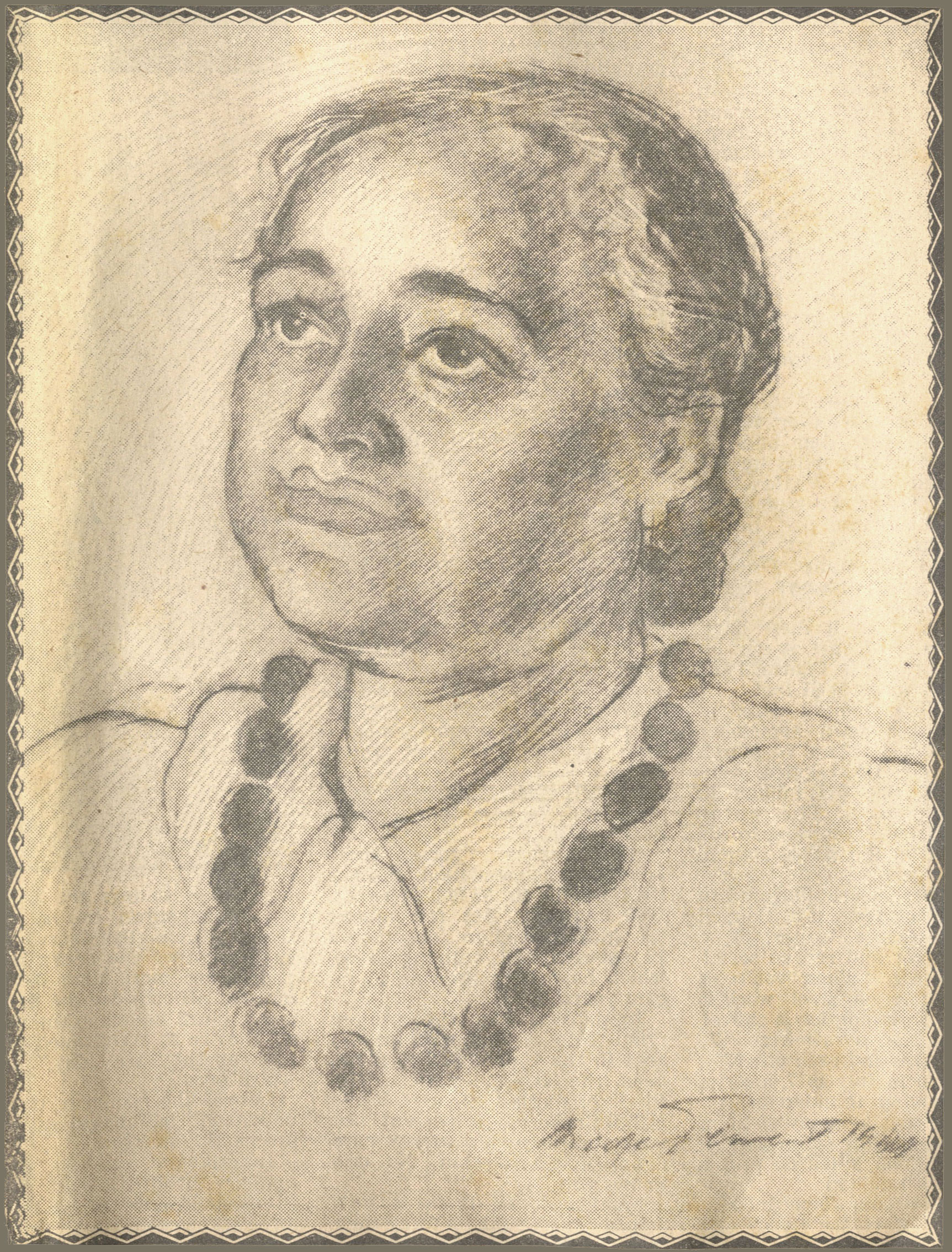
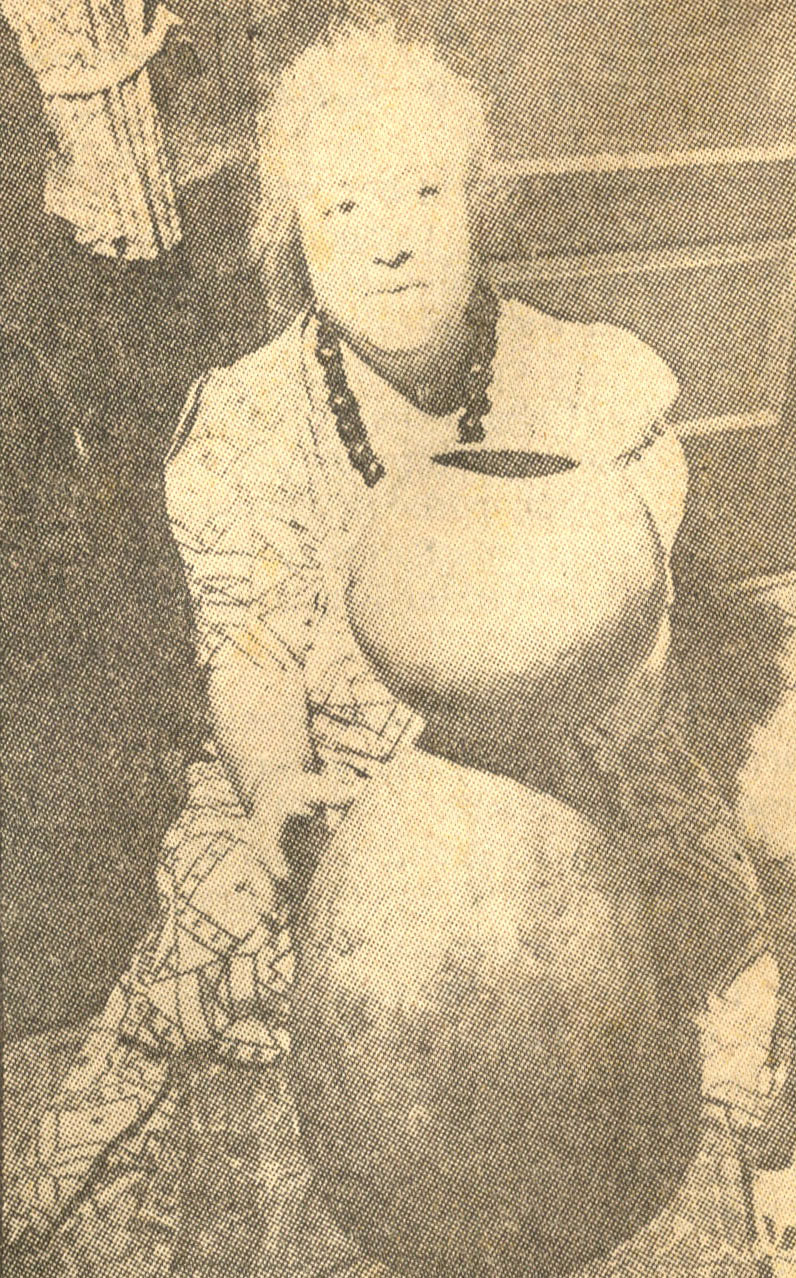
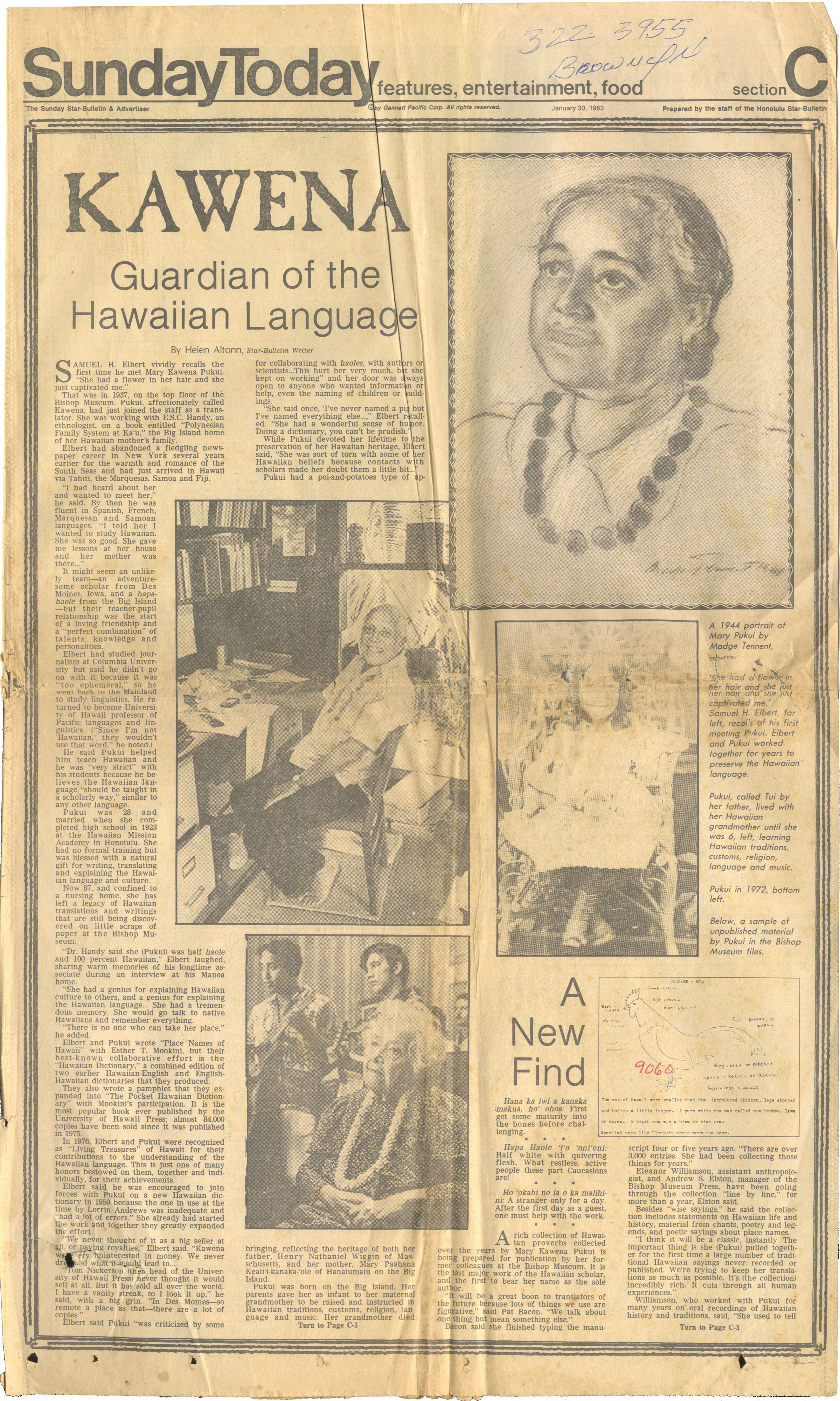
Samuel H. Elbert vividly recalls the first time he met Mary Kawena Pukui. "She had a flower in her hair and she just captivated me." That was in 1937, on the top floor of the Bishop Museum. Pukui, affectionately called Kawena, had just joined the staff as a translator. She was working with E.S.C. Handy, an ethnologist, on a book entitled "Polynesian Family System at Kaʻu," the Big Island home of her Hawaiian mother's family.
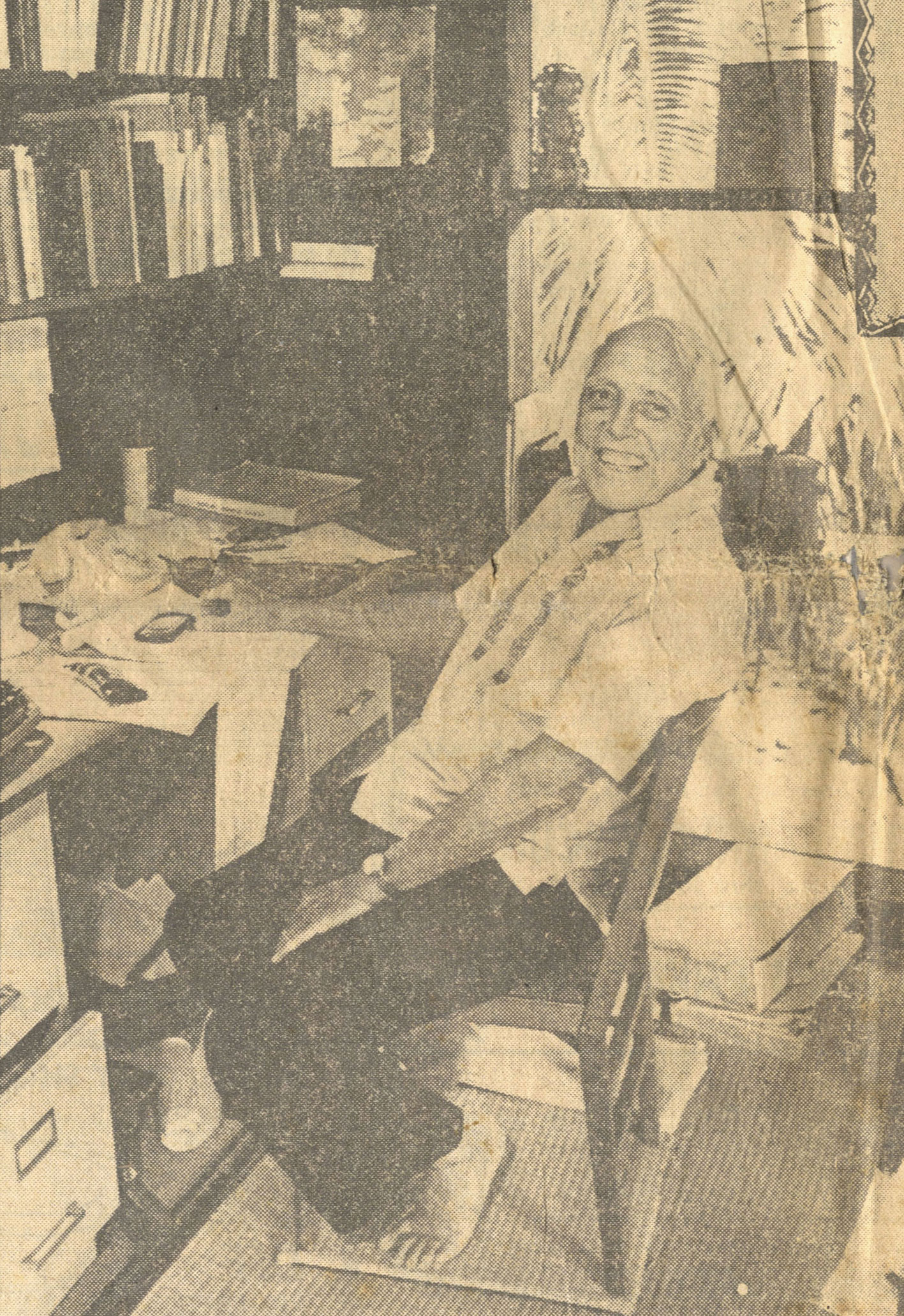
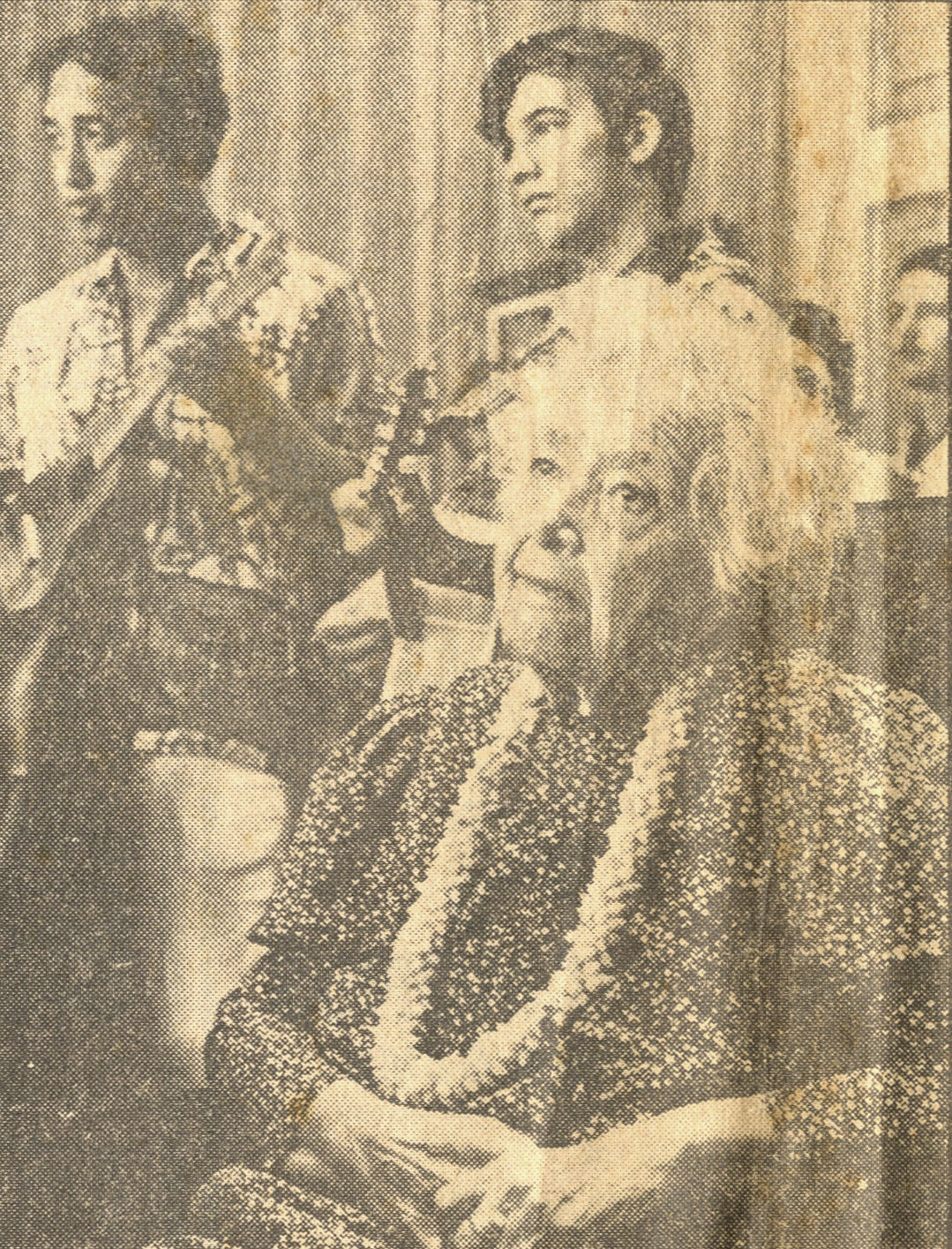
"I had heard about her and wanted to meet her," he said. By then he was fluent in Spanish, French, Marquesan and Samoan languages. "I told her I wanted to study Hawaiian. She was so good. She gave me lessons at her house and her mother was there... It might seem like an unlikely team – an adventuresome scholar from Des Moines, Iowa, and a hapa haole from the Big Island – but their teacher-pupil relationship was the start of a loving friendship and a "perfect combination" of talents, knowledge and personalities. Elbert had studied journalism at Columbia University but said he didn't go on with it because it was "too ephemeral," so he went back to the Mainland to study linguistics. He returned to become University of Hawaii professor of Pacific languages and linguistics. ("Since I'm not 'Hawaiian,' they wouldn't use that word," he noted. He said Pukui helped him teach Hawaiian and he was "very strict" with his students because he believes the Hawaiian language "should be taught in a scholarly way," similar to any other language. Pukui was 28 and married when she completed high school in 1923 at the Hawaiian Mission Academy in Honolulu. She had no formal training but was blessed with a natural gift for writing, translating and explaining the Hawaiian language and culture. Now 87, and confined to a nursing home, she has left a legacy of Hawaiian translations and writings that are still being discovered on little scraps of paper at the Bishop Museum. "Dr. Handy said that she (Pukui) was half haole and 100 percent Hawaiian," Elbert laughed, sharing warm memories of his longtime associate during an interview at his Manoa home. "She had a genius for explaining Hawaiian culture to others, and a genius for explaining the Hawaiian language... She had a tremendous memory. She would go talk to native Hawaiians and remember everything. "There is no one who can take her place," he added. Elbert and Pukui wrote "Place Names of Hawaii" with Esther T. Mookini, but their best-known collaborative effort is the "Hawaiian Dictionary," a combined edition of two earlier Hawaiian-English and English-Hawaiian dictionaries that they produced. They also wrote a pamphlet that they expanded into "The Pocket Hawaiian Dictionary" with Mookini's participation. It is the most popular book ever published by the University of Hawaii Press; almost 84,000 copies have been sold since it was published in 1975.
Elbert said he was encouraged to join forces with Pukui on a new Hawaiian dictionary in 1950 because the one in use at the time by Lorrin Andrews was inadequate and "had a lot of errors." She already had started the work and together they greatly expanded the effort. "We never thought of it as a big seller at all, or paying royalties," Elbert said. "Kawena was very uninterested in money. We never dreamed what it would lead to... "Tom Nickerson (then head of the University of Hawaii Press) never thought it would sell at all. But it has sold all over the world. I have a vanity streak, so I look it up," he said, with a big grin. "In Des Moines – so remote a place as that – there are a lot of copies." Elbert said Pukui "was criticized by some for collaborating with haoles, with authors of scientists... This hurt her very much, but she kept on working" and her door was always open to anyone who wanted information or help, even the naming of children or buildings. "She once said "I've never named a pig but I've named everything else...," Elbert recalled. "She had a wonderful sense of humor. Doing a dictionary, you can't be prudish." While Pukui devoted her lifetime to the preservation of her Hawaiian heritage, Elbert said, "She was sort of torn with some of her Hawaiian beliefs because contacts with scholars made her doubt them a little bit..." Pukui had a poi-and-potatoes type of upbringing, reflecting the heritage of both her father, Henry Nathaniel Wiggin of Massachusetts, and her mother, Mary Paahana Kealiʻi-kanaka-ʻole of Hanaiumalu on the Big Island.
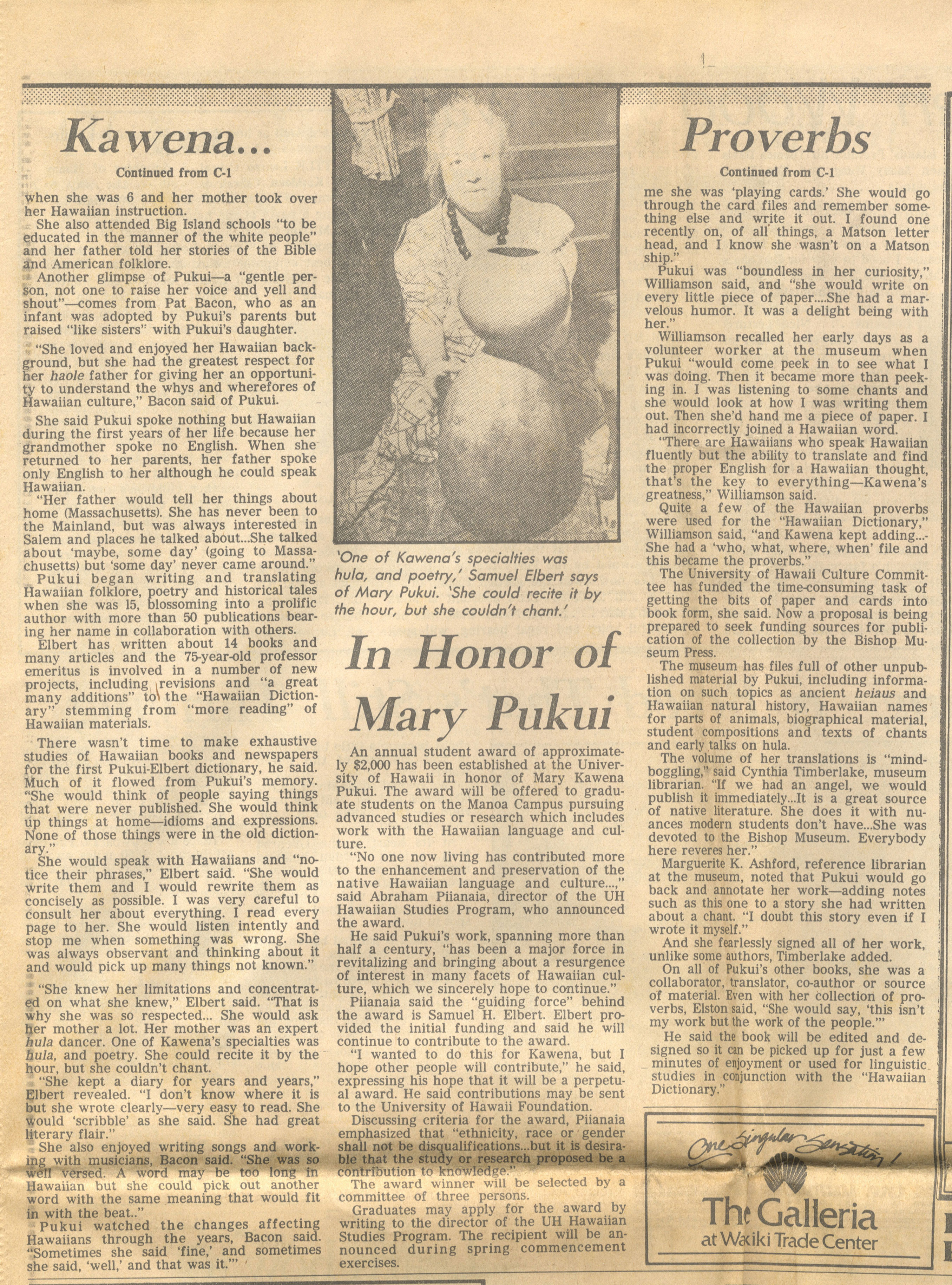
She also attended Big Island schools "to be educated in the manner of the white people" and her father told her stories of the Bible and American folklore. Another glimpse of Pukui – a "gentle person, not one to raise her voice and yell and shout" – comes from Pat Bacon, who as an infant was adopted by Pukui's parents but raised "like sisters" with Pukui's daughter. "She loved and enjoyed her Hawaiian background, but she had the greatest respect for her haole father for giving her an opportunity to understand the whys and wherefores of Hawaiian culture," Bacon said of Pukui. She said Pukui spoke nothing but Hawaiian during the first years of her life because her grandmother spoke no English. When she returned to her parents, her father spoke only English to her although he could speak Hawaiian. "Her father would tell her things about home (Massachusetts). She has never been to the Mainland, but was always interested in Salem and places he talked about... She talked about 'maybe, some day' (going to Massachusetts) but 'some day' never came around." Pukui began writing and translating Hawaiian folklore, poetry and historical tales when she was 15, blossoming into a prolific author with more than 50 publications bearing her name in collaboration with other. Elbert has written about 14 books and many articles and the 75-year-old professor emeritus is involved in a number of new projects, including revisions and "a great many additions" to the "Hawaiian Dictionary" stemming from "more reading" of Hawaiian materials.
She would speak with Hawaiians and "notice their phrases," Elbert said. "She would write them and I would rewrite them as concisely as possible. I was very careful to consult her about everything. I read every page to her. She would listen intently and stop me when something was wrong. She was always observant and thinking about it and would pick up many things not known." "She knew her limitations and concentrated on what she knew," Elbert said. "This is why she was so respected... She would ask her mother a lot. Her mother was an expert hula dancer. One of Kawena's specialties was hula, and poetry. She could recite it by the hour, but she couldn't chant. "She kept a diary for years and years," Elbert revealed. "I don't know where it is but she wrote clearly – very easy to read. She would 'scribble' as she said. She had great literary flair." She also enjoyed writing songs and working with musicians, Bacon said. "She was so well versed. A word may be too long in Hawaiian but she could pick out another word with the same meaning that would fit in with the beat..." Pukui watched the changes affecting Hawaiians through the years, Bacon said. "Sometimes she said 'fine,' and sometimes she said, 'well,' and that was it." A New findHana ka iwi a kanaka makua, hoʻohoa
Hapa Haole ʻiʻo ʻoniʻoni
Hoʻokahi no la o ka malihini
* * *
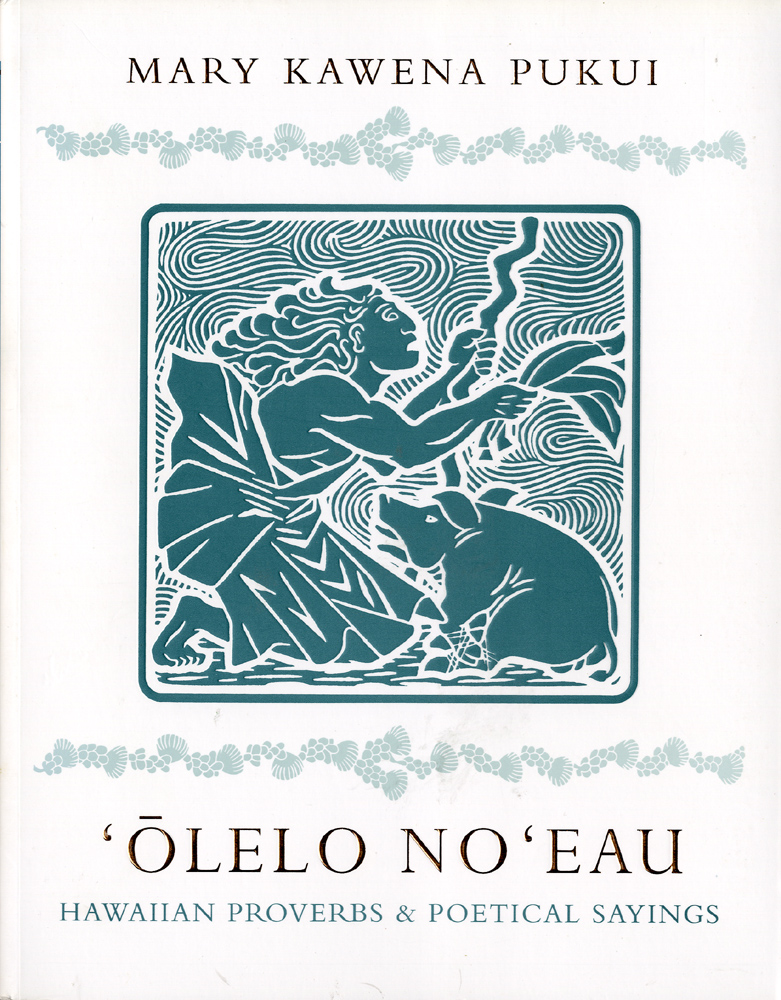
A rich collection of Hawaiian proverbs collected over the years by Mary Kawena Pukui is being prepared for publication by her former colleagues at the Bishop Museum. It is the last major work of the Hawaiian scholar, and the first to bear her name as the sole author.
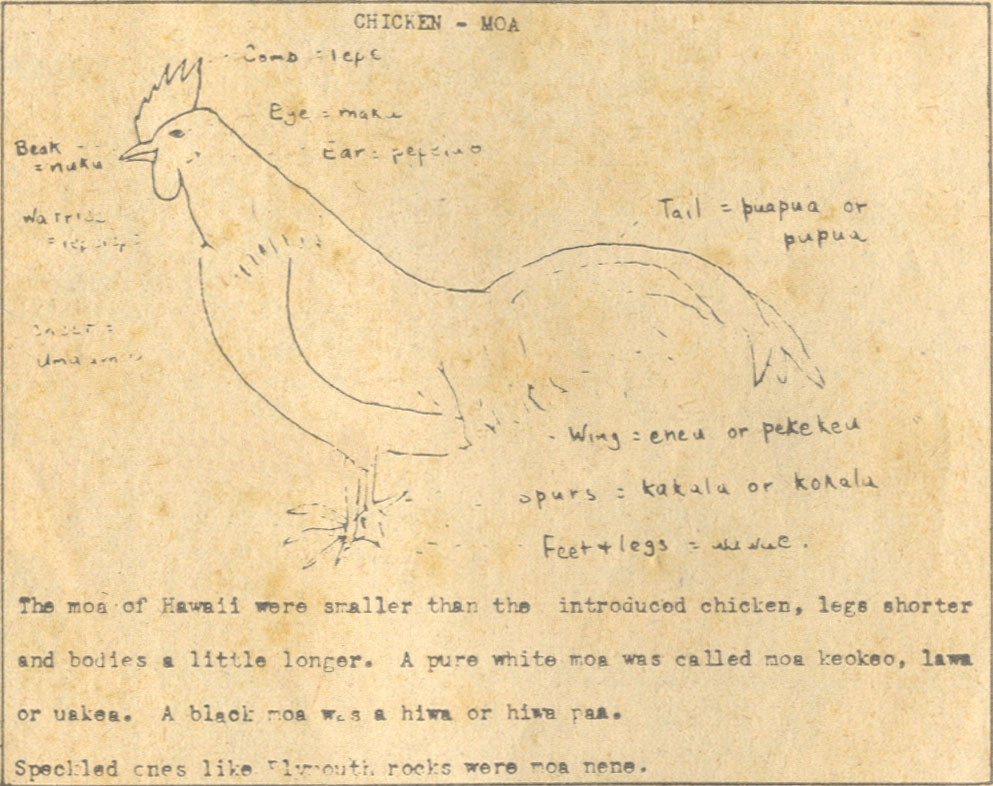
"It will be a great boon to translators of the future because lots of things we use are figurative," said Pat Bacon. "We talk about one thing but mean something else." Bacon said she finished typing the manuscript four or five years ago. "There are over 3,000 entries. She had been collecting those things for years." Eleanor Williamson, assistant anthropologist, and Andrew S. Elston, manager of the Bishop Museum Press, have been going through the collection "line by line," for more than a year, Elston said. Besides "wise sayings," he said the collection includes statements on Hawaiian life and history, material from chants, poetry and legends, and poetic sayings about place names. "I think it will be a classic, instantly. The important thing is she (Pukui) pulled together for the first time a large number of traditional Hawaiian sayings never recorded or published. We're trying to keep her translations as much as possible. It's (the collection) incredibly rich. It cuts through all human experiences." Williamson, who worked with Pukui for many years on oral recordings of Hawaiian history and traditions, said, "She used to tell me she was 'playing cards." She would go through the card files and remember something else and write it out. I found one recently on, of all things, a Matson letter head, and I know she wasn't on a Matson ship." Pukui was "boundless in her curiosity," Williamson said, and "she would write on every little piece of paper... She had a marvelous humor. It was a delight being with her." Williamson recalled her early days as a volunteer worker at the museum when Pukui "would come peek in to see what I was doing. Then it became more than peeking in. I was listening to some changes and she would look at how I was writing them out. Then she'd hand me a piece of paper. I had incorrectly joined a Hawaiian word. "There are Hawaiians who speak Hawaiian fluently but the ability to translate and find the proper English for a Hawaiian thought, that's the key to everything – Kawena's greatness," Williamson said. Quite a few of the Hawaiian Proverbs were used for the "Hawaiian Dictionary," Williamson said, "and Kawena kept adding... She had a 'who, what, where, when' file and this became the proverbs." The University of Hawaii Culture Committee has funded the time-consuming task of getting the bits of paper and cards into book form, she said. Now a proposal is being prepared to seek funding sources for publication of the collection by the Bishop Museum Press. The museum has files full of other unpublished material by Pukui, including information on such topics as ancient heiaus and Hawaiian natural history, Hawaiian names for parts of animals, biographical material, student compositions and text of chants and early talks on hula.
The volume of her translations is "mind-boggling," said Cynthia Timberlake, museum librarian. "If we had an angel, we would publish it immediately... It is a great source of native literature. She does it with nuances modern students don't have... She was devoted to the Bishop Museum. Everybody her reveres her." Marguerite K. Ashford, reference librarian at the museum, noted that Pukui would go back and annotate her work – adding notes such as this one to a story she had written about a chant. "I doubt this story even if I wrote it myself." And she fearlessly signed all of her work, unlike some authors, Timberlake added. On all of Pukui's other books, she was a collaborator, translator, co-author or source of material. Even with her collection of proverbs, Elston said, "She would say, 'this isn't my work but the work of the people.'" He said the book will be edited and designed so it can be picked up for just a few minutes of enjoyment or used for linguistic studies in conjunction with the "Hawaiian Dictionary."
In Honor of Mary PukuiAn annual student award of approximately $2,000 has been established at the University of Hawaii in honor of Mary Kawena Pukui. The award will be offered to graduate students on the Manoa Campus pursuing advanced studies or research which includes work with the Hawaiian language and culture. "No one now living has contributed more to the enhancement and preservation of the native Hawaiian language and culture...," said Abraham Piianaia, director of the UH Hawaiian Studies Program, who announced the award. He said Pukui's work, spanning more than half a century, "has been a major force in revitalizing and bringing about a resurgence of interest in many facets of Hawaiian culture, which we sincerely hope to continue." Piianaia said the "guiding force" behind the award is Samuel H. Elbert. Elbert provided the initial funding and said he will continue to contribute to the award. "I wanted to do this for Kawena, but I hope other people will contribute," he said, expressing his hope that it will be a perpetual award. He said contributions may be sent to the University of Hawaii Foundation. Discussing criteria for the award, Piianaia emphasized that "ethnicity, race or gender shall not be disqualifications... but it is desirable that the study or research proposed be a contribution to knowledge." The award winner will be selected by a committee of three persons. Graduates may apply for the award by writing to the director of the UH Hawaiian Studies Program. The recipient will be announced during spring commencement exercises.
|