ʻAlalā News
|
(ʻokina and kahakō added)
|
Honolulu Star-Advertiser – 12/18/2016
NEIGHBOR ISLANDS HAWAIʻI ISLAND Native crows released into wildStar-Advertiser staff Five young Hawaiian crows or ʻalalā raised in captivity were released into the wild on Hawaiʻi island last week. The Department of Land and Natural Resources said the critically endangered birds were released Wednesday at the Puʻu Makaʻala Natural Area Reserve. The male birds took a few minutes to emerge from the aviary where they had been temporarily housed, and they appeared to show a natural curiosity for their surroundings, the department said. After being released, the ʻalalā “quickly adjusted to their new home, and began to search for and find food items in the forest,” said Bryce Masuda, conservation program manager of the Hawaiʻi Endangered Bird Conservation Program, in a statement. “Although the birds have now been released, we will continue to monitor them and provide appropriate supplemental food, to ensure they are supported as they encounter challenges.” The birds were moved to a flight aviary in mid-October, to allow them to adjust to the sights and sounds of the Hawaiian forest. They were then transferred to a smaller aviary in the forest one week before the release. Puʻu Makaʻala Natural Area Reserve is an area that conservationists have worked to preserve, protecting native plants and species, and it represents the type of habitat where the crows originally lived before their numbers began to decline. The ʻalalā has been extinct in the wild since 2002, preserved only at the Keauhou and Maui bird conservation centers managed by San Diego Zoo Global. With more than 100 individuals of the species now preserved at the centers, conservationists are ready to return the birds to their native forests. ʻAlalā are an important part of the life of the Hawaiian forest, as they eat and help disperse native plant seeds. The re-introduction of this species is expected to play an important part in the overall recovery of the ecosystem. |
|
Honolulu Star-Advertiser – 12/27/2016
ISLAND VOICES
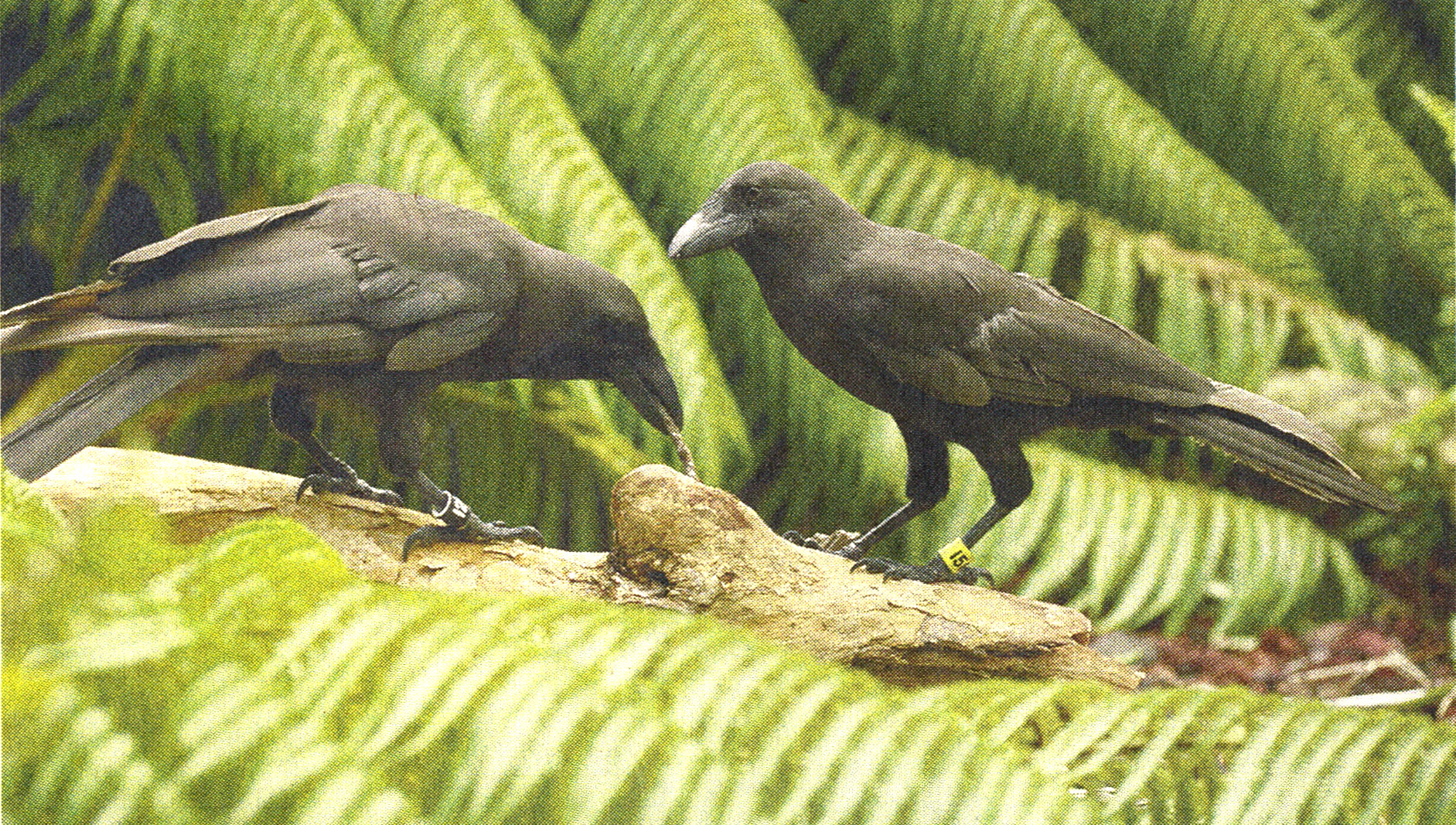
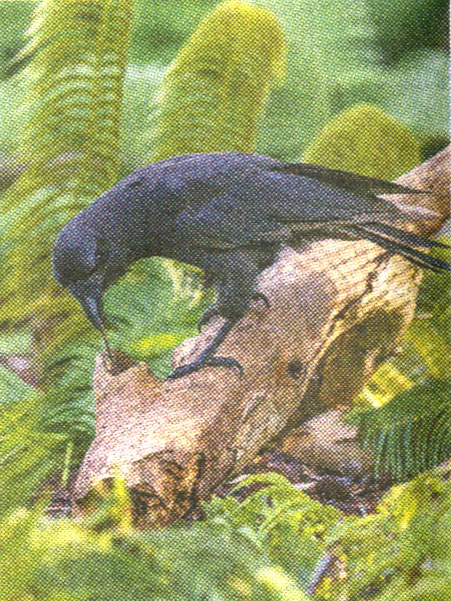
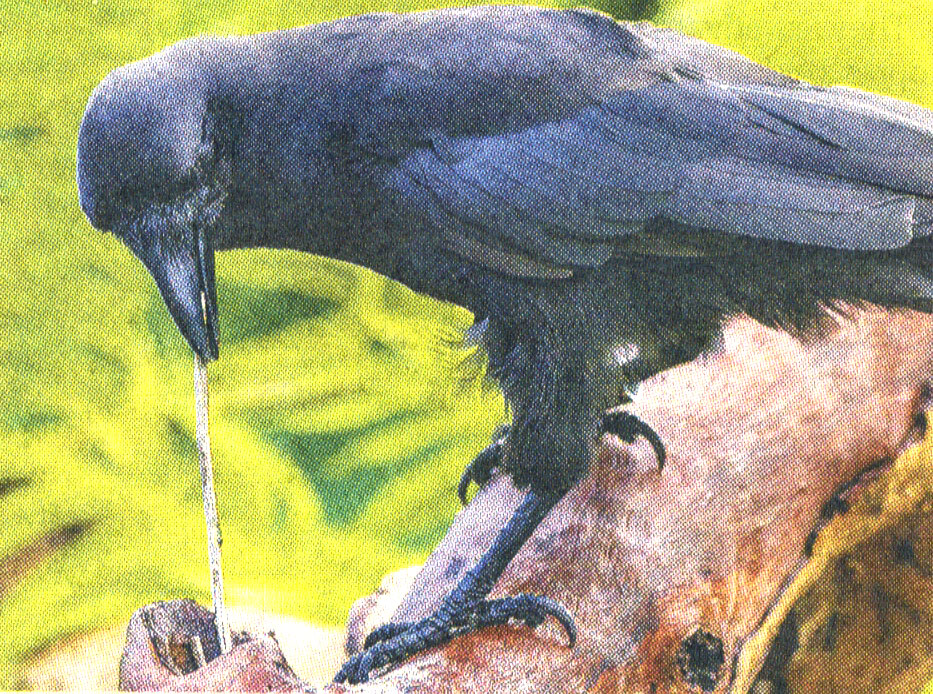
Forests hear call of ʻalalāBy Michael Bean The forests on the island of Hawaiʻi once rang with the cacophonous — sometimes almost human-sounding — cries, screams and yells of the Hawaiian crow, or ʻalalā. Though once abundant, over time the sounds subsided as habitat loss, predation by invasive species and disease caused sharp declines in ʻalalā numbers, leading to its placement on the endangered species list. Eventually, the birds disappeared from the wild. With them went not only important ecological functions, such as seed dispersal, but also an important cultural symbol for the people of Hawaiʻi. For a time, it seemed as if the distinctive calls from the Hawaiian crow would be forever gone from Hawaiian forests. That is a fate that has already befallen many other native species in Hawaiʻi, the state with more endangered species than any other. Thanks to collaborative partnerships and captive breeding of Hawaiian crows that began in the 1970s, however, the ʻalalā may escape that fate. The ʻalalā, which had been extinct in the wild since 2002, is preserved in captive breeding facilities at the Keauhou and Maui Bird Conservation Centers managed by San Diego Zoo Global. There are more than 100 ʻalalā at the centers. Much has been learned about the ʻalalā since it was brought into captivity, including a rare skill in the avian community: tool use. The birds use twigs to extract food from hard to reach places, placing them in the company of other famed tool-users such as chimpanzees. This relatively recent discovery shows the importance and power of endangered species conservation in the advancement of our understanding of nature. After decades of work, research, and planning by a team of scientists and landowners, five young male Hawaiian crows were released into the wild at Puʻu Makaʻala Natural Area Reserve on Hawaiʻi island on Dec. 14. Once released, the birds appeared curious about their surroundings and began searching for food in the forests. Five young female ʻalalā will be released in early 2017 to join the males. The ʻalalā are fitted with radio-transmitters. Biologists are tracking their movements throughout the forests and monitoring their survival. The Puʻu Makaʻala Natural Area Reserve is a state reserve that is managed to promote native forest and has a dense understory with ample food to provide ʻalalā with a safe place to return after its absence. The reserve has been undergoing extensive management for decades. The ʻAlalā Working Group, which consists of state and federal agencies, and local and national nonprofit groups and conservation organizations, plans to release more ʻalalā into the wild in the coming years, with the ultimate goal of establishing a free-living population in the wild and full recovery. The conservation of Hawaiian crows has been a huge undertaking that goes beyond any one group. The U.S. Fish and Wildlife Service, Hawaiʻi Department of Land and Natural Resources, San Diego Zoo Global, and other partners worked in close collaboration to get this species to where we are now. With continued hard work and collaboration, the sounds of the ʻalalā will return to Hawaiʻi’s forests.
|

|
Honolulu Star-Advertiser – 12/28/2016
HAWAIʻI REPORT 3 Hawaiian crows die after being set freeBy Timothy Hurley
Conservation officials said Tuesday that they recaptured the remaining two birds and moved them back into an aviary until they can figure out what happened through medical examinations of the carcasses. The five captive-raised Hawaiian crow, or ʻalalā, were released into the Puʻu Makaʻala Natural Area Reserve near Hilo on Dec. 14 after an extended transition period in which they lived in an outdoor aviary set up in the wilderness. After the release, officials reported that the birds quickly adjusted to their new surroundings, eating from feeders placed in the area. John Vetter, a wildlife biologist with the state Department of Land and Natural Resources Division, said some level of mortality is expected when reintroducing a species back into the wild. “The initial days of release are always the most difficult stage of any release program, and the level of uncertainty is also highest with the first release cohort,” Vetter said in a news release. Puʻu Makaʻala Natural Area Reserve was said to be ideal for the ʻalalā. Conservationists worked to preserve and protect native plants and species within the 18,730-acre protected area for two decades, leaving a habitat similar to the one where ʻalalā lived before their numbers began to decline. The Hawaiian crow has been extinct in the wild since 2002, preserved only at the Keauhou and Maui bird conservation centers managed by San Diego Zoo Global’s Hawaiʻi Endangered Bird Conservation Program. At last count 130 birds were living in captivity. Bryce Masuda, the program's conservation manager, said condolences for the loss have come from around the world. “The loss of these three birds is difficult for the entire community, including the many people who have cared for these birds since their hatch and have worked steadfastly to prepare for their release,” he said in a statement. The released birds, all males, were examined for suitability and subjected to a battery of health tests in preparation for the long-awaited release, officials said. They also underwent predator-avoidance training to help to teach the danger represented by the Hawaiian hawk and to allow them to respond with evasive action. Scientists said anti-predator behaviors in wild animals can be lost after only a few generations in captivity, so it’s likely the remaining ʻalalā do not know they need to avoid the hawk. The birds were moved to a flight aviary in mid-October, allowing them to acclimate to the forest before they were transferred to a smaller aviary in the forest one week prior to the release. Each bird was outfitted with tiny radio and GPS transmitters and was being monitored daily. A second release of seven mostly young females, also hatched this year, was planned for January. Officials were planning to release 12 birds a year over the next five years. Scientists say ʻalalā are an important part of the life of the Hawaiian forest because they help disperse native plant seeds. They also hold significant value in Hawaiian culture. Recently shown to be adept users of tools, the clever ʻalalā use a vast array of calls and vocalizations, more than any other raven or crow. |
|
Honolulu Star-Advertiser – 4/10/2017
LOCAL & BUSINESS Officials seek aid to save the ʻalalā
|
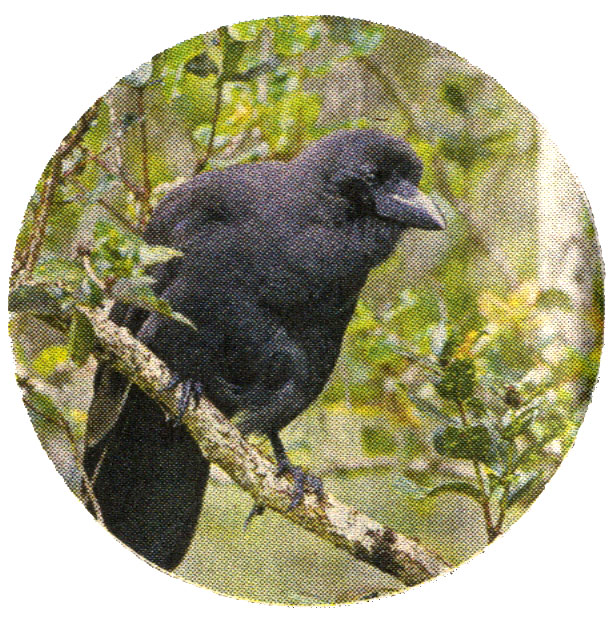 ʻAlalā, or Hawaiian crows, have been extinct in the wild since 2002. (Star-Advertiser) |
Like Hawaiʻi’s endangered ʻalalā, the Puerto Rican parrot was on the edge of extinction and being bred in captivity for reintroduction into the wild.
And like the Hawaiian crow, an initial release did not go well, with similarly disastrous results: Six of 22 parrots were attacked and killed by hawks in that first week in 2006, compared with two of five ʻalalā a decade later.
Despite the early setback in Puerto Rico, 100 or more wild parrots are now thriving in the Rio Abajo State Forest following subsequent releases.
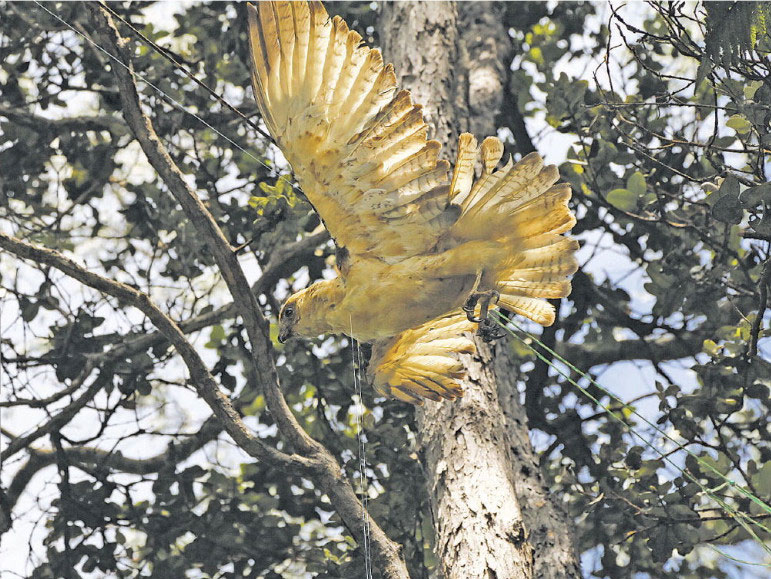
Today, Hawaiʻi officials are looking to their counterparts in Puerto Rico for advice as they seek to rebound from December’s aborted ʻalalā release, when three birds perished in the first week of freedom — two apparently picked off by the ʻio, or Hawaiian hawk, and another that weakened after getting caught in a winter storm, according to necropsies.
The remaining two juvenile males were brought back into captivity, rejoining the nearly 130 birds that represent the entirety of the species. Plans for the release of a second group of juvenile females were shelved.
Extinct in the wild since 2002, the Hawaiian crow is preserved only at the Keauhou and Maui bird conservation centers managed by San Diego Zoo Global’s Hawaiʻi Endangered Bird Conservation Program.
The zoo has joined the state Department of Land and Natural Resources, the U.S. Fish and Wildlife Service and Hawaiʻi island land managers in the ʻAlalā Project, which aims to return the ʻalalā to its traditional habitat in the forest of the Big Island.
Following the ill-fated first release, the project invited Tom White, a U.S. Fish and Wildlife Service biologist with the Puerto Rico Parrot Recovery Program, to travel to Hawaiʻi to help evaluate the effort and offer guidance and technical assistance.
His advice?
Conduct more intensive predator-aversion training. That’s how the outlook improved for the Puerto Rican parrot following the initial release at Rio Abajo, White said.
“Needless to say, subsequent groups released the following years were all subjected to aversion training, and we did not see any similar episodes of high mortality with the other Rio Abajo releases,” White said in an email.
Hawaiʻi officials are now aiming to conduct their second release in the Puʻu Makaʻala Natural Area Reserve near Hilo in late summer or early fall, according to Jackie Gaudioso-Levita, coordinator of the ʻAlalā Project.
That will allow enough time to implement changes needed to give the birds a better chance at survival, she said. Among those changes is more intensive predator-aversion training.
In Puerto Rico, trainers teach their release candidates to fear, avoid and hide from fierce red-tailed hawks. They employ a number of techniques, including playing hawk shrieks while the predator’s silhouette passes overhead and staging simulated attacks by a trained hawk in full view of the parrots.
Observing the reaction to the danger helps biologists determine which birds might best survive in the wild.
Gaudioso-Levita said the project is modifying the outdoor flight aviary to better implement some of the new training techniques.
There are also plans to move the release site a couple of miles to a location higher on the mountain — and hopefully away from the typical range of the Hawaiian hawk.
Gaudioso-Levita said biological surveys of the io — also an endangered species — indicate fewer of them venture above the 5,500-foot level.
To more precisely locate the release site, officials plan to explore other areas of Puʻu Makaʻala and broadcast the shrill, high-pitched call of the io. The predator is territorial, she said, so if there are no responses to the calls, it might indicate a safer locale for the crows.
Another planned change is to release a dozen ʻalalā at the same time, rather than the previously planned dozen in two separate stages. Releasing the group together from the beginning, she said, will allow more social interaction, communication and potential for warning calls when any hawks fly into the vicinity.
Gaudioso-Levita said it’s important to remember that predator mortality is “not at all uncommon” in the initial stages of reintroduction programs.
“More important are the lessons learned and to keep in mind the bigger picture,” she said.
Successful reintroductions, such as the nene and the California condor, took decades to achieve success, with many ups and downs and bumps and bruises along the way, she said.
“The recovery of nene took over five decades of conservation actions to achieve, and while there are now over 3,000 birds in the wild, nene populations still require active management to persist,” Joey Mello, Big Island wildlife program manager with the state Division of Forestry and Wildlife, said in a press release.
Donna Ball, a Fish and Wildlife Service biologist and member of the advisory ʻAlalā Working Group, said that although she wasn’t surprised by what happened to the first release, she didn’t really think it would happen so quickly.
Still, she said, it’s important to manage expectations.
“You’ve got to be realistic. You can’t expect overnight success,” she said. “In the 1990s we had only a handful of birds. We stopped (releasing them) because there weren’t enough to release. Now there are birds and we’re doing our due diligence.”
Studies indicate that fewer hawks are found in the densest forest areas.
By releasing them in the highest-quality areas, biologists are giving them a better shot at survival, she said.
|
Honolulu Star-Advertiser – 9/27/2017
LOCAL & BUSINESS 6 rare native crows released into wildBy Timothy Hurley
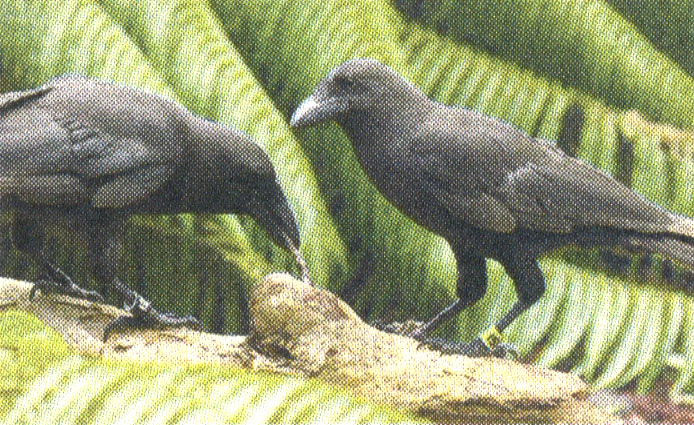
Nine months after its last attempt ended in failure, the state and its conservation partners Tuesday released another six captive-born Hawaiian crows into the East Hawaiʻi wilderness, hoping to re-establish a species that hadn’t been seen in the wild since 2002. The young ʻalalā — two females and four males — were released high into the Puʻu Makaʻala Natural Area Reserve, officials said. Officials with the state Department of Land and Natural Resources, U.S. Fish and Wildlife Service and San Diego Zoo Global said it took some time for the birds to emerge from the aviary where they had been temporarily housed for months, but eventually they appeared to exhibit curiosity toward their surroundings. In December three birds perished in the first week following the project’s first release. Two were picked off by Hawaiian hawks, while the third was fatally weakened by a winter storm, according to necropsies. The remaining birds were brought back into captivity, rejoining the more than 125 birds that represent the entirety of the species. Plans for a second release were shelved until officials could retool their strategy. According to a news release, project leaders changed the timing of the release to avoid winter storms, moved the release site location, changed the makeup of the release group to include both males and females, and stepped up the “anti-predator training program” to teach the birds how to better respond to threats such as the hawks. “This has been an ongoing learning process for everyone, to get it right for the ʻalalā to learn the skills they need to survive,” DLNR Director Suzanne Case said. Plans call for the release of a second group of five birds — two females and three males — in mid-October from the same aviary. Nine of this year’s released birds were moved to a spacious flight aviary early in the year, allowing them to acclimate to the wilderness and socialize with the two males that survived the December release. They were transferred to a smaller aviary in the forest two weeks ago, officials said. Project officials are planning to release 12 birds a year over the next five years, with each bird outfitted with tiny radio and GPS transmitters for daily monitoring. Once abundant on Hawaiʻi island, the ʻalalā is important to a healthy forest in that they help disperse native plant seeds, according to scientists. Recently shown to be adept users of tools, the ʻalalā use a vast array of calls and vocalizations, more than any other raven or crow. A ceremony marking Tuesday’s release was held at sunrise. |
|
Honolulu Star-Advertiser – 10/6/2017
LOCAL B3 Released crows doing well, officials sayBy Timothy Hurley
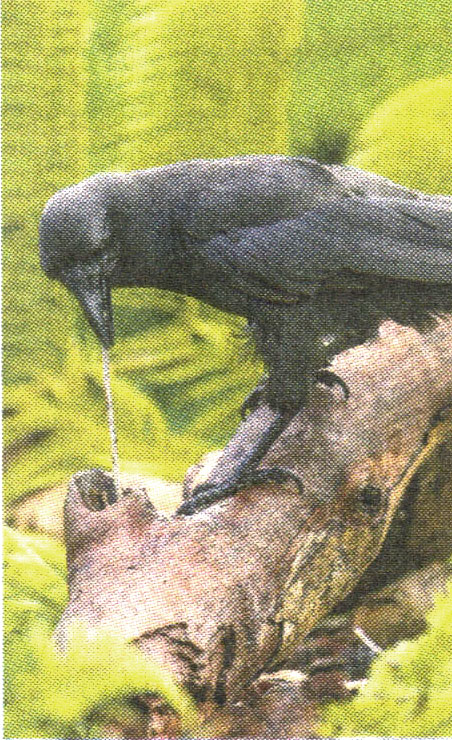
The six Hawaiian crows released into the Hawaiʻi island wilderness last week are alive and well, state and conservation officials reported Thursday. “The ʻalalā appear to be adjusting well to their new home in the forest,” said Bryce Masuda, manager of San Diego Zoo Global’s Hawaii Endangered Bird Conservation Program. The early success stands in stark contrast to the project’s aborted first release in late 2016, when in the first week two birds were fatally attacked by Hawaiian hawks and one didn’t survive a winter storm. Over the last nine months, officials have worked to revamp the project, formulating a new strategy, consulting with experts, conducting more rigorous anti-predator training and finding a new release site within the Makaʻala Natural Area Reserve near Hilo. On Sept. 26 two females and four males were released into the northern section of the reserve in an area of dense forest known to harbor fewer Hawaiʻian hawks, or ʻio. The ʻalalā have been monitored daily using tracking telemetry and very high-frequency transmitters. So far the birds haven’t wandered off too far, spending much of their time together near the release aviary ancj roosting in one or two groups 50 to 75 meters apart, said Jackie Gaud- ioso-Levita, coordinator of the ʻAlalā Project. The birds are feeding on both the supplemental feed set out for them and on wild fruit in the forest, and they are vocalizing and calling out to each other in a way they would be expected to, she said. Gaudioso-Levita said the birds have been together for nearly nine months and studied for their social inter actions and behaviors. The long-term success of the group, she said, could depend on how they work and interact together, look out for one another and make calls of warning. Masuda said so far no hawks have been observed in the area, and there have been no emergencies or close calls. “It’s exciting to see them being curious and exploring their new forest habitat,” Masuda said. The ʻAlalā Project is an effort among the state Department of Land and Natural Resources, U.S. Fish and Wildlife Service and San Diego Zoo Global, which operates conservation centers on Maui and the Big Island that house about 125 ʻalalā — the entirety of the ʻalalā population. The goal of the project is to re-establish a species that hasn’t been seen in the wild since 2002. The project plans to release a dozen birds per year over the next three to five years. A second 2017 release of two females and three males is planned for mid-October. The five birds are already in the release aviary, growing accustomed to their surroundings, Gaudioso-Levita said. Gaudioso-Levita said seeing the birds alive and healthy in the wild fills her with optimism for the species’ future, but she realizes there’s a long way to go. “The most important thing is that we’re always learning, because it’s a long road full of challenges,” she said. “We are guaranteed to encounter more challenges.” A high mortality rate is often associated with releasing animals into the wild. This is especially true for species like the Hawaiian crow that have been in captivity for longer periods of time. Scientists say anti-predator behaviors in wild animals can be lost after only a few generations in captivity. |
|
Honolulu Star-Advertiser – 10/19/2017
LOCAL B2 5 more ʻalalā released in conservation effortStar-Advertiser staff
Five more ʻalalā were released into the wilderness near Hilo last week, joining the six young Hawaiian crows that were introduced to the forest there at the end of September. State officials announced earlier this week that a second group of two females and three males was released into the Puʻu Makaʻala Natural Area Reserve Oct. 11. Together, the 11 birds represent what conservationists hope will be the start of a wild population that hasn’t been seen in the forest since 2002. The four females and seven males are being monitored daily using tracking telemetry and transmitters. The reintroduction effort, a project of the state Department of Land and Natural Resources, San Diego Zoo Global and U.S. Fish and Wildlife Service, plans to release a dozen birds per year over the next three to five years. The project’s first release in late 2016 was aborted after two birds were fatally attacked by Hawaiian hawks and one didn’t survive a winter storm. The rest of the birds were brought back into captivity, and officials devised a new strategy that included changing the timing of release to avoid the peak of winter storms, changing the release site location, releasing mixed-sex groups with established social associations and conducting more rigorous anti-predator training to help them deal with predators like the Hawaiian hawk, or ʻio. “The first group has stayed together, foraging close to the release aviary and creating social groups with each other similar to what we expect for young birds of this species,” Joshua Pang-Ching, research coordinator for the Hawaii Endangered Bird Conservation Program, said in a news release Monday. “We also observed some alarm calling showing us that these individuals are very aware of their surroundings and are learning to respond to the natural threats that may occur in their environment,” he said. About 125 ʻalalā are housed in conservation centers operated by San Diego Zoo Global on Maui and the Big Island. |
|
Ka Wai Ola – Malaki 2018
ʻĀina - Land and Water Four months after release, 11 endangered ʻalalā are thriving in native forestAs monitoring continues, preparations are underway for additional releasesSubmitted by the Department of Land and Natural Resources
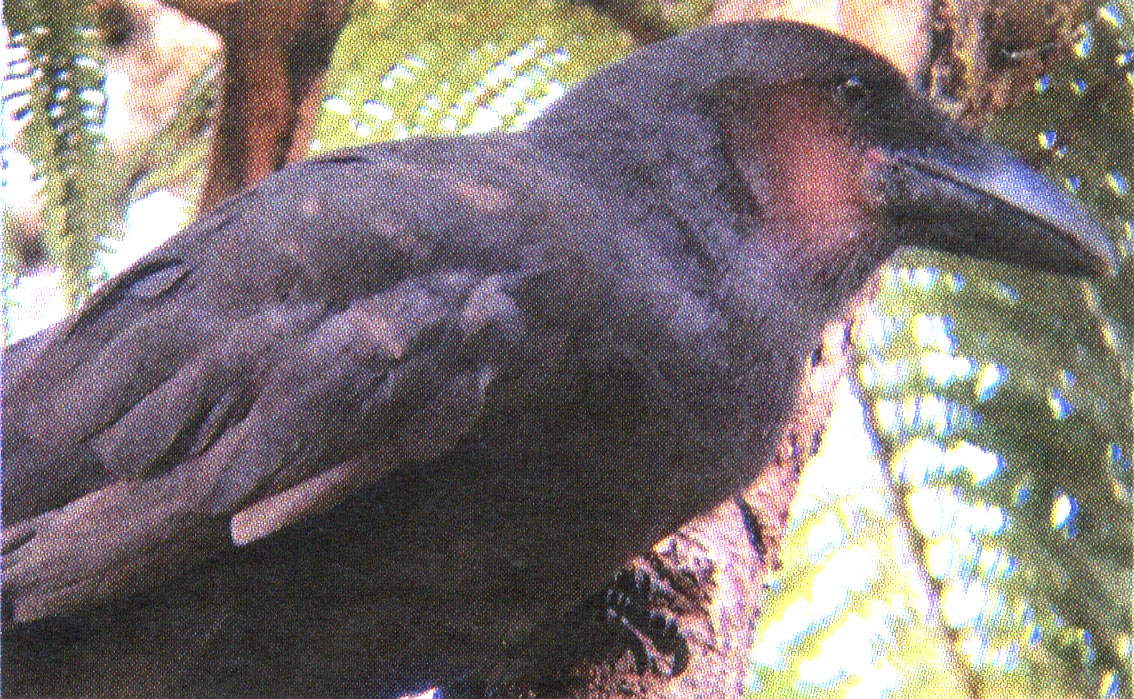
(HILO, HAWAIʻI - Jan. 24, 2018) - You usually hear them before you see them. There’s no mistaking the loud and often synchronized cacophony of caws from 11 ʻalalā released into a Hawaiʻi Island Natural Area Reserve (NAR) last fall. These birds, seven young males and four young females, represent what conservationists hope is the beginning of a recovered population of this critically endangered Hawaiian crow on the island. ʻAlalā have been extinct in the wild since 2002. Since the birds took flight from a remote forest aviary in September and October 2017, they have been under the daily, watchful eye of a monitor- ing team from San Diego Zoo Global. In partnership with the Hawaiʻi Department of Land and Natural Resources, the U.S. Fish and Wildlife Service and others, San Diego Zoo Global reared the ʻalalā at its Hawai'i Endangered Bird Conservation Program een- ters on the Big Island and on Maui.The ʻalalā are tracked daily by researchers monitoring signals from the lightweight radio trans- mitters eaeh bird wears, as well as watching them with the naked eye or through binoculars. Their movements, their flights, what they eat, where they roost, their behaviors and virtually everything else about these birds is closely monitored and carefully recorded. Of high interest to all the folks involved in The ʻAlalā Project is how the birds individually and collectively react to threats from predators. An initial release of ʻalalā in 2016 was halted and surviving birds were brought back into captivity after two were attacked by another native bird - their natural predator, the ʻIo or Hawaiian hawk. Prior to their release, the birds now living in the Puʻu Maka'ala NAR received extensive anti-predator training. “Similar to any predator-prey interaction, there’s a lot that goes on that we don’t necessarily see - but the observations we’ve made indicate that the birds do identify ʻio as a predator and can take evasive action when needed,” explained Alison Greggor, Ph.D., a postdoctoral research associate with San Diego Zoo Global. Recently, the monitoring team saw this in action: Two members of the project heard an eruption of ʻalalā alarm calls and heard quick wing flapping. A dark morph ʻio darted across an opening. Immediately after, a light morph ʻio crossed the opening with four ʻalalā following it or chasing it above the canopy. All four ʻalalā disappeared for about 15 seconds before the ʻalalā came back to the release area/feeder area. “At this stage, we can’t be certain that the training is the crucial piece of the puzzle, but we like to hope that it helped,” Greggor said. “Actually being in the wild around predators, observing other forest birds and interactions with predators, is the best training they can possibly get.”
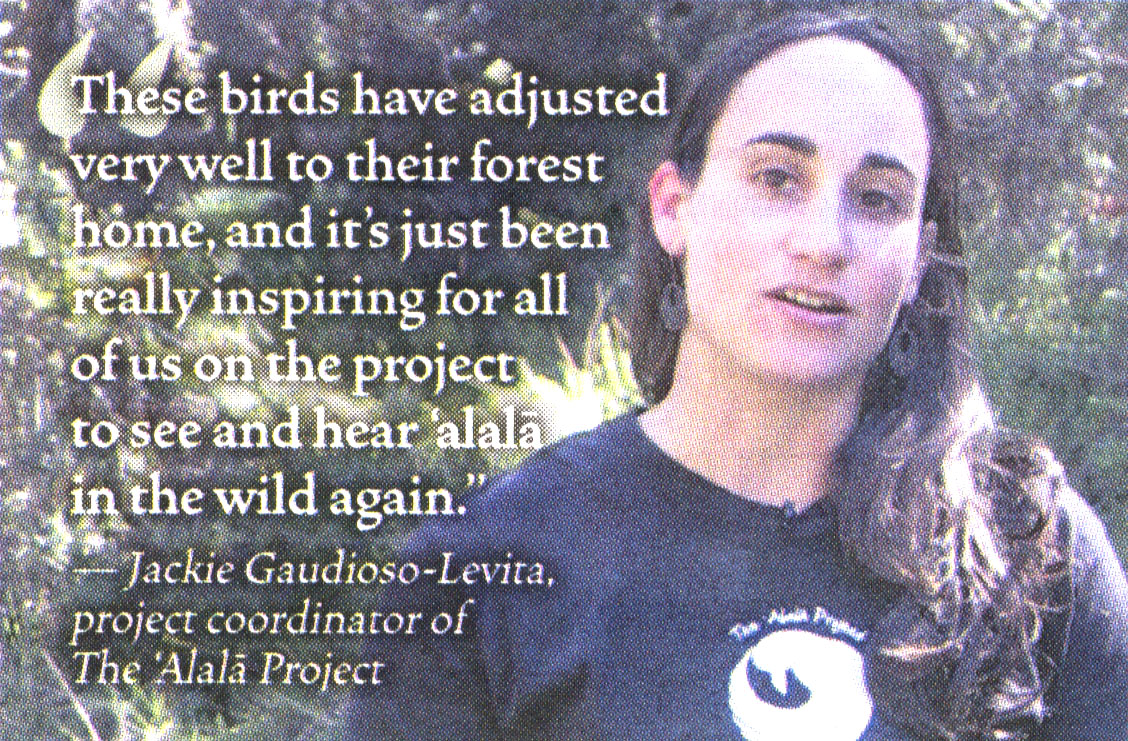
Another sign of how well they’ve accepted their new home in the forest is that they are being observed foraging more often for native fruits, instead of relying on feeders placed strategically outside the release aviary. Joshua Pang-Ching, the field operations manager for the project, noted, “In the beginning, they would spend much more time at or around the feeders. Now we see birds coming to feeders much less. We have seen an anecdotal shift in their use of the feeders and see birds daily foraging on the fruits and foliage of native trees.” The supplemental feeders will remain in place for at least a year, to ensure that the newly “wild” birds have that extra helping hand they might need. Greggor, Pang-Ching and Jackie Gaudioso-Levita, project coordinator of The ʻAlalā Project, are all hopeful for the birds’ future, given how this released group of ʻalalā is doing. “We really leamed a lot from the 2016 release,” Gaudioso-Levita said. “We made major revisions to our reintroduction strategy. These birds have adjusted very well to their forest home, and it’s just been really inspiring for all of us on the project to see and hear ʻalalā in the wild again.” Not only can you hear them, “they’re very loud,” Gaudioso-Levita added. It’s a sweet sound for the many people who’ve worked for decades to get to this point. In time, researchers hope, the distinctive caw of the ʻalalā will again be heard loud and clear throughout the forest. Plans are underway to release additional birds in the NAR later this year. See DLNR’s video at vimeo.com/252588023 |
|
Honolulu Star-Advertiser – 9/2/2018
LOCAL B2, Hawaii Report Hawaiian crows find shelter in heavy rainStar-Advertiser staff State officials reported that 11 ʻalalā, or Hawaiian crows, survived several days of heavy rain from Tropical Storm Lane at Puʻu Makaʻala Natural Area Reserve on the Big Island with little difficulty. It was an encouraging sign for The ʻAlalā Project, a partnership between the state, U.S. Fish and Wildlife Service and San Diego Zoo Global, whieh is working to re-establish a wild population of the critically endangered native birds. Last fall, the 11 ʻalalā were the first to have been successfully released into the forest from captive-breeding facilities. San Diego Zoo Global researcher Alison Greggor and a team went into the field to check on the crows once it was safe and were encouraged to find them healthy and dry. “We have a hardy set of birds,” she said in a news release. “They survive very well in wet conditions and they’re able to fend for themselves. We’ve seen over time that the birds have gotten much better seeking shelter in the forest and finding natural nooks and crevices where they can hide from the rain.” The last wild ʻalalā was sighted more than 15 years ago in South Kona. Through The ʻAlalā Project, experts from state and federal agencies and non-profit and private entities are working together to raise the birds in conservation centers on Maui and Hawaiʻi island while planning their release into the wild. Another 10 ʻalalā are expected to be released this fall, with more to follow in Hawaiʻi's native forests over the next three years in hopes they will eventually thrive on their own. |
|
Honolulu Star-Advertiser – 9/24/2018
B2, Local & Business More ʻalalā to be set free as Hawaiian crow soarsBy Timothy Hurley
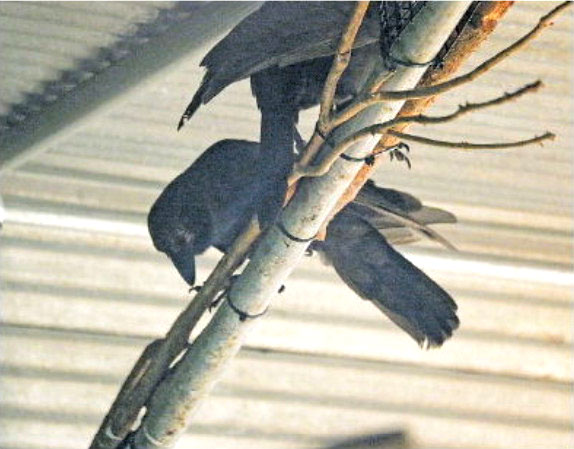
A year after successfully re-introducing the Hawaiian crow into the wild on Hawaiʻi island, conservation officials are preparing to release their first group of ʻalalā in 2018, adding to the small population of birds that survived predatory hawks, avian disease, Hurricane Lane and other torrential rainstorms. Five juvenile ʻalalā are being readied for release next week in a special aviary set up high in the Puʻu Makaʻala Natural Area Reserve on the slopes of Mauna Loa. The group and another five-bird cohort scheduled to be set free in the coming weeks will join the 11 birds released into the wilderness a year ago. Officials aren’t saying exactly when the captive-bred crows will be released. That will depend on the weather and several other factors. “We will wait until the right time for the birds,” said Jackie Gaudioso-Levita, coordinator of the ʻalalā Project, a partnership of the state, U.S. Fish and Wildlife Service and San Diego Zoo Global. The project is the evolution of the state’s 40-year effort to save the once-abundant ʻalalā, the highly intelligent crow considered to be important to a healthy forest. Early attempts to re-establish the crow sputtered, and the species became extinct in the wild in 2002. Today, 125 or so ʻalalā live at the Keauhou and Maui bird conservation centers managed by San Diego Zoo Global’s Hawaiʻi Endangered Bird Conservation Program, and project officials say they are planning to release 10 to 12 birds a year into the Big Island forest over the next five years. Alison Greggor, a post-doctoral research associate at San Diego Zoo Global, said the birds scheduled to be released next week passed all of their veterinary checks and pre-release training, and now it’s just a matter of becoming accustomed to the environment outside their aviary. Among the keys to preparing the birds for the outside world was the predator-aversion training developed after the project’s aborted initial release in 2016: when two of five ʻalalā were attacked and killed by ʻio, the Hawaiian hawk. Having been raised in captivity, these birds had never encountered predators or had the chance to learn from their parents or their peers about what dangers to look out for, the scientists said. The training is a 25-minute production featuring a live Hawaiian hawk from the Panaewa Rainforest Zoo, a stuffed ʻio loaned from the Bishop Museum in Honolulu and a stuffed American crow from the Yale Peabody Museum of Natural History. The skit also features prerecorded ʻio calls, as well as ʻalalā alarm and distress calls intended to convey danger and the need to call out for help. “We want to make sure that when we open those doors, they know who the ʻio are and that the ʻio is a threat,” Greggor said. It appears the team is doing something right. The 2017 birds, each outfitted with a tiny radio and GPS transmitter for daily monitoring, survived an entire year without falling victim to the hawks. Greggor said she and another scientist even witnessed separate incidents in the forest in which the crows ended up ganging up to chase away the hawks. The mobbing behavior, she said, is common among other ravens and crows. “I was certainly excited to see that, because it’s not easily trainable,” she said. Over the last year, the wild ʻalalā not only fought off ʻio but survived and resisted powerful winter storms, the impacts of tropical cyclones and even toxic gases from the Kilauea eruption. But the scientists said it’s too early to celebrate. While Gaudioso-Levita said she is encouraged and happy by the success of the last year, the real milestone is decades into the future when the offspring of these birds are successfully breeding in the wild. Greggor said she remains only "cautiously optimistic" about the future of the species. She noted that the reintroduction of the Hawaiian goose, or nēnē, started in the 1950s. "Only now are we feeling comfortable that the (nēnē) population is self-sustaining and well on the road to recovery," she said. For now the ʻalalā are “very much vulnerable,” Greggor said. “They’re pretty hardy,” Gaudioso-Levita said. “It doesn’t mean letting up monitoring the birds.”
See video at www.staradvertiser.com |