| Pukui & Elbert - 1986
Māmaka Kaiao - 2003-10 Lorrin Andrews - 1865 |
updated: 12/18/2016 |
bananas 190
Aaaka [a-a-ka]. Peeled; skinned, as a banana. ʻaʻao₂. n. uncultivated bananas. rare. aao [aa-o]. adj. A species of tall, wild banana, he maia aao. aʻeaʻe₂ [aʻe·aʻe]. n. a kind of banana with green and white striped leaves and fruits. also koaʻe, manini. (Neal 249) [(MQ) PPN *ake, banana variety] āewa₁ [ā·ewa]. vi. thin, tall spindly; to weave to and fro, as seaweed; to sway, as a branch or sea eddy. cf. ewa, māewa. [PPN *ʻaʻewa, walk about: *(q)aqewa] ulu maikaʻi a āewa hua ʻolegrowing well but spindly and fruitless [of bananas] (Kep. 159) ʻāhui [ʻā·hui]. n. bunch or cluster, as of bananas, grapes; whole pandanus fruit consisting of keys. [(EP) PPN *kaa-fui, bunch (of fruit etc.) (clk): *kaa-fui] ahui [a-hu-i]. s. A bunch or cluster of fruit, as bananas, grapes, or hala. akua₅. same as maiʻa Polapola, a banana. ʻaoa₄. n. name for sacrificial places near fishponds where semiannual offerings were made, as of taro, bananas, mullet, kohekohe sedge, and black pigs. (Ii 26) ʻaulena [ʻau·lena]. n. a variety of native banana. (HP 177)
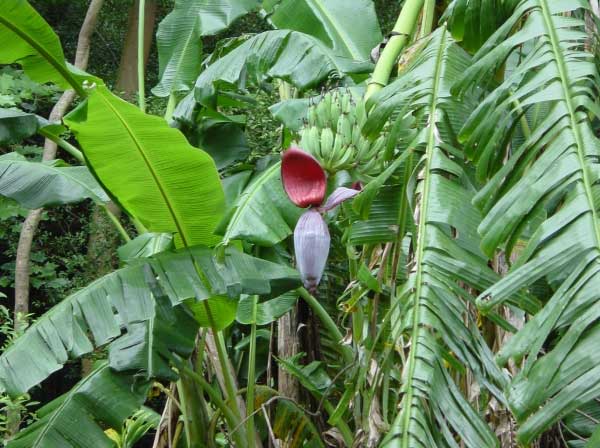
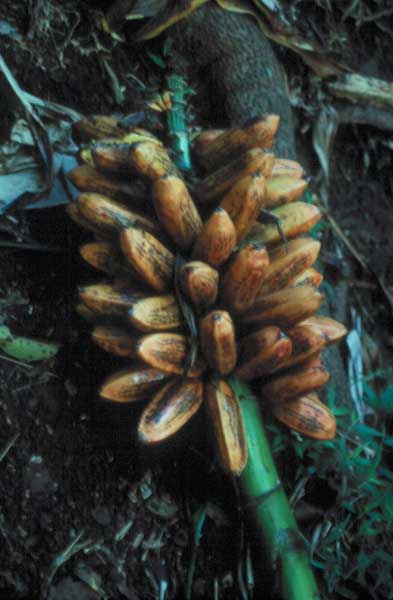
Eʻeʻa₂. n. mountain banana patch. Līlā ka maiʻa o ka ʻeʻa, wili ka ʻōkaʻi.Spindly is the growth of the mountain banana patch, the blossom container twists [even a spindly plant may bear fruit]. ʻeka₃. n. a variety of bananas. (PH 173) ʻēkā₁ [ʻē·kā]. n. hand of bananas. Compare maiʻa for pejorative connotations. [PPN *taa, bunch of fruit, especially a hand of bananas] E painuʻu ʻoe me nā mahalo a pala hinu nā ʻēkā maiʻa.You brag with praise of bright and ripe banana hands [worthless bragging]. (Kel. 138) eka [e-ka]. s. The upper part of a bunch of bananas; he lila wale no mai ka eka luna a hiki i ka pola. ʻekeʻula. n. a type of banana. (Kam. 76:38) ʻeleʻele₄. n. a cooking banana (a form of Musa xparadisiaca), valued for shiny black skin of trunk, used for designs worked into pandanus mats and hats. also hinupuaʻa. (Neal 249)
Hhā₄. nvs. stalk that supports the leaf and enfolds the stem of certain plants, as taro, sugar cane; layers in a banana stump. cf. ʻohana. [(AN) PPN *faʻa, stalk n] haʻa₃. n. a short variety of banana. haikea₁ [hai·kea]. same as hākea₁, ₂, pale...; type of banana... hākea₂ [hā·kea]. n. a variety of banana. hākonakona₁ [hā·kona·kona]. vs. parched, as a blemished bread-fruit; unhealthy condition of a banana when the skin adheres to the pulp, supposedly after the plant has been touched by the ʻākōlea fern. hālala₁ [hā·lala]. vs. big, large, overgrown, oversized. E hānai i nui, i hālala ka ʻāhui.Raise until large, and big the banana bunch. halala [ha-la-la]. A large bunch of bananas. hale pua niu. n. house where offerings of bananas, coconuts, and kava were kept, said to be offered in ceremonies deifying a deceased person or making him into a lizard god. lit., coconut-blossom house. hāluapou [hā·lua·pou]. vi. to make sturdy, as a banana plant (a word used in ancient prayers). E hāluapou ka paʻa o ka ʻāhui.Sturdy the holding of the banana bunch. haluapou [ha-lu-a-pou]. v. To plant out bananas. hao₅. same as maiʻa ʻoa, a variety of banana. hāpai₃ [hā·pai]. n. a native variety of banana with trunk of medium height, the fruit maturing within it, about two-thirds of the way up. The fruits are small, finger length, and ten or less; their skin is yellow, and the flesh yellow, sweet, and edible raw. (HP 175), (Neal 250). also hua waena. hēʻī₃. same as maiʻa Polapola, a wild banana. [(CE) PPN *fekii, plantain (musa troglodytarum) (borrowed)] hilahila₂ [hila·hila]. same as iholena, a banana. hinupuaʻa₁ [hinu·puaʻa]. same as maiʻa ʻeleʻele or ʻeleʻele, a mountain banana with shiny black trunk. see also hinu. hualau [hua·lau]. n. a variety of banana. lit., many fruits. huamoa₃ [hua·moa]. same as moa, a native variety of banana. huawaena [hua·waena]. same as hāpai, a variety of banana. hui₄. n. cluster, as of grapes or coconuts; bunch, as of bananas. also huhui, huihui. [PPN *fuhi, bunch or cluster; tie in a bunch] hulimaiʻa [huli·maiʻa]. n. name of a reddish-brown honey-sucking bird (no data). lit., banana seeker.
Iʻia. part. marking pas/imp. (sometimes written as a part of modified word). (Gram. 6.6.3) PNP *kia. ʻAi ʻia ka maiʻa.The banana was eaten; eat the banana. E hele ʻia e kāua.We should go; let's go. Nānā ʻia ke kanaka.The person was looked at; look at the person. iholena [iho·lena]. n. a favorite and common native variety of banana, eaten raw or cooked. The fruit bunches are small, the skin thin, ripening yellow, the flesh salmonpink. (HP 115). This was one of the few bananas permitted women. Also hilahila. lit., yellow core. iholena [i-ho-le-na]. s. A species of banana which were permitted to be eaten under the kapu system; eia na maia a Papa e ai ai, o ka popolu, o ka iholena. ila₂. vs. dark. Pau ka wao maiʻa a pala ila.All the bananas of the uplands are ripened black. (chant) ʻiliki₂. n. a varnish, as made of candlenut bark, ti root, banana stump, and other plants. ʻiʻo₃. n. grain of wood. cf. ʻiʻo lau maiʻa. ʻiʻo lau liʻigrain with slight curliness ʻiʻo pū maiʻagrain straight as a banana stalk ʻiʻo lau maiʻa. n. yellowish grain in wood, especially koa, named for its resemblance to the yellow color of a banana leaf (lau maiʻa).
Kkaʻakaʻalina [kaʻa·kaʻa·lina]. vs. tough, stringy, as of banana trees; viscid, gluey. kaakaalina [kaa-kaa-li-na]. adj. See lena. Tough; stringy; not soft or pulpy; applied to bananas. Kahiki₃. n. a variety of banana, common wild on Maui. Kinds are kahiki hae, kahiki mauki, and kahiki puhi. kaʻio. see maiʻa kaʻio, a Hawaiian banana kākuʻai. v. var. spelling of kākūʻai, to sacrifice food (fish... kākūʻai, kākuʻai [kā·kūʻai]. v. to sacrifice food (fish, bananas, kava) to the gods, as at every meal; to feed the spirits of the dead; to deify a dead relative by food offerings and prayer; to dedicate the dead to become family protectors (ʻaumākua) or servants of ʻaumākua (HM, p. 123); to transfigure, transfiguration (Kam. 64: 64, 91). (Contraction of kākua ʻai) see kino ahi, a "fire body": the bones of a deceased... kakuai [ka-ku-ai]. s. The constant daily sacrifice offered at every meal. NOTE.—The offerings were mostly of bananas. kana₁. num. tens (usually compounded with numbers from three to nine to indicate 30 to 90). (Gram. 10.3) kanaiwaninety nā kana ʻēkātens of banana hands (Kep. 159) ʻo ka waʻa kana koʻokahiten one-man canoes (Nak. 40) kāne₅. n. name given at ʻEwa, Oʻahu, for the Tahitian banana known as polapola and hēʻī. kano₁. n. large, hard stem, as on a banana bunch, sweet potato, or pandanus fruit; shank of fishook (Kam. 76:77); tool handle; crosspiece on a lāʻau kia, bird-catching pole; bones of the lower arm or lower leg; male erection; stiffening, hardening; hard, stiff. cf. kakano. hoʻokanoto harden; to form a tuber, as of sweet potato kano [ka-no]. The body of a tree in distinction from its branches. kāpua [kā·pua]. see maiʻa kāpua, same as kāpuapua [kā·pua·pua]. var. of maiʻa kāpua, a banana. kapuapua [ka-pu-a-pu-a]. s. A kind of plantain or banana. kāpule [kā·pule]. vs. overripe, black or spotted, as a banana skin; fat, as a plover. see ex. Kāʻelo₁. hoʻokāpuleto ripen, fatten kapule [ka-pu-le]. v. To be hung up, as a bunch of bananas until the skin turns black in spots; ua kapula ala mea wale i ka ua. kaualau [ka-ua-lau]. see maiʻakaualau, Hawaiian banana. kaualau [kau-a-lau]. s. The plantain, a vegetable like the banana. kaupō [kau·pō]. n. a variety of native bananas, perhaps named for the place on Maui. also waimūhea. keʻa₂. n. hand, as of bananas. (FS 245) kiomana [kio·mana]. vt. to ride or sit astride, as on a horse; to straddle. cf. kīhelei. Kiomana nā wāwae o ua keiki nei ma kēlā ʻaoʻao a me kēia ʻaoʻao o ua hā maiʻa nei.Then the legs of this child sat astride of each side of this banana trunk. koaʻe₂. n. a variety of banana. also aʻeaʻe, manini. (Neal 249) kōkōwaikī [kō·kō·wai·kī]. n. pith of banana stalk. Kona Hili Maiʻa. n. name of a Kona wind with protracted rains. lit., Kona wind smiting bananas. (Malo 14) koʻo₁. nvt. hoʻokoʻoprop with a pole, as a heavily laden banana plant, or a house to keep it from falling down; to pole, as a canoe kuʻina koʻoplug·in, as in a computer program paipu koʻopipe used to hold up clear plastic sheeting over an aquaculture tank kukanaloa, kūkanaloa [ku·kana·loa]. n. a variety of banana. kukanaloa [ku-ka-na-lo-a]. adj. Some property or kind of banana; he mai kukanaloa. kūkanaloa. n. var. spelling of kukanaloa, a variety of banana. kūpola [kū·pola]. vt. to roll, wrap up, as a package; to wither and curl up, as a banana leaf. Kūpola i kēia pūʻolo.Tie up this package. kupola [ku-po-la]. To wither and roll up, as the under or dead leaves of bananas.
Llahi₃. n. a variety of banana. lālei [lā·lei]. nvs. cluster, bunch, as of bananas; assembled together, as flowers in a lei. rare. hoʻolāleito gather together, as flowers lauhulu₁ [lau·hulu]. nvt. dry banana leaf; to wrap, as a bundle, with ti leaves inside and banana leaves outside. fig., outsider, one from another locality (sometimes said disparagingly). lauhulu [lau-hu-lu]. s. The banana leaf. lau kapalili₁ [lau kapa·lili]. same as hukilau, seine fishing, but reportedly used in deeper water and with yellowed ti or banana leaves. lit., trembling net. laulau₁ [lau·lau]. nvt. wrapping, wrapped package; packages of ti leaves or banana leaves containing pork, beef, salted fish, or taro tops, baked in the ground oven, steamed or broiled; any cloth, net, or leaves used as a wrapper or carrier; to wrap or carry in such bundles. [PPN *laulau, basket or leaves for serving or carrying food; to serve food] laulau monibundle of money (Kin. 42.35) lele₁₁. n. a tall variety of wild banana (Musa xparadisiaca), formerly planted near the altar (lele). It was offered to the gods and used for love magic. Its essence was thought to fly (lele) to the gods. It was used (for weaning (cf. lele₈): the banana was placed near the child with appropriate prayers in order to obtain the god's consent for weaning. This banana was taboo to women. liko₄. n. a Tahitian banana (Musa troglodytarum). līlā [lī·lā]. vs. spindly, undeveloped, as of plants; thin, as a line of words across a page. cf. ʻeʻa₂. [PPN *lila, thin, emaciated, sickly: *li(i)la(a)] He maiʻa līlā, ʻaʻohe ʻiʻo.A thin banana without substance [either fruit or plant]. (ON 780) loha₄. n. a variety of banana. lohelohe₃ [lohe·lohe]. rare var. of lohaloha₁, redup. of loha₁, drooping... lohelohe i honuapoetic name for banana plant because its fruit droops (loha), to the ground (i honua) Lohelohe peleʻunu Mahiki i ka ua.Mahiki is beaten down and made musty by the rain. lohelohe i honua. banana (poetic) (EH)
Mmahakea₁ [maha·kea]. n. once uncultivated land, as for bananas, sweet potato, taro; fallow land. cf. kūmahakea.
Hoʻohui ʻāina pala ka maiʻa.Annexation is ripe bananas. [no good for us]. (ON 1063) Pala ka maiʻa.The banana is ripe (Nothing is gained.) [a rude expression]. (ON 2591) maia [mai-a]. s. The plantain, the banana and its different varieties; a fruit kapu for women to eat in ancient times. maiʻa ʻaʻao. n. tall, wild bananas. maiʻa aʻeaʻe [maiʻa aʻe·aʻe]. same as maiʻa koaʻe. lit., prematurely gray banana. maiʻa akua. n. Maui name for maiʻa Polapola. lit., god banana. (HP 177) maiʻa ʻanoʻano. n. a variety of banana with seeds. lit., seeded banana. maiʻa ʻau lena. n. an ancient variety of banana. lit., yellow-stem banana. maiʻa ʻeka. n. a Hawaiian variety of banana; fruit with skin changing from red to green to yellow, edible when cooked. lit., discolored banana. (HP 173) maiʻa ʻeke ʻula. n. an ancient Hawaiian variety of banana. maiʻa ʻeleʻele. n. a Hawaiian variety of mountain banana with black trunk, the skin of which is used to make designs in mats. The fruit has orange flesh, which is edible when cooked. lit., black banana. also maiʻa hinu puaʻa, maiʻa poni, maiʻa Puna. (HP 173) maiʻa haʻa, maiʻa haʻahaʻa [maiʻa haʻa, maiʻa haʻa·haʻa]. n. a Hawaiian variety of banana, with short trunk and leaves, but taller than maiʻa Pākē. The fruit is yellow, edible raw or cooked. lit., low banana. (HP 175) maiʻa haikea [maiʻa hai·kea]. n. a Hawaiian variety of banana that bears yellow fruit, edible raw or cooked. lit., pale banana. (HP 175) maiʻa hākea [maiʻa hā·kea]. same as maiʻa ʻohe. lit., whitish banana. (HP 177) maiʻa hāpai [maiʻa hā·pai]. n. a Hawaiian variety of banana of medium height, the fruit maturing within the trunk. The fruits are small, ten or fewer in a bunch, yellow, sweet, edible raw. (HP 175), (Neal 250). also maiʻa hua waena. maiʻa hēʻī. same as maiʻa Polapola. Fēʻī is the Tahitian name. (Neal 250–1) maiʻa hilahila [maiʻa hila·hila]. same as maiʻa iho lena. lit., bashful banana. (HP 175) maiʻa hinu puaʻa. same as maiʻa ʻeleʻele. lit., hog's-grease banana. (HP 173) maiʻa hua lua. same as maiʻa māhoe. lit., bearing two bunches, twin banana. (HP 176) maiʻa hua moa. same as maiʻa moa. lit., egg banana. (HP 176) maiʻa hua nui. n. a variety of banana lit., big-fruited banana. maiʻa hua waena. same as maiʻa hāpai. lit., central fruit banana. (HP 175) maiʻa iho lena. n. a Hawaiian variety of banana, popular and common. The trunk is green, purple, and pink. Fruits are salmon-pink, edible raw cooked; one of the few bananas formerly permitted to women. lit., yellow-cored banana. also maiʻa hilahila. (HP 175) maiʻa ihu ʻū. a Hawaiian variety of banana, growing wild on Kauaʻi and Hawaiʻi, rarely cultivated. The fruit is yellow, edible only when cooked. lit., snub-nosed banana. (HP 175) maiʻa ʻili pakapaka [maiʻa ʻili paka·paka]. n. a kind of rough-skinned banana. maiʻa kahiki. n. a variety of banana growing wild on Maui, rarely cultivated. The trunk is tall; the fruit long, skin yellow, flesh white and edible only when cooked. lit., foreign or Tahitian banana. (HP 175) maiʻa kahiki hae. n. a Hawaiian variety of banana, similar to maiʻa kahiki, but having short trunk. (HP 175) maiʻa kahiki mālei [maiʻa kahiki mā·lei]. same as maiʻa mālei, a Hawaiian variety of banana; trunk green and pink, streaked with brown; fruit like maiʻa puhi... (HP 176) maiʻa kahiki mauki. n. a Hawaiian variety of banana with tall, green trunk. The fruits looks like maiʻa kahiki. (HP 175) maiʻa kahiki puhi. same as maiʻa puhi, an ancient Hawaiian variety of banana with green and brown trunk... (HP 177) maiʻa kaʻio. same as maiʻa pōpō ʻulu, a Hawaiian variety of banana, with short, green trunk; one of two varieties not taboo to women in old times... (HP 177) maiʻa Kāne. n. an Oʻahu name for maiʻa Polapola. (HP 177) maiʻa kāpua [maiʻa kā·pua]. same as maiʻapōpōʻulupuapuanui, a Hawaiian variety of banana, resembling maiʻa iho lena, but the fruit broad-tipped... (HP 177) maiʻakaualau. n. a Hawaiian variety of banana. Fruit like that of maiʻa maoli, except that the young, dark-green fruit has light-green spots like raindrops; when ripe, yellow, waxy, with flesh light-yellow, good only when baked. lit., many rain drops banana. (HP 175) maiʻa Kaupō [maiʻa kau·pō]. same as maiʻa wai mūhea, an ancient variety of Hawaiian banana. lit., insipid water banana... (HP 177) maiʻa koaʻe. n. a Hawaiian variety of banana, beautifully striped leaves, trunk, and young fruit. Fruit is yellow and round; flesh yellow, edible cooked or raw. Also called maiʻa aʻeaʻe, maiʻa manini. lit., tropic bird banana. (HP 177) maiʻa koana. n. a Hawaiian seed-producing variety of banana. also ʻōpule₃. maiakukanaloa [mai-a-ku-ka-na-lo-a]. s. Maia and kukanaloa, a species of banana. A thin, shriveled or blasted banana. FIG. Any fruit blasted or shriveled up. maiʻa lahi. n. an ancient Hawaiian variety of banana. lit., delicate banana. maiʻa lele. n. a common wild Hawaiian variety of banana of the uplands; trunk tall, yellowish-green; fruit yellow; flesh pink, edible raw or cooked, good for piepiele, eczema. Root of shoot used in medicine. The fruit was commonly offered to gods, the tree planted to shelter the altar. It was planted far from a dwelling house, for fear it would cause the occupants to lele (fly) elsewhere. lit., altar banana. (HP 176) maiʻa liko. same as maiʻa Polapola; lit., bud banana. (HP 177) maiʻa loha. n. an ancient Hawaiian variety of banana; trunk and leaf like maiʻa lele, fruit like maiʻa iho lena. lit., droopy banana. (HP 177) maiʻa māhoe [maiʻa mā·hoe]. n. a Hawaiian variety of banana, the stem bearing two bunches; fruit small, yellow, flesh light salmon and very palatable. lit., twin banana. also maiʻa hua lua, maiʻa mana lua, maiʻa pā lua. (HP 176) maiʻa mālai ʻula [maiʻa mā·lai ʻula]. same as maiʻa mālei ʻula, a Hawaiian variety of banana, common both cultivated and wild in the uplands... (HP 176) maiʻa mālei [maiʻa mā·lei]. n. a Hawaiian variety of banana; trunk green and pink, streaked with brown; fruit like maiʻa puhi. also maiʻa kahiki mālei. (HP 176) maiʻa mālei ʻula [maiʻa mā·lei ʻula]. n. a Hawaiian variety of banana, common both cultivated and wild in the uplands. Fibers of the stalk are used for stringing flowers for leis with a coconut-leaf needle (mānai). Ripening fruit changes from maroon (ʻula) to green to yellow; the flesh is orange, edible only when cooked. also maiʻa mālai ʻula, maiʻa mānei ʻula, maiʻa mānai ʻula. (HP 176) maiʻa mānai ʻula [maiʻa mā·nai ʻula]. same as maiʻa mālei ʻula, a Hawaiian variety of banana, common both cultivated and wild in the uplands... (HP 176) maiʻa mana lua. same as maiʻa māhoe; lit., two-branched banana. (HP 176) maiʻa manini. same as maiʻa koaʻe; lit., manini (fish) banana. (HP 176) maiʻa maoli. n. a Hawaiian variety of banana, growing in uplands and lowlands. It has a green trunk, large leaves. The fruit is long, waxy-yellow, and has yellow flesh, edible raw or cooked. lit., indigenous banana. (HP 176) maiʻa moa. n. a Hawaiian variety of banana with a tall, yellowish-green trunk. The fruit is large, somewhat egg-shaped, and yellow; the flesh yellow, edible raw or cooked. lit., chicken banana. also maiʻa hua moa. (HP 176) maiʻa noʻu. n. a Hawaiian variety of banana, usually cultivated; the trunk green, with pink and brown markings; fruit short, thick, yellow, the flesh cream-colored, edible raw or cooked. lit., short banana or big-mouthful banana. (HP 177) maiʻa Nuhōlani [maiʻa nuhō·lani]. n. a variety of introduced banana cultivated by Hawaiians for many generations. The trunk is tall, green; the fruit yellow, edible raw or cooked. lit., New Holland (Australian) banana. (HP 178) maiʻa ʻoa. n. probably a distinct species of Hawaiian banana, according to W. T. Pope, being unique in producing fertile seeds. Trunk and leaves dull-green, tinted with bronze and purple; fruit inedible. also hao, ʻoa, poni. (HP 177) maiʻa ʻohe. n. an ancient Hawaiian variety of banana. lit., bamboo banana. also maiʻa hākea. (HP 177) maiʻa Pākē [maiʻa pā·kē]. n. Chinese banana (Musa xnana, syn. M. cavendishii), a stocky tree to more than 2 m high, a native of southern China, brought in 1855 to Hawaiʻi from Tahiti. (Neal 247–8) maiʻa pālua [maiʻa pā·lua]. same as maiʻa māhoe; lit., banana in pairs. (HP 176)
maiʻa pō lua. an ancient Hawaiian variety of banana. (HP 177) maiʻa poni. same as maiʻa ʻeleʻele; lit., purple banana. (HP 175) maiʻa pōpō ʻulu [maiʻa pō·pō ʻulu]. n. a Hawaiian variety of banana, with short, green trunk; one of two varieties not taboo to women in old times; the root of young plants used medicinally. Fruit is rounded and yellow, the flesh salmon-pink, edible raw but preferred baked. lit., breadfruit ball-like banana. also maiʻa kaʻio, pōpōʻulu. (HP 177) maiʻapōpōʻuluʻililahi [maiʻa-pō·pō-ʻulu-ʻili-lahi]. lit., thin-skinned pōpō ʻulu. same as maiʻapōpōʻululahi. (HP 177) maiʻapōpōʻulupuapuanui [maiʻa-pō·pō-ʻulu-pua·pua-nui]. n. a Hawaiian variety of banana, resembling maiʻa iho lena, but the fruit broad-tipped. lit., bigtailed pōpō ʻulu banana. also maiʻa kāpua. (HP 177) maiʻa puapua nui [maiʻa pua·pua nui]. n. a Hawaiian variety of banana. lit., big-tailed banana. (HP 178) maiʻa puhi. n. an ancient Hawaiian variety of banana with green and brown trunk. The fruit is twisted when young; when ripe long, thick, yellow, the flesh yellow and edible only when cooked. also maiʻa kahiki puhi. (HP 177) maiʻa Puna. new name for maiʻa ʻeleʻele; lit., Puna banana. maiʻa wai mūhea [maiʻa wai mū·hea]. an ancient variety of Hawaiian banana. lit., insipid water banana. also maiʻa Kaupō. (HP 177) mala₃. same as ʻāhui, bunch, as of bananas. mālei₁ [mā·lei]. short for maiʻa mālei, k.o. banana... manene₂. n. a kind of small plantain or laukahi (Plantago grayana var. grayana native to Oʻahu and Kauaʻi; P. krajinai native to Kauaʻi). manini₃. n. a kind of banana generally eaten cooked; leaves and fruits green and white striped. also aʻeaʻe, koaʻe. (Neal 249) maoli₃. n. a native variety of banana, with tall, green trunk; the fruit forming large, compact bunches, having thick yellow skin and sweet yellow flesh; edible cooked or raw. (HP 176) maoli [ma-o-li]. s. A species of banana; the long dark colored plantain; he maia eleele loloa. maoli-ʻili-lahilahi. n. var. spelling of maoli ʻili lahilahi, a native variety of banana. lit., thin-skinned maoli. maoli ʻili lahilahi, maoli-ʻili-lahilahi [maoli ʻili lahi·lahi]. n. a native variety of banana. lit., thin-skinned maoli. māui₃. nvs. hoʻomāuito bruise, sprain, beat down, as by heavy rain or sea; to crush, as a leaf for a poultice; to cause a sprain; to ripen bananas by burying in a leaf-lined pit Māui ka pua, uē ʻeha i ke anu.Bruised is the flower which weeps, hurt by the cold. ʻO aʻu lehua i ʻaina e ka manu a māui i ke kai, nūpolupolu akula i ke kai o Hilo.My lehua blossoms picked by the birds and bruised by the sea, scattered there on the sea of Hilo. prayer to Kapo maui [mau-i]. To wring the stem of a bunch of bananas to cause it to ripen. Hoo. E hoopalapalani, e hoomakaukauea. moa₂. n. a native banana fruit with large and plump skin and flesh yellow, edible raw or cooked, growing in a small bunch. also huamoa. (HP 176) [PPN *moa, flower-bud of banana, which is cone-shaped, like a whipping top and the head of traditional dart] moa [mo-a]. A kind of banana or plantain. mōkaʻokaʻo [mō·kaʻo·kaʻo]. vs. hard and lacking moisture, as of tasteless bananas, taro, meat, poi. Mū₅. n. legendary people of Lāʻauhaelemai, Kauaʻi, often called Mū ʻai maiʻa, banana-eating Mu. cf. Nāmū, Nāwao. Mu. The name of a man who lived in the country above Lauhaele and ate bananas. Mū-ʻai-maiʻa. n. var. spelling of Mū ʻai maiʻa, name of a mythical people; they were not tiny like the Menehune. lit.... Mū ʻai maiʻa, Mū-ʻai-maiʻa. n. name of a mythical people; they were not tiny like the Menehune. lit., banana-eating Mū. also Mū, Nāwao.
Nnoʻu₂. n. a native variety of banana, bearing small bunches of thick, round fruit, eaten raw or cooked, the skin yellow, the flesh cream-colored. nuhōlani₂ [nuhō·lani]. n. introduced Brazilian banana. nuʻuhiwa₂ [nuʻu·hiwa]. n. a variety of banana, mistakenly called in English the New Zealand banana.
Oʻōkaʻi₄ [ʻō·kaʻi]. n. blossom container of bananas. cf. ʻeʻa₂. ʻolohaka [ʻolo·haka]. nvs. empty, sunken, hollow, as eyes or cheeks; emptiness, deficiency, deficit. he pū maiʻa, he ʻolohaka o lokoa banana tree, hollow inside [said of one lacking strength] ka ʻolohaka o ka waihonadeficit in the treasury poʻo ʻolohakanumskull, empty head, dunce opū. n. var. spelling of ōpū₁, clump, as of sugar cane, bananas, kava; cluster. cf. pū₄. ōpū₁, opū [ō·pū]. n. clump, as of sugar cane, bananas, kava; cluster. cf. pū₄. see ex. ʻahuʻawa. ʻōpuʻu maiʻa [ʻō·puʻu maiʻa]. n. the root bud and buds of a banana plant, and the sheaths enclosing them.
Ppaʻaʻā₁, pāʻā. n. fiber, as of sugar-cane stalk or of banana sheath (probably a contraction of paʻa, solid, and ʻaʻa, fiber). paaa [pa-aa]. s. The rind of the banana; the skin or outside covering of a cluster of bananas; the fibre of a banana stalk; he ili mawaho o ka pumaia. See aa. paʻalua₁ [paʻa·lua]. n. a variety of banana. paʻapū₁ [paʻa·pū]. vs. hoʻopaʻapūto make crowded, covered with, stifling, etc paʻapū i ka ulu lāʻauforested, wooded Paʻapū ka umauma.The chest is stifled [as from a severe attack of asthma]. Ua hoʻopaʻapū lākou i kō waena ou me ka haunaele.They filled those around you with violence. (Ezek. 28.16) pākanaloa₂ [pā·kana·loa]. n. a kind of banana. pala₁. vs. hoʻopalato ripen, turn yellow hoʻopala maiʻato ripen bananas [as by burying in a pit] Pala ʻeʻehu ka lau o ka ʻulu.The breadfruit leaves are reddish-yellow. pala [pa-la]. v. To cook soft; to ripen and be soft, as a banana or other fruit. pala hāʻama. vs. yellow but not dead ripe, of bananas; half ripe. palahuki [pala·huki]. vs. rotten, as a banana stump; overripe, as banana fruit with juice dripping and black skin, as used in medicine. pala ila. vs. overripe, as bananas that have turned black. lit., spotted ripening. palakū [pala·kū]. vs. ripe to perfection, as of bananas that drop when touched; to ripen uniformly. [PPN *pala-tuʻu, over-ripe, of fruit] pepeieʻe [pepei·eʻe]. n. overripe breadfruit or banana kneaded with coconut cream, wrapped in ti leaves, and baked in the oven. This could be preserved for a season. also paipaieʻe. [PPN *pekepeke, coconut cream sauce (problematic)] pīʻā₁. n. cluster, as of bananas, grapes. rare. piele₃. n. pudding of grated taro, sweet potato, yam, banana, or breadfruit, baked in ti leaves with coconut cream. [(CE) PPN *piere, pudding of grated taro, banana, etc: kind of food made from banana, breadfruit or taro.] pihaweuweu₁ [piha·weu·weu]. n. temporary bed made of dry ʻilima branches, dried banana leaves and grasses, over which a mat or two were spread. pīkaʻo₁ [pī·kaʻo]. nvs. dehydrated food, as yam cooked, grated, dried, packed in banana fiber, used on long sea voyages; dried up, juiceless, parched (applied jestingly to old hags). cf. pōkaʻo. (For. 6:386) pīlali₁ [pī·lali]. nvs. pīlali kukui kau lāʻaukukui gum on the trees (song) pipili ka pīlali i ke kumu kukuithe gum sticks to the kukui tree [a person who stays close] (ON 2662) pīlali maiʻa [pī·lali maiʻa]. n. honey in a banana blossom, fed to small children. pōhuli [pō·huli]. nvi. sucker, sprout, shoot; to sprout, usually of bananas. See (Neal 246). E kanu ai i nā mea kanu maikaʻi, a e pōhuli i nā lālā wainaplant good plants, so that grapevine branches will sprout. (Isa. 17.10) pohuli [po-hu-li]. v. To plant that which has been dug up for transplanting, as a tree, banana, &c. Anything which is transplanted, as a banana or other vegetable. poi maiʻa. n. mashed ripe bananas and water. pola₃. n. blossoms and sheath of a banana. pola [po-la]. The hanging down of the blossom of the maia or banana. The lower end of a bunch of bananas; o na eka malalo. polapola₃ [pola·pola]. same as hēʻī, the Tahitian banana. poni₄. same as maiʻa ʻoa, a banana. poʻo₁. n. ʻAʻohe mea nāna e paʻi i ke poʻo.No one can slap his head. [he has no superior, especially in knowledge] (ON 190) hoʻopoʻoto appoint a head or leader; to go ahead; to be brave ke poʻo o nā mokuthe head of the islands [Hawaiʻi] Lele hoʻopoʻo aʻela ka ua.The rain falls headlong. (For. 6:240) Moe poʻo ā hiʻu.To lie from head to tail [in trouble]. (ON 2177) nā poʻo ʻoihanaexecutive departments poʻo maiʻaupper part of a banana stalk pōpōʻulu [pō·pōʻulu]. same as maiʻa pōpō ʻulu, a Hawaiian variety of banana, with short, green trunk... popoulu [po-po-u-lu]. s. The plantain bearing the short round fruit. See popohe and niuhiwa. pū₄. n. tree, cluster of several stalks, as of bananas [pū maiʻa], pandanus [pū hala], or kava [pū ʻawa]; clump, as of sugar cane [pū kō]. (always precedes a noun). also ōpū. [(NP) PPN *puʻu, base of a tree] pua niu₁. n. coconut flower. hale pua niuhouse where offerings of bananas, coconuts, puapua₅ [pua·pua]. n. a variety of banana. puapuanui [pua·pua·nui]. n. a variety of banana. puhi₅. same as maiʻa puhi, a banana. pūlehu₁ [pū·lehu]. vt. to broil, as sweet potatoes, breadfruit or bananas placed on hot embers. cf. kōʻala, to broil flesh. pū maiʻa. n. banana stalk. he waʻa pū maiʻaa canoe with straight, rounded hull ʻiʻo pū maiʻastraight grain [as in wood] nui pū maiʻalarge as a banana stalk [a weakling] pumaia [pu-mai-a]. s. A bunch of bananas. See opuu and opuu maia under opuu. pūpū₃ [pū·pū]. nvt. relish, appetizer, canapé, hors dʻoeuvre; formerly, the fish, chicken, or banana served with kava; to eat a pūpū. cf. pū₉. PPN *puupuu. Ā pūpū i ka ʻanaeand mullet as appetizer (For. 5:491)
Wwaihau₁ [wai·hau]. n. a heiau where hogs, bananas, and coconuts were sacrificed, but not human beings; a heiau for moʻo spirits. waimūhea [wai·mū·hea]. same as kaupō, a native banana. weo₂. n. dried banana bark, perhaps so called because of a reddish color. |