| Pukui & Elbert - 1986
Māmaka Kaiao - 2003-10 Lorrin Andrews - 1865 |
updated: 12/18/2016 |
birds 636
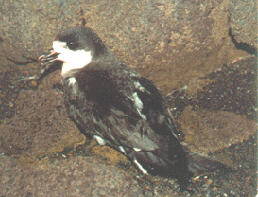
Aʻā₄. n. red-footed booby bird (Sula sula rubripes), brown booby (Sula leucogaster plotus), masked or blue-faced booby (Sula dactylatra personata); all indigenous and also breeding elsewhere. Legendary birds believed to have taken the shape of this bird are ʻā ʻaia, ʻāʻaiʻanuheakāne and ʻāʻaianuinūkeu; ʻā by some were considered ʻaumākua. See also (Kep. 33). also ʻaʻa. a. s. Name of a large sea bird often caught by natives; also called aaianuheakane, feathers white. ʻaʻa₅. same as ʻā₄, booby bird. ʻāʻā₄. probable var. of ʻā₄, booby bird. aa [a-a]. s. See A above. Name of a bird that hunts fish during the day, but flies back to the mountains in the evening. ʻāʻā₅. n. male ʻōʻō bird. [(EO) PPN *kaakaa, parrot sp] ʻāʻaia. n. var. spelling of ʻā ʻaia, legendary bird believed to have taken the shape of the ʻā, booby bird. ʻā ʻaia, ʻāʻaia. n. legendary bird believed to have taken the shape of the ʻā, booby bird. see ʻā₄. ʻaʻaiʻanuheakāne. n. legendary bird. Lit., caterpillar eater of Kāne. see ʻā₄. ʻaʻa manu. n. coconut-leaf or pandanus-leaf bag used for carrying birds. ʻaʻau₁. vi. to move here and there, wander, rove; to ripple, as the sea. ka lele ʻaʻau o ka manuthe flight here and there [as in fright] of the bird aau [a-au]. s. See au. To swim dispersedly; a flock, as of birds when frightened; a school, as of fish as they come together and frightened; suddenly separate. To separate, as a flock of birds when frightened, or a school of fish. Ka lele aau o ka manu o Kiwaa, The frightened flight of the birds of Kiwaa. Ka aau mai Kukona ke koae, The flock from Kukona, the koae. Ke koae nui hulu meamea, The great feathered koae. ʻaekelona, aeselona [ʻaeke·lona]. n. falcon, vulture. ʻaeko₁, aeto. n. eagle. Gr. aetos. lio hulu ʻaekodark-gray horse; lit., eagle-feather horse ʻaeko kula. n. golden eagle. ʻāeko poʻo hina. n. bald eagle. lit., white-haired eagle. also ʻāeto poʻo hina
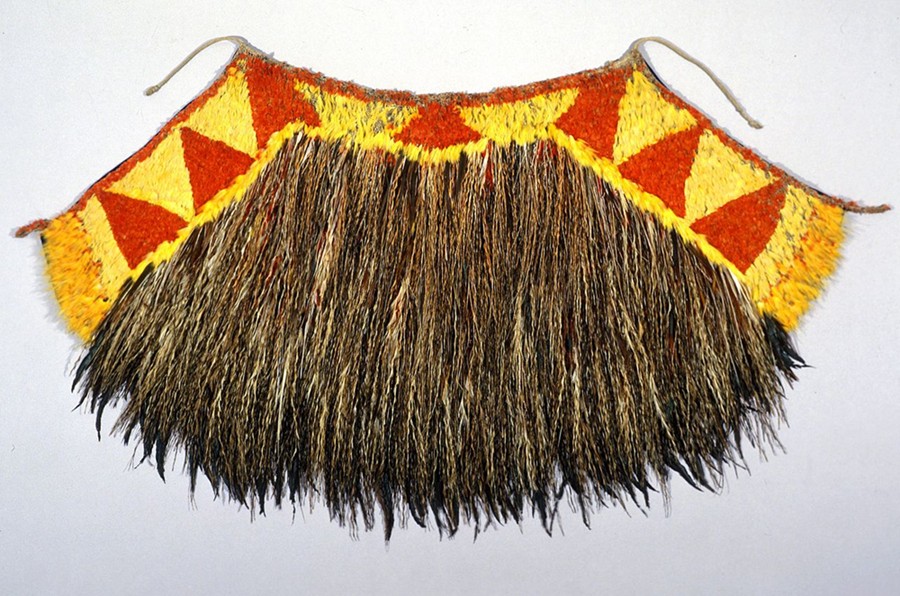
ʻaeselona [ʻaese·lona]. n. var. spelling of ʻaekelona; falcon, vulture. ʻāeto. see ʻāeko poʻo hina, bald eagle aeto₁. n. var. spelling of ʻaeko₁; eagle. Gr. aetos. ʻāhaʻihaʻi [ʻā·haʻi·haʻi]. redup. of ʻāhaʻi₁, to carry off, chase... Na ka manu ʻāhaʻihaʻi, kanu lau ʻawa o uka.It was the birds who carried, planting kava leaf in the upland. (song) ahaihai [a-hai-hai]. adj. See above. Ka manu ahaihai kanu awa e, the bird breaking off the awa plants. ʻahuʻula. n. var. spelling of ʻahu ʻula₁, feather cloak or cape made of the feathers of the ʻōʻō...
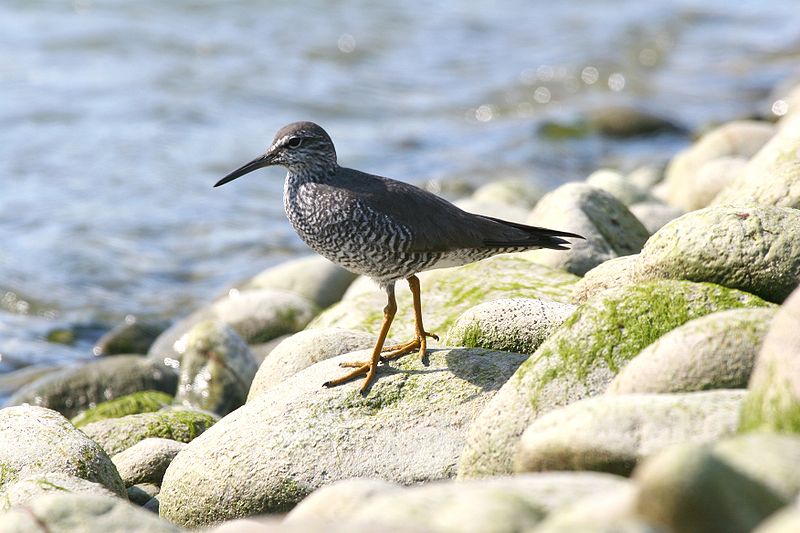
ahuula [a-hu-u-la]. s. Ahu, a garment, and ula, red. A red feathered cloak; a cloak made of the feathers of the oo and the red feathers of the iiwi, worn by kings and high chiefs; a gorgeous dress. Laieik. 112. ʻaiʻai₁. see ʻōpū ʻaiʻai, stomach; craw, as of a bird... ʻaimīkana [ʻai·mī·kana]. n. linnet, California house finch, papaya bird (Carpodacus mexicanus frontalis), an early introduction to Hawaiʻi, now well established throughout the Hawaiian Islands. lit., papaya eater. ʻainohu Kauō [ʻai·nohu kau·ō]. n. Laysan finch (Telespiza cantanc). see hona, nuku ʻekue, ʻainohu Nīhoa. ʻainohu Nīhoa [ʻai·nohu nī·hoa]. n. Nīhoa finch (Telespiza ultima). see hona, nuku ʻekue, ʻainohu Kauō. ʻākaha [ʻā·kaha]. same as ʻēkaha, bird's-nest fern. [PPN *katafa, bird's nest fern, (asplenium nidus)] akaha [a-ka-ha]. s. Name of a tree. One species has long leaves and grows inland; one species by the sea. It is a hard tree, like the uwea; also called ekaha. ʻakapane [ʻaka·pane]. same as ʻapapane, a bird. ʻakēʻakē. n. Hawaiian storm petrel (Oceanodroma castro cryptoleucura). akeake [a-ke-a-ke]. s. Name of a bird. ʻakekeʻe [ʻake·keʻe]. n. a honey creeper (Loxops coccinea caeruleirostris). Usually called ʻākepa in Eng. also ʻōʻūholowai. akekee [a-ke-kee]. s. Name of a little brown bird resembling the wren found on the mountain of Waialeale, on Kauai; it was formerly worshipped by the natives as the god of the mountain. ʻakekeke₁ [ʻake·keke]. n. ruddy turnstone (Arenaria interpres), a winter migrant to Hawaiʻi, occurring in small flocks which rise and wheel together. also keke. akekeke [a-ke-ke-ke]. s. A species of bird. See keke.
akepa [a-ke-pa]. s. The name of a bird. ʻakepeuʻie [ʻake·peuʻie]. n. Oʻahu ʻākepa (honey eater), Loxops coccinea rufa, presumed extinct; Maui ʻākepa, L. c. ochracea, endangered. ʻakialoa [ʻakia·loa]. n. a group of Hawaiian honey creepers with long, curved bill, olive or yellow-green above, lighter below (Hemignathus obscurus), with subspecies on Hawaiʻi (H.o.o.), Lānaʻi (H.o. lanaiesis), and Kauaʻi (H. procerus). The latter is endangered; it has the longest curved beak, for sipping honey at the base of ʻieʻie and hala pepe leaves. cf. ʻiwi, ʻiʻiwi. also ʻakihi loa, kipi. ʻakia pōlāʻau [ʻakia pō·lāʻau]. same as ʻakihi poʻo lāʻau, the nuku puʻu honey creeper of ʻakihi, ʻakihia [ʻakihi, ʻaki·hia]. n. birds. See below. ʻakihi keʻehi ʻale. n. a small black sea bird, probably a stormy petrel (Oceanodroma), of which two dark, sooty species are known about the Hawaiian Islands, especially those to the northwest. lit., billow-treading ʻakihi. ʻakihi loa. same as ʻakialoa, a group of Hawaiian honey creepers with long, curved bill... ʻakihi pōlena [ʻakihi pō·lena]. n. a bird listed by Malo. (Malo 39) akihipolena [a-ki-hi-po-le-na]. s. Name of a small bird with red feathers. ʻakihi poʻo lāʻau. n. the nuku puʻu honey creeper of Hawaiʻi (Hemignathus wilsoni). see nuku puʻu. ʻakikiki [ʻaki·kiki]. n. the endemic Kauaʻi creeper (Loxops maculata bairdi, formerly Paroreomyza bairdi). ʻakipohe₁ [ʻaki·pohe]. vt. to nip. ʻAkipohe nā manu i ka lehua.The birds nip at the fringes of the lehua flowers. ʻākohekohe [ʻā·kohe·kohe]. n. the crested honey creeper (Palmeria dolei), formerly endemic on Maui, endangered. akohekohe [a-ko-he-ko-he]. s. Name of a small bird making its nest on the ground. ʻakolika [ʻako·lika]. n. ostrich. Eng. akua loa. n. a tall image, especially an image of Lono carried on a circuit of the island during the makahiki, harvest festival; it was called loa, long, because of its "long" travels. The image consisted of a staff about two fathoms long. Pieces of pala fern, feather leis, and skins of the kaʻupu bird were fastened to a crosspiece tied near the top of the staff, in the center of which was a tiny carved head. A long and white tapa banner was attached to the crosspiece. ((Malo 143–5), but see (Malo text, chapter 36, sections 22–4)) Tribute was collected. also Lono Makua. ala₁. n. path, road, trail. cf. alaloa, alanui, alawai. [(AN) PPN *hala, road, path] ala a ka manua bird's trail [a life difficult to emulate] ala hoʻi ʻole maia pathway on which there is no returning [death] ala iki a kāhunathe small path of priests [a difficult way of life] ala. n. aisle, as in a supermarket. also alakaha. n. lane, as on a highway or in a bowling alley. ala [a-la]. s. A path; way; road; often alanui, great road; it is used in some places as synonymous with kuamoo; he kahi e hele ai; kuu aku ana keia i ke ala; po oloko i ke ala. Laieik. 62.
alaa [a-la-a]. s. A kind of tree.
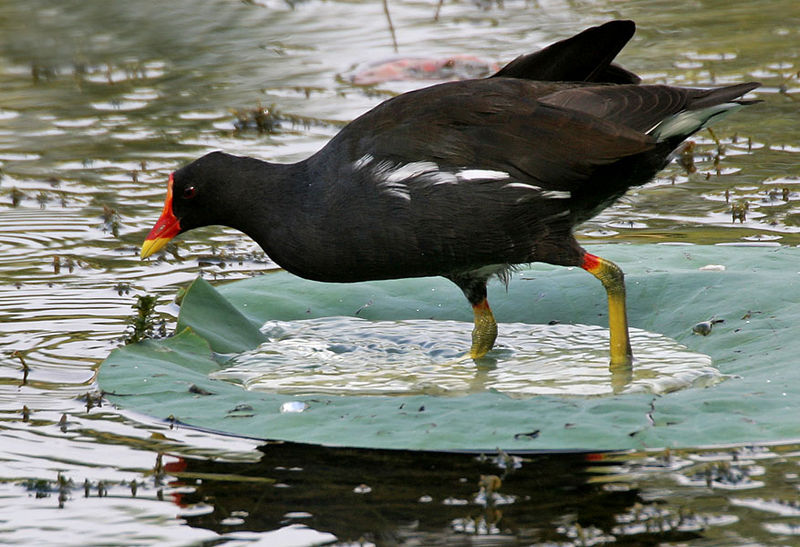
alae [a-lae]. s. Name of a bird with a red skin on the upper part of its bill; oia ka mea (o Mauiakalani) nana i imi i ke ahi, a loaa i ka alae, he it was (Mauiakalani) who being in search of fire, found the alae; alae, he moa eleele loa, a very black fowl. The alae was formerly worshipped as a god, especially the alae keokeo, the white alae. ʻalae huapī [ʻalae hua·pī]. same as ʻalae ʻula, Hawaiian gallinule or mudhen (Gallinula chloropus sandvicensis)... ʻalae kea. n. Hawaiian coot (Fulica americana alai), a marsh and pond bird, distinguished from ʻalae ʻula by its ivory-white frontal knob; endangered. [(EO) PPN *kalae, purple swamphen (porphyrio porphyrio)] ʻalae keʻokeʻo [ʻalae keʻo·keʻo]. same as ʻalae kea, Hawaiian coot... ʻalae nū kea. same as ʻalae kea, Hawaiian coot (Fulica americana alai), a marsh and pond bird... lit., white-beaked ʻalae. see ʻalae₁. ʻalae ʻula. n. Hawaiian gallinule or mudhen (Gallinula chloropus sandvicensis), distinguished from ʻalae kea by its reddish bill and frontal plate; endangered. ʻalaiaha [ʻalai·aha]. n. an upland bird, gray, about rite size of the ʻelepaio, reported in 1863. see ʻeʻea₂. (KL. line 308) alakō₂ [ala·kō]. n. bird-catching pole. also ʻaukuʻu.
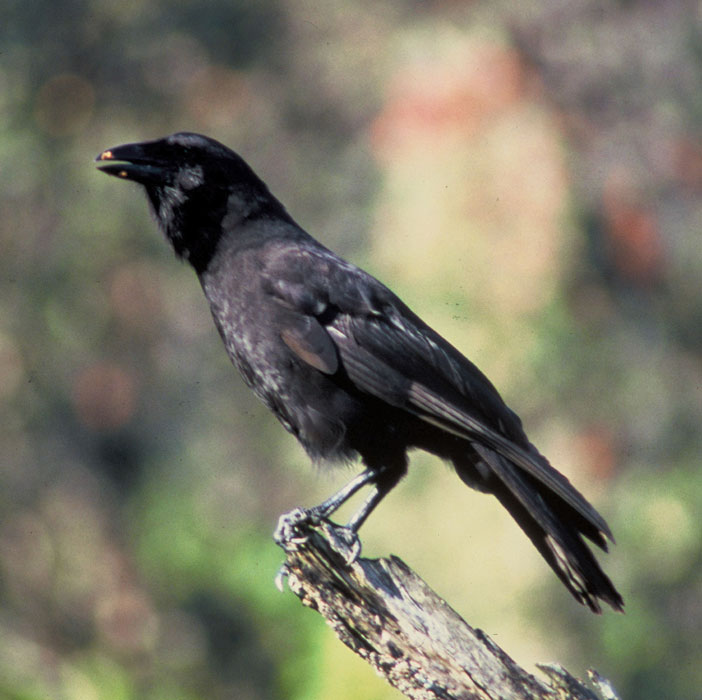
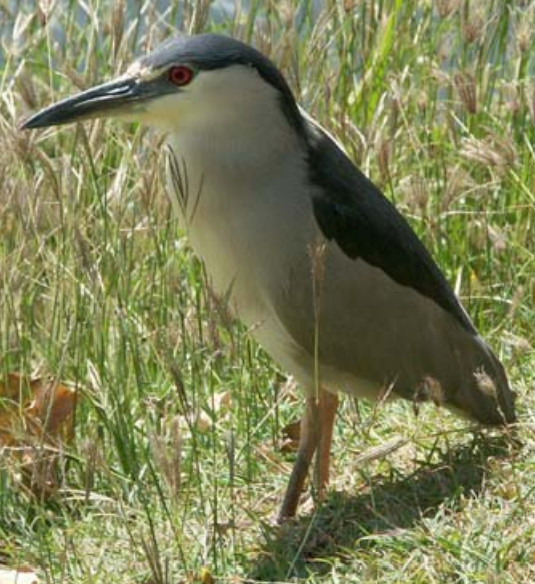
He ʻalalā, he manu leo nui.A crow, a bird with much talk [a talkative person]. (ON 527) alala [a-la-la]. s. Name of a bird; a species of raven on Hawaii; so named from its cry, resembling that of a child. Laieik. 29. ʻalamea₃ [ʻala·mea]. n. a bird (no data) ʻalauahio [ʻalaua·hio]. n. endemic Hawaiian honey creepers (Loxops maculata), Oʻahu creeper (L. m. maculata), endangered; Lānaʻi creeper (L. m. montana), presumed extinct; Maui creeper (L. m. newtoni); Hawaiʻi creeper (L. m. mana), endangered. ʻalauwahio [ʻalau·wahio]. var. spelling of ʻalauahio, endemic Hawaiian honey creepers (Loxops maculata)... alauwahio [a-lau-wa-hio]. s. A species of bird, small and yellow. See lauwi. ʻalauwī [ʻalau·wī]. same as ʻalauahio, endemic Hawaiian honey creepers (Loxops maculata)... ʻalawa₂. n. a bird (no data). alawī₂ [ala·wī]. n. upland bird, reported to be the young of the ʻanianiau, and on Kauaʻi, the ʻamakihi. ʻalekea, aredea [ʻale·kea]. n. heron. Latin Ardeidae, a family. (Oihk. 11.19) ʻalekea [ʻale·kea]. n. heron, general term. see ʻalekuʻu. ʻalekuʻu [ʻale·kuʻu]. n. egret, general term. see ʻalekea. Papapū ka ʻāina mahi kō i ka ʻalekuʻu kau pipi ma hope o ka puhi ʻana i ke kō.The cane field is covered with cattle egrets after the cane is burned. ālialia [ā·lia·lia]. same as ālia, salt bed, salt-encrusted area; salty, brackish... He ālialia paʻakai, he ālialia manu, nā ālialia o nā waipuna huʻihuʻi.It is a salt bed, a salt bed for birds, salt-encrusted places with cool springs. alialia [a-li-a-li-a]. s. He alialia paakai, a bed where salt is dried; he alialia manu; na alialia o na wai puna huihui. See alia above. Ground which is smooth, dry and barren, as that which is baked in the sun, or covered with salt. alokele₂ [alo·kele·]. n. a red bird reported by Kepelino (no data). ʻamakihi [ʻama·kihi]. n. a group of small endemic Hawaiian honey creepers, Loxops virens; abundant on Hawaiʻi (L. v. v.), Maui (L. v. wilsoni), and Kauaʻi, uncommon on Oʻahu (L. v. chloris) and Molokaʻi, rare on Lānaʻi. The feathers are yellow and greenish, and were formerly used in feather capes. The Kauaʻi form was also called alawī kihi. ʻamakihi ʻawaʻawasour ʻamakihi [person with a sour disposition] amakihi [a-ma-ki-hi]. s. Name of a small yellow bird; he manu hulu lenalena ia. ʻāmaui [ʻā·maui]. n. Oʻahu thrush (Phaeornis obscurus oahuensis), dusky, olive-brown above, ashy-gray beneath, endemic, presumed extinct, with subspecies on Hawaiʻi (ʻōmaʻo₃), Lānaʻi (olomaʻo), Molokaʻi (olomaʻo), and Kauaʻi. amaui [a-ma-ui]. s. A species of small bird. Ke ānai maila ka ʻiwa ānai maka.The frigate bird that fascinates the eyes is attracting attention. (UL 197) ʻanianiau [ʻania·niau]. n. a small, bright olive or yellowish-green Hawaiian honey creeper (Loxops [formerly Chlorodrepanis] parva), endemic to Kauaʻi, and related to the ʻamakihi. The young birds which are confused with young ʻamakihi, were reported to have been called alawī. The greater ʻamakihi (L. satittirostris) is presumed extinct. ano₁. nvi. Ano wale mai nō kō aloha.Your love overpowers me. E ko mākou Makua i loko o ka lani, e hoʻāno ʻia kou inoa.Our Father which art in Heaven, hallowed be Thy name. (Mat. 6.9) hoʻānoholy, devoted to sacred use, hallowed, solemn; to reverence, sanctify, attribute divine honor, hallow Hoʻāno, Hoʻāno, Hoʻāno.Holy, Holy, Holy. (Hoik. 4.8) Ke ano mai nei ka nahele, ʻaʻohe manu o ke kula.The forest is silent, there are no birds in the plains. (song) Poʻe Hoʻāno o nā Lā Hope Nei.Latter-Day Saints. ano [a-no]. s. Fear; dread; ua kau mai ke ano ia’u la, fear fell upon me; ke kau mai la ke ano hewa ia oe. v. To be in fear; ano wale mai la no au. See ano or anoano. To be silent; solitary, as a deserted village; ua pau i ke kaua, hauaia na kanaka a pau i ka hana. ʻaʻo. n. Newell's puffin or shearwater (Puffinus puffinis newelli), said to be the only sea bird endemic to Hawaiʻi, and to breed only in Hawaiʻi; glossy black above, white beneath; endangered. also liʻo. [(OC) PPN *kao, green heron (butorides striatus) (clk) (problematic)] Hoʻokahi nō hua a ka ʻaʻo.The ʻaʻo lays but a single egg [said of an only child]. (ON 1073) ao. s. Art., ka. Name of a species of bird. Laieik. 29. ʻāpane₂ [ʻā·pane]. short for ʻapapane, a bird. see ʻōhiʻa ʻāpane. apane [a-pa-ne]. s. A species of bird much valued on account of its red feathers.
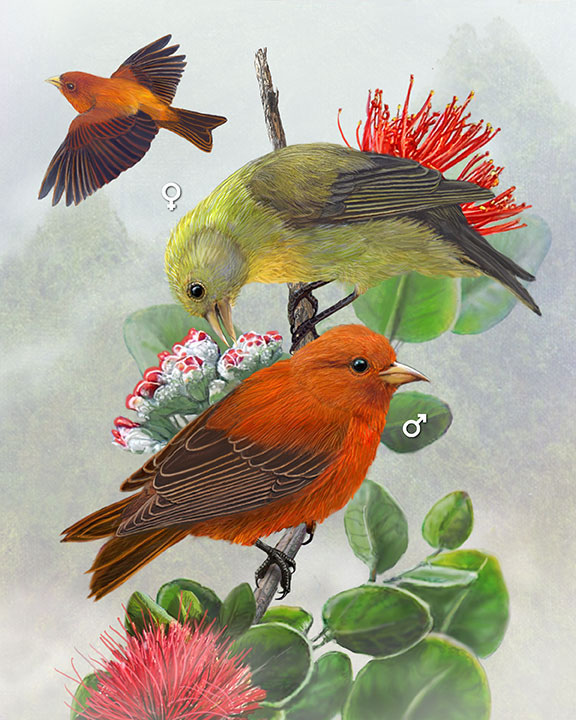
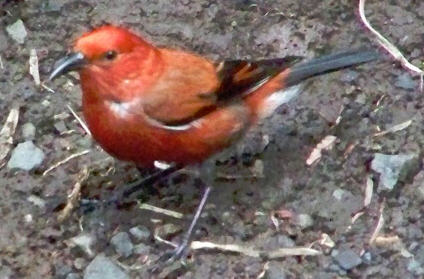
apapane [a-pa-pa-ne]. s. The name of a bird on Hawaii; a i kani aku ka leo o ka apapane. Laieik. 29. It has red feathers. Hulu apapane, the red feathers of the apapane. ʻauʻau₃. trap, snare, as for catching birds. (And.) auau [au-au]. s. A snare for catching and killing birds; he pahele e make ai ka manu; he auau manu. ʻauʻauna manu [ʻau·ʻauna manu]. n. birdbath. lit., bird bathing place. Aukoaʻeuamālie [au·koaʻe-ua-mā·lie]. n. name of a stroke in lua fighting. lit.., tropic bird hastens, it is calm.
aukuu [au-kuu]. s. The name of a bird; me he aukuu la ke kau i ke ahua, as an aukuu, lights on a bank; ua hoolikeia ke kanaka hana hewa me ka aukuu, a bad man is likened to an aukuu; no ka mea, he ahua kahi e kau ai ka aukuu, because the aukuu sits on a bank; nolaila i olelo mai ka poe kahiko; hence the ancients say: Me he aukuu la ke kau i ke ahua, As the aukuu sits upon a sand bank, Alaalawa na maka me he pueo la, Its eyes looking about like an owl. ʻaukuʻu₃ [ʻau·kuʻu]. n. a long bamboo pole with two maile stalks across the top that were gummed with lime to catch birds. also alakō. ʻaukuʻu pili ʻāina [ʻau·kuʻu pili ʻāina]. n. name given by Kepelino for a bird resembling the kioea, and not an ʻaukuʻu. aulele [au·lele]. vi. to fly, as a frightened flock of birds. aulele [au-le-le]. v. To fly off in flocks, as many kinds of birds. aulia [au·lia]. pas/imp. of au₂, ₃, current, to flow, as a current...; movement, eddy, tide, motion... ʻāuna [ʻā·una]. n. large group, flock. he kohu ʻāuna manu o ke kulalike flocks of birds of the plains hoʻāunato flock, collect (intransitive) auna [au-na]. s. A collection or flock of birds; as, auna kolea, a flock of koleas; auna kolea e wili ana me he auna manu la, a flock of koleas mingling together like a flock of birds. ʻawawaiakamanu [ʻawa-wai-a-ka-manu]. n. a variety of kava, an offshoot of ʻawa hiwa, with joints green on one side and dark on the other. lit., watery kava of the bird. (HP 202) ʻāweʻaweʻa₁ [ʻā·weʻa·weʻa]. nvs. faint trace, spot, glimpse; faint, dim; streaked, faded. ʻāweʻaweʻa koko aliʻitrace of royal blood (Kep. 127) ʻāweʻaweʻa lonodim recollection hoʻāweʻaweʻacaus/sim ʻIke ʻāweʻaweʻa.To see fleetingly, to know but have slight knowledge; faint glimpsing, slight knowledge. Ua ʻike ʻāweʻaweʻa aʻe nei au i ua manu nei.I caught but a fleeting glimpse of this bird. ʻāweʻaweʻa [ʻā·weʻa·weʻa]. vs. trace, small amount. kumumea ʻāweʻaweʻatrace element aweawea [a-we-a-we-a]. v. To see in a slight degree; to catch a glimpse of an object.
s. A glimpse; a half sight of an object.
adj. Spotted; variegated with spots of different colors; he aweawea ulaula; obscure; not plain; aweawea ka lohe.
adv. Dimly to the sight; not plainly, seen; faintly; ike aweawea aku la oia he wahi onohi ma Koolau, o Hawaii. Laieik. 26 [15].
Eʻeaʻea₃. n. a bird (no data). ʻēʻē₂. n. yellow underwing feathers of the ʻōʻō, a bird, as used in featherwork. ee [e-e]. adj. He hulu ee no ka manu oo, that is, the yellow feathers under the wing (or the ee) of the oo, oia ka lei hulu manu. ʻeʻea₂. n. a bird, said to be an adult ʻalaiaha. (KL. line 307) ʻeʻele₁. same as ʻeleʻele₁, black, dark... but used chiefly in old chants. Ka manu ʻeʻele koi.The black bird begged. (For. 5:99) ʻēheu₁ [ʻē·heu]. nvi. wing, as of bird, kite, or airplane; winged, soaring on wings; to fly, take wings. Also ʻēkeu, pēkeu. cf. ʻeheheu, ʻekekeu, pekekeu. (Kel. 140) PCP *ke(e)(f,s)eu. hoʻēheuto flap the wings; to lift up or stretch the wings; to undulate the arms in a hula imitating a bird in flight; to flap the arms, shrug the shoulders; to pull up shoulders proudly, hence to be proud ka uhi ʻana mai o nā ʻēheu o ka pōthe covering of the wings of night [nightfall] eheu [e-he-u]. s. The wing of a fowl; na mea eheu, winged animals. Kin. 1:21. FIG. Care; protection; eia no au iloko o na eheu o ko kaua makuahine; the wing, as of an eagle. Puk. 19:4. Oukou, e na hoa (scholars of the Sem.) o na eheu o ke kakahiaka nui. Eheu takes both forms of the article ka and ke. See eheheu. adv. As wings; as if with. wings. Isa. 40:31. ʻēkaha₁ [ʻē·kaha]. n. the bird's-nest fern (Asplenium nidus), widespread in the tropics, forming large rosettes and in some forests perching on branches of trees. The fronds are large, entire, sword-shaped. The black midrib is used like the ʻamaʻu fern for decorating pandanus hats. Also ʻākaha. This fern is sometimes called ʻēkaha kuahiwi, mountain ʻēkaha, to distinguish it from the mosses or from ʻēkaha kū moana. (Neal 21) [PPN *katafa, bird's nest fern, (asplenium nidus)] ekaha [e-ka-ha]. Also the name of a fern-like plant. ʻēkahakaha₁ [ʻē·kaha·kaha]. n. juvenile or small form of bird's-nest fern. cf. ʻēkaha. ʻekekeu [ʻeke·keu]. n. wings. see ʻēheu₁. ekekeu [e-ke-ke-u]. s. A wing; the wing of a bird. See eheu and ekeu. s. A wing, &c. See ekeke above. ʻekelo. see pihaʻekelo, mynah bird. ʻekepuʻu [ʻeke·puʻu]. n. a bird (no data). (KL. line 355) ʻekue. see hona, ʻainohu Kauō, ʻainohu Nīhoa. nuku ʻekueKing Kong finch (
Ua ʻelepaio ʻia ka waʻa.The canoe is [marked] by the ʻelepaio. (ON 2777) elepaio [e-le-pai-o]. s. A species of bird. Laieik. 29. Also, ʻewaʻewa₂. n. sooty tern (Sterna fuscata oahuensis); forehead and sides of head white, rest of head black; upper parts black, white beneath. Also ʻewaʻewa iki.
Hhaʻakoaʻe [haʻa·koaʻe]. vs. like the tropic bird. see koaʻe. pali haʻakoaʻean inaccessible cliff where koaʻe birds fly haakoae [haa-ko-ae]. Haa. causative, and koae. Name of a species of bird that is white. See koae. A high precipice. hāʻale. vs. Hāʻale i ka wai a ka manu.Rippling in the water of birds [an attractive person likened to rippling waters that attracts birds]. (ON 393) Ua hāʻale ka wai i ka lau o ke pili.The stream rose up to the very pili grass. haale [ha-a-le]. v. Contraction for haa, causative, and ale, a wave or swell of water. To cause to be full; to swell up, as water. To be deep; to overflow; to rise high; haale ka wai, the water rises. hae₂. vi. to bark (Isa. 56.10) , growl, snap, as a dog; to chirp noisily or scold, as a mynah bird. hoʻohaeto cause to bark, growl, scold hae. v. To bark, as a dog. Isa. 56:10. The growling or snarling of a cross dog. haehae₂ [hae·hae]. redup. of hae₁, wild, fierce, rage... hoʻohaehaecaus/sim.; to drive into a fury; to decoy uhu fish by tying an uhu to a line; to tease Ka ʻiwa hoʻohaehae nāulu.An ʻiwa, frigate bird, teases the showers [an attractive person provokes envy]. Haehaekamanuokānealoha [hae·hae-ka-manu-o-kāne-aloha]. n. a lua fighting stroke. lit., the birds of Kānealoha tear to bits. hāʻena₃. same as hāʻeʻena, shy... Ua lū ʻia e ka manu, hāʻena wale i ka nahele.Scattered by the birds, shy in the forest. (song) hāhāʻaiakamanu [hā·hā-ʻai-a-ka-manu]. n. a native lobelia (Clermontia clermontioides), found only in high mountains of Kauaʻi, a shrub or small tree with many branches; oblong and narrow leaves; greenish-purple, curved flowers; and sweet, edible yellow berries. lit., hāhā, food of the birds, so called because the thick sap was used for catching birds. hahai manu. n.v. bird hunter, fowler; to hunt birds. haka₁. n. haka kau a ka manua perch for birds to light upon [a promiscuous woman] (ON 413) halahalakau [hala·hala·kau]. redup. of halakau, to perch high, as a bird... Ua halahalakau nā manu pūnua mai kō lākou pūnana aku.The young birds perch far away from their nests. (Kep. 89) halakau₁ [hala·kau]. vi. to perch high, as a bird. halakau ka manu i ka lāʻauthe bird perches high in the tree [a person not easily gotten] (ON 426) halakau [ha-la-kau]. v. To place one thing on top of another. To lean over; e haukau. halalani [hala·lani]. n. high heavens, atmosphere. nā manu i halalanithe birds in the heavens hale manu. n. birdhouse, aviary. halolani [halo·lani]. vi. to move quietly, as a soaring bird. halolani [ha-lo-la-ni]. s. The flight of a bird that sails round and round with but little motion of the wings; lele ka pinao o Halolani, lele i ka lani. Halulu₂. n. a legendary man-eating bird. (For. 4:65) halulu [ha-lu-lu]. s. The name of a fabulous bird in ancient times killed by the chief Waukulenuiaiku; o halulu, o ka mani kani halau. hanina₁. same as hani₁, to step or move lightly or softly; to graze, touch... Nā manu hanina i ka laʻi.The birds moving lightly in the calm. hapaina. n. carrying, lifting, carrier; pregnancy. He hoa manu nēnē, he hapaina ʻino.A goose bird companion, carrier of filth. (chant) cf. (ON 584) hāpaina [hā·paina]. n. carrier, as of a radio-wave signal. hāpapa₃ [hā·papa]. n. stick for catching ʻio hawks; the crosspieces were gummed and a live bird was tied as a decoy. hehe. n. a kind of bird (no data). (KL. line 348) hehē. nvi. burst of laughter, guffaw; to guffaw. Ka ʻaka hehē a ka manu a Kaiona.The loud laughter of the birds [people] of Kaiona. (song) hehe [he-he]. v. To laugh; to mock; to deride. hehelo. redup. of helo, red, as ʻōhelo berries; rosy...; reddish, bright, showy. hoʻohehelocaus/sim Nā pāpale hulu manu like ʻole o nā aliʻi e hoʻohehelo ana i ka ʻōnohi o ka lā.The hats of the varying bird feathers of the chiefs shining brightly within the eyeball [sight] of the sun. hehelo [he-he-lo]. v. To be like the helo or ohelo, a reddish brown; hence, To be good looking; grand; proud. hiena₃. n. speckled bird of prey. (Ier. 12.9) hīlia₂ [hī·lia]. n. a native bird (no data). hīnālea ʻiʻiwi [hī·nā·lea ʻiʻiwi]. n. bird wrasse, Gomphosus varius, 23 cm. hīpuka [hī·puka]. n. a concealed snare for plovers. rare. hipuka [hi-pu-ka]. s. A kind of snare for catching birds; ka hipuka no na manu hihiu; kau aku la ia i ka hipuka pahele. -hoa. cf. uahoa, hard, severe, harsh, indifferent to the distress of others... Hana ka iwi a kanaka makua, hoʻohoa mai.Get maturity into the bones before issuing a challenge. hoʻohoato challenge, dare, provoke; daring, defiant. Hoʻohoa nā manu hanina.The quiet birds are daring. hoe₃. n. a bird reported by (Kep) as being the size of the ʻōʻō and black and gray. hōʻeu₂. n. a bird name (no data). hoiʻa. n. Niʻihau name of a sea tern. hōʻio. same as ʻuaʻu kani, wedge-tailed shearwater... rare. Hōkū-ʻiwa [hō·kū-ʻiwa]. n. a Hawaiian constellation, perhaps Boōtes. lit., frigate-bird star. holokia [holo·kia]. vi. to dart, as a bird. hona. n. grosbeak finch (Chloridops kona). lit., name of a tree frequented by this finch. cf. hōpue. see nuku ʻekue, ʻainohu Kauō, ʻainohu Nīhoa. hōpue₁ [hō·pue]. n. orange finch (Psittirostra palmeri), the largest of the Hawaiian finchlike forms, found only in the Kona and Kaʻū districts, Hawaiʻi. hua moa, huamoa. n. chicken egg. PPN *fua moa. huamoa [hu-a-mo-a]. s. Hua, egg, and moa, a fowl. A hen's egg. huapī [hua·pī]. same as ʻalae huapī, same as ʻalae ʻula, Hawaiian gallinule or mudhen huhulu. vs. bristling, tousled, as feathers, fur, body hair. huhulu iʻi. intensifier of huhulu, bristling, tousled, as feathers, fur, body hair... Huhulu iʻi ka hulu o ka manu i ka ua kakahiaka.Tousled were the feathers of the bird in the morning rain. (chant) huhuluii [hu-hu-lu-i-i]. v. Hulu, hair, and ii, mould like. To stand up, as the comb of a cock; to stand up, as bristles; to stand erect, as the hair on the flesh when one is wet and cold. To be wet and cold; to shiver with cold. adj. Made rough and ugly, as the hair or feathers of an animal in water. huihui ā kōlea [hui·hui ā kō·lea]. vi. to gather together like a flock of kōlea birds. fig., to gather together to help one another in time of trouble. hulikoʻa [huli·koʻa]. nvt. to seek into the depths of a matter, to describe fully; description. "He Wahi Hulikoʻa Manu Hawaiʻi"."A Short Study of Hawaiian Birds". (title of an article about birds) hulimaiʻa [huli·maiʻa]. n. name of a reddish-brown honey-sucking bird (no data). lit., banana seeker. hulu₂. nvs. esteemed, choice, precious; esteemed older relative, as of parents or grandparents' generations. (This meaning may be connected with the value attached to featherwork.) He hulu aliʻi.An elderly chief who is loved and esteemed. hoʻohuluto esteem, prize Inā hoʻi ʻoe he manu lele i luna, hoʻohulu aku ua hoa nei.If you then were a bird flying above, this companion would nurse great esteem. (chant for Kamehameha III) Nā hulu makaʻāinana o nā aliʻi.The most precious of the chiefs' citizenry. huluʻiwi. n. a pig that is reddish-colored about the hams. lit., ʻiwi bird feather. (Malo 37) hulukoa [hulu·koa]. n. bird crest. hulumanu [hulu·manu]. n. tick used for mattresses and pillow covers, so called because they were stuffed with bird feathers. hulu manu₁. n. bird feathers. hulumanu [hu-lu-ma-nu]. s. Hulu and manu, a bird. A bird-feather. NOTE.—Bird's feathers were highly valued in former times; o ka hulumanu ka mea i manao nui ia, he wai-wai ia. s. LIT. A bird's feather. Name of a class of men around a chief, very great favorites; a favorite of the chief. See the foregoing. hunakai₂ [huna·kai]. n. sanderling (Calidris alba), a small winter migrant to Hawaiʻi, cinnamon brown with dark markings. lit., sea foam, so called from the bird's habit of following close behind receding waves.
Iiana. n. ostrich (RSV), owl (KJV). (Isa. 13.21) iana [ia-na]. s. Heb A word translated owl in Isa. 13:21. The ostrich perhaps. ʻiao₄. n. a bird said to resemble the moho (no data). iao [ia-o]. Name of a bird somewhat like the moho. ihu kikiwi. curved beak (EH) ʻiʻi₁. vs. small, stunted, undersized, dwarf. kioea ʻai pua ʻiʻi o Hiliathe kioea bird that eats the tiny spawn of Hilia [of big persons gobbling up little ones] ii [i-i]. Name of a species of fish around Molokai; ka pua ii. adj. Stinted; unthrifty; choked with weeds; applied to vegetables or animals. ʻiʻi₇. same as ʻapapane, a bird. ii [i-i]. s. Name of a bird, partly red, bill hooked. See apane. He manu liilii ulaula; he apapane kekahi inoa.
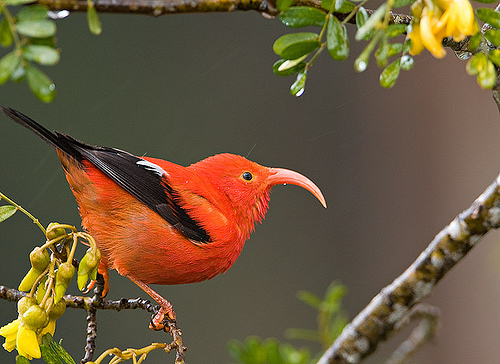
ka mahiole ʻie i haku ʻia i ka hulu o nā ʻiʻiwiplaited helmet made of ʻiʻiwi feathers (Laie 479 [90]) iiwi [i-i-wi]. s. A small red bird; also iawi. ʻiʻiwi₂. n. same as the honey creeper called ʻakialoa on Oʻahu (Hemignathus obscurus ellisianus). ʻiʻiwi pōlena [ʻiʻiwi pō·lena]. same as ʻiʻiwi₁, scarlet Hawaiian honey creeper... ʻiʻiwi pōpolo [ʻiʻiwi pō·polo]. n. immature, greenish-yellow, blackspotted stage of the ʻiʻiwi bird, lit., pōpolo berry honey creeper. ʻikuā₁, ʻikuwā [ʻiku·ā]. nvs. noisy, clamorous, loud-voiced; to make a din; din, clamor; voices of the gods in the elements. ʻIkuwā nā manu i ka nahele.The birds make a din in the forest. ʻIkuā₂, ʻIkuwā [ʻiku·ā]. n. month of the Hawaiian year, named, according to Kepelino, for the roar of surf, thunder, and cloudbursts of this month. Pohākōʻeleʻele is a var. name: see month. (Kep. 95) ʻO ʻIkuwā i pohā kōʻeleʻele, ʻikuwā ke kai, ʻikuwā ka hekili, ʻikuwā ka manu.ʻIkuwā is the month when dark storms arise, sea roars, thunder roars, birds roar. Ikua [i-ku-a]. s. Ancient name of one of the months; also written Ikuwa; October. ʻikuwā. nvs. var. spelling of ʻikuā₁, noisy... ʻIkuwā. n. var. spelling of ʻIkuā₂, month of the Hawaiian year... ʻilikalakala [ʻili·kala·kala]. n. a bird (no data). ʻili kalapu wāwae [ʻili kalapu wā·wae]. n. jess, a leg strap for falcons. lit., leg strap. ʻīlio hahai manu. n. bird dog. ʻīnana₁ [ʻī·nana]. nvi. to come to life or activity, as of a sick person; to show liveliness, as of young birds about to fly; animated; stirring of life. cf. kīnana, pūnana. Hōʻeu, kukupu, ʻīnana, kū i luna o ka moku.Bestir, grow, come to life, rule the island. (For. 6:267, ancient prayer) hōʻīnanato animate, give life to Ke ʻīnana lā mehe ʻōpae ʻoehaʻa.Active there like freshwater shrimps [of scattered foes]. (ON 1710) Ō hoʻūlu ʻoe, ō ʻīnana ʻoe, hoʻīnana i ke ola.Inspire, animate, give life. (PH 150, prayer) ʻO ka honua nui a Kāne i hoʻīnana a ʻahu kīnohinohi.The great earth that Kāne gave life to and clothed decoratively. (Kep. 123) Wahi piopio moa i ka hua e ʻīnana nei i loko ou.Little chicken in the egg coming to life within you. inana [i-na-na]. v. To walk about idly, without any definite object; to loaf about.
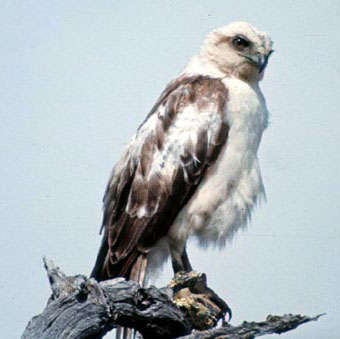
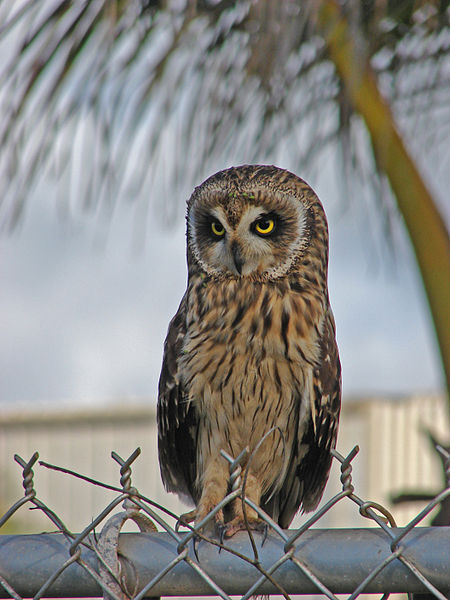
Kaha ka ʻio i ka mālie.The ʻio hawk poises in the calm [admiration of a handsome person]. (ON 1288) io [i-o]. s. A species of bird; a hawk. ʻioʻio₁. redup. of ʻio₂; cheeping, peeping. cf. māʻioʻio. PPN *kiokio. ʻAʻohe mea i hāmama ka waha ā ʻioʻio.None opened the mouth or peeped. (Isa. 10.14) manu ʻioʻioswallow (Isa. 38.14) pene ʻioʻiobrooder (lit.: cheeping pen) ioio [i-o-i-o]. v. To peep, as a chicken; also piopio. Isa. 10:14. Misprinted oioi; to chatter. Isa. 38:14. To whisper, as ghosts were supposed to do. See hanehane. adj. Peeping, as a chicken; he manu ioio, a swallow. Ier. 8:7. ʻiolana [ʻio·lana]. nvi. to soar, poise, as a hawk; soaring hawk. iolana [i-o-la-na]. v. See lana. To float in the air, as a bird. ʻio mea. n. a variety of ʻio hawk without dark markings. ʻio poʻi moa. n. chicken-stealing hawk. fig., a clever thief, especially of another's sweetheart. manu ʻīpikiibis, a flightless bird in prehistoric Hawaiʻi ipu hānai manu. n. bird feeder (HE)
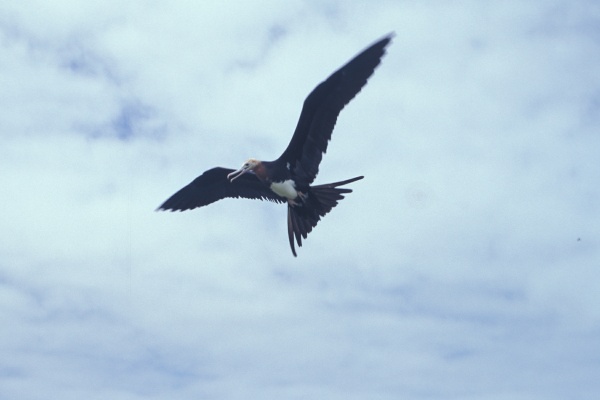
He ʻiwa ka hoa e like ai.Just like one's friend the ʻiwa bird (of one dressed up in finery). (Kel. 134) ka ʻiwa ālai makathe frigate bird that fascinates the eye [an attractive person] Ka ʻiwa hoʻohaehae nāulu.An ʻiwa, frigate bird, teases the showers. [an attractive person provokes envy]. Ke ānai maila ka ʻiwa ānai maka.The frigate bird that fascinates the eyes is attracting attention. (UL 197) Kīkaha ka ʻiwa, he lā makani.Poises the frigate bird, a windy day [of a handsome person who draws attention, as does the ʻiwa bird poised aloft]. (ON 1795) iwa [i-wa]. s. A thief; the word comes from Oiwa, a notorious thief who lived long ago and obtained the surname of Oiwahue, i. e., Oiwathief. s. The name of a large bird with black feathers. ʻiwi₁. Var. of ʻiʻiwi, a bird; considered by some an ʻaumakua. [(NP) PPN *kiwi, probably the bristle-thighed curlew (numenius tahitiensis)] iwi [i-wi]. s. The name of a small bird with red feathers; o ka iwi, he ulaula ka hulu. ʻiwi pōlena [ʻiwi pō·lena]. same as ʻiʻiwi pōlena, a honey creeper.
Kkā₁. nvt. hoʻokāto dash down, shatter, break, strike i ke kā ʻanain tying [thatch] (For. 5:650) kā i ka hoeto pull on a paddle with all one's strength kā i ka ʻinoto curse, do evil to kā i ka nele loa.to take away everything, utterly deprive, to be without. kā kēhauto rub tapa on grass or shrubbery to absorb the dew as a means of gathering moisture in arid places such as Kaʻū kā makauto make a fishhook of bone or other material kā make loato dash to death, hurl down, as a foe in lua fighting; to doom to death limu kā kanaka o Manuʻakepa.the man-striking moss of Manuʻakepa [name of a famous slippery alga growing on the beach at Hanalei, Kauaʻi]. kaʻalele [kaʻa·lele]. vi. to sway, reel; to fly or soar, as birds. kaalele [kaa-le-le]. v. To make a reeling motion, as a feeble person attempting to lean on a staff; to reel. kaha₃. vi. hoʻokahacaus/sim Kaha ka lā ma ke kua o Lehua.The sun passes to the back of Lehua [Island]. (UL 238) kaha. vi. to drive, in basketball. kīloi kahalead pass; to throw such a pass Ua kaha palamimo ʻo Ioredāne ma waena o nā kūpale ʻehā.Jordan slyly cut right through the four defenders. kaha [ka-ha]. To turn about and go away; to go off; to set out to go. Laieik. 67. v. To stand sideways; to stand up on the edge like the comb of a cock; to tread water; to swim standing up. Laieik. 92. kahakō₁ [kaha·kō]. vs. steep, sheer. [(CE) PPN *tafa-too, steep, sheer] Ka pali kahakō lele a koaʻe.Sheer cliff reached by tropic bird. (ON 1527) kahekahe₃ [kahe·kahe]. nvi. a method of birdcatching: all save a few lehua blossoms were plucked and the remaining flowers were gummed so that birds would be stuck; to catch birds thus. kaʻi₃. fish net or seine; snare or noose for birds. (And.) kai. s. See verb, No. 4. A net for fish; a snare for birds; a lasso for cattle, &c. kaini. n. name of a mother ʻuaʻu, bird. kaio [ka-i-o]. s. The name of a bird like the pueo or owl. kākāwahie [kā·kā·wahie]. n. Molokaʻi creeper (Loxops maculata flammea); the male is largely scarlet; the female and the immature male are brown with scarlet markings. lit., wood chopping. also ʻalauahio. kakawahie [ka-ka-wa-hi-e]. s. The name of a bird; he kakawahie kahi manu. kala₁₅. same as pākalakala, a tern. [PPN *tala, tern species (sterna lunata) (thalassius bergii)] kalaiaha [kalai·aha]. n. name of a bird (no data). kalapuna [kala·puna]. n. seagull. Maori tarā-punga. kāluʻu [kā·luʻu]. see palekona kāluʻu, peregrine falcon... kama₅, tama. n. nighthawk. (Oihk. 11.16) kā manu. v. to kill or snare (kā) birds. rare. kāmaʻo. n. endemic and endangered Kauaʻi thrush (Phaeornis obscurus myadestina). Kauaʻi. kanawai [ka-na-wai]. Still more modern, a legislative enactment. kanene. vi. to fluff out the feathers, as birds do in hot weather. cf. nenene. rare. Kāneneʻeneʻe [kāne-neʻe·neʻe]. n. a place on the bird island Kaʻula and a name for the west. (Kam. 76:4–5) kāne o ka pō. n. spirit husband of the night (it was believed that a child born of such a mating might resemble an eel, lizard, shark, or bird, or might have supernatural powers; sometimes sickness or death followed his nightly visits: cf. wahine o ka pō. (Nānā 120–2) kani₁. nvi. sound or noise of any kind; pitch in music; to sound, cry out, ring, peal, jingle, tinkle, toll, whir, resound, reverberate; roar, rumble, crow, resonance; to strike or tick, of a clock, to sing, as birds; voiced. cf. leokani. [(AN) PPN *taŋi, cry, weep] hoʻokanito play a musical instrument or drum; to cause to sound, honk; to crack, as a whip; to ring up on the telephone. See ex., pila₁ hoʻokani piheto shout, roar, wail, as by a crowd hoʻokani ponoto tune, as a musical instrument kani ā hiaʻāto grieve and moan so sorrowfully that one cannot sleep kani ā ʻuʻinaflash of lighting followed immediately by a peal of thunder Kani ka moa.The rooster crows. Kani ka papa waʻa.The canoe floor sounds [a poetic expression applied to aged persons just before death, as the dead were sometimes laid in canoes which were placed in burial caves]. Kani nā peleJingle bells (song) kani ʻōkalakalascreech ke kani ʻana o ka leothe sound or tone of the voice, intonation leo kanisweet or pleasant voice Mākaukau, kī, kani.Ready, aim, fire. Ua pūhā kēia lāʻau, ke kani ʻia ala e ka manu.This tree is rotten, [it] is being made to sound by the bird [said of a tree not suitable for a canoe: see ʻelepaio₁]. (Nak. 36) ʻUmi minuke i koe, kani ka hola ʻewalu.Ten minutes before eight; lit., ten minutes remaining strikes the hour eight. kani. n. sound effects, as on a computer. see kani keaka, pīpa. kani [ka-ni]. v. To make a sound more or less musical; to hum, as a tune. To strike, as a clock; kani wale ka wati me ka hookani ole ia aku e ka lima kanaka. To sound, as a trumpet. Puk. 19:13. To explode, as a pistol. To crack, as a whip. To rumble, as thunder. To squeak, as shoes. To crow, as a cock; ke kani mai nei ka moa. Hoo. To sing; to praise; to play on an instrument of music. 1 Sam. 16:18, 23. To cry out, as a multitude; to exclaim; hookani aku la na kanaka penei, the people exclaimed thus. To be unpleasantly affected, as the ears at hearing bad news. 1 Sam. 3:11. Na mea kani, musical instruments. s. A singing; a ringing sound; a report, as of a gun; the sound of a trumpet, or of musical instruments. adj. Sounding; singing; squeaking; making a noise. kanikani₁ [kani·kani]. redup. of kani, sound or noise of any kind...; chattering, noisy, jingle. PPN *tangitangi. hoʻokanikaniredup. of hoʻokani; also a diminutive: ka hoʻokanikani mai o kēia leo ʻūlili liʻiliʻi (ka uē keiki)the sobbing of the voice of the small tattler bird (a child's cry) Kanikani pihe akula ka ʻaha.The crowd shouted loudly. kanikani [ka-ni-ka-ni]. v. Freq. of kani, to make a sound. To tinkle, as a small bell. Isa. 3:16. To sound, as any sharp noise; to cry out with a shout, kanikani pihe aku la ka aha, "ka wahine maikai, e!" the woman is beautiful! Laieik. 165. To play on a musical instrument. Hoo. The same. s. The sound of any tinkling instrument. kanikani₄ [kani·kani]. redup. of kani₂, strong, hard, tough... kanikani₅ [kani·kani]. redup. of kani₃, to satisfy a need, particularly thirst... kani kohā. nvi. sudden loud sound, as the report of a rifle or pop of a paper bag, loud cry of a bird; to sound thus. kanikoha [ka-ni-ko-ha]. v. Kani, to sing, and koha, to crack. To cackle like the ao, a bird of the mountains. kano₁. n. large, hard stem, as on a banana bunch, sweet potato, or pandanus fruit; shank of fishook (Kam. 76:77); tool handle; crosspiece on a lāʻau kia, bird-catching pole; bones of the lower arm or lower leg; male erection; stiffening, hardening; hard, stiff. cf. kakano. hoʻokanoto harden; to form a tuber, as of sweet potato kano [ka-no]. The body of a tree in distinction from its branches. A notch made in a tree, &c., where birds may light in order to catch them. kanono₂. n. red chicken. kanono [ka-no-no]. A red fowl; he moa ula hiua. kanuʻeʻeʻina. vi. to smooth down, as the wet, ruffled feathers of a bird; to preen; to tamp and smooth. rare. kanueeina [ka-nu-e-e-i-na]. v. See eeina. To fix and smooth down, as the wet ruffled feathers of a fowl. kāpapa₄ [kā·papa]. vi. to do in unison, as of crowing cocks; all together. Ā hiki i ka wanaʻao, kāpapa ana nā moa.When morning arrived, the cocks crowed together. kāpili manu [kā·pili manu]. n.v. to catch birds with lime; one who does so. kapilimanu [ka-pi-li-ma-nu]. s. See kapili and manu, a bird. The art of catching birds with bird lime (pilai, &c.); i ko'u pii ana iuka i ke kapilimanu. kāpiʻo₁ [kā·piʻo]. nvt. bird snare made by bending a sapling over and attaching a baited noose; the bird enters, dislodges a weight, the sapling straightens up and the noose tightens and catches the bird; to catch in such a snare. also piʻo₃. ʻAʻohe manu noho i ka lipo e pakele i ke kāpiʻo.No bird of the deep forest can escape the snare. [of an expert lover] (ON 183) kapio [ka-pi-o]. v. To be arched; he pio kolea. See pio. kaukau₄ [kau·kau]. nvt. bird snare; to set or fix a bird snare. kaukau [kau-kau]. v. To set or fix, as a snare or net for birds. See kau. Hal. 141:9. A snare so placed or fixed as to catch birds. The snaring or taking of fish; kaukau ulua. kau kepa. vi. to fall or lie on a slant, as rain; slanting. Mehe manu lā ka ua e kau kepa nei, e wili nei i luna o ka lāʻau.Like a bird the rain falls slanting, whirling about on the tops of trees. (chant for Kahakuohawaiʻi) Kaʻula₁. n. a rocky islet off Niʻihau. [Kaʻula was famous for its birds: see examples]. ʻAi lā ʻoe i ka manu o Kaʻula.Then rule the birds of Kaʻula. (FS 97) Hei kōʻalaʻala ka manu o Kaʻula,.The bird of Kaʻula is quickly caught [perhaps as a sweetheart]. Kaʻula i ka hoʻokē a nā manu.Kaʻula [Islet] is crowded with birds [of any crowded place]. (saying) Ke lei maila ʻo Kaʻula i ke kai.Kaʻula wears the ocean as a lei. (UL 56) Puaea ka manu o Kaʻula i ke kai.The bird of Kaʻula expires at sea [utter destruction, as of birds dropping dead while flying overseas]. kaʻula₃. n. a sea bird. kaumanu₂ [kau·manu]. method of catching birds by tying a caterpillar and a stick at one end of a string; when the bird swallows the caterpillar the stick lodges in his throat. kaunu₂. var. of kaulu₆, neighborhood, locality, place... kaunu a nā laua place of verdure, especially one frequented by birds. lit., place of leaves. kaunuanalau. a large Hawaiian bird. (And.) kaunuanalau [ka-u-nu-a-na-lau]. s. Name of a large bird on Hawaii. kauō₂, kauwō [kau·ō]. n. yolk or white of an egg. cf. kauō keʻokeʻo, kauō melemele. [PPN *tooua, yolk of an egg (clk)] kauō [kau·ō]. n. egg white or yolk. kauo [kau-o]. s. The yellow part or yolk of an egg; kauo moa; kauo ke akua hulu. kauō keʻokeʻo [kau·ō keʻo·keʻo]. n. white of an egg. kauō melemele [kau·ō mele·mele]. yolk of an egg. kau pipi. see ʻalekuʻu, egret, general term... kaʻupu₁. n. perhaps Laysan albatross (Diomedea immutabilis); it breeds on the Northwestern Hawaiian Islands, Niʻihau, and Moku Manu. see song, (EM 65) . [(FJ) PPN *takupu, booby sp] kaʻupu hehi ʻalebillow-treading kaʻupu kaupu [ka-u-pu]. s. Name of a large black bird the size of a turkey, found mostly on Nihoa and Kaula. kāwaʻa₂ [kā·waʻa]. interj. call of the curlew bird, believed to say: "I kāwaʻa, e holo, ua nui ke kai o ke aumoe.""Let's do canoe net fishing, sail, the sea is high at midnight.” kawaa [ka-waa]. s. The voice of a bird on Molokai which seems to say, "i kawaa, e holo, ua nui ke kai o ke aumoe." kāwili. vt. hoʻokāwilicaus/sim ka poʻe kāwili manu ʻōʻōpeople who ensnared ʻōʻō kawili [ka-wi-li]. v. See wili. To mix together different ingredients, as flour and water in making bread; to stir up together. Hoo. To mix together; to knead bread. Nah. 15:4. kāwili manu [kā·wili manu]. n.v. bird catcher or snarer; to snare birds. kawilimanu [ka-wi-li-ma-nu]. s. See kawili and manu, a bird. A method of catching birds with bird lime; he lawaia manu. kē₁. nvt. protest, complaint, criticism; critic, especially a hula critic; formerly a hula master who was invited by another hula master to criticize his class; to criticize; to push, shove, struggle against, oppose, shun, avoid, abstain from, refuse. hoʻokēto crowd, elbow, push aside, jostle, struggle, oppress, shun, scorn, protest. Fig., to beset with difficulties hoʻokē ā makato favor some at the expense of others, as relatives Kaʻula i ka hoʻokē a nā manu.Kaʻula [Islet] is crowded with birds [of any crowded place]. (saying) nā weliweli hoʻokēoppressive terrors Nui ke kē o ka poʻe i kēlā puke.There was much protest by the people about that book. keʻemoa₂ [keʻe·moa]. n. rump bone of a chicken. keke. same as ʻakekeke, turnstone. keke [ke-ke]. s. Name of a species of bird. See akeke. kekoleka, setoreka [keko·leka]. n. stork. also kikonia. Eng. (Zek. 5.9) kelola, derora. n. swallow (bird). Hebrew deror. (Sol. 26.2) keluka, terusa. n. thrush. Eng. keluka. n. thrush. also manu keluka. manu keluka ululāʻauwood thrush kenele. n. canary. Eng. Ka pae moku ʻo KeneleCanary Isles kenola, tenora [ke·nola]. tern. Eng. kepola, zepora. n. sparrow (RSV), bird (KJV). (Sol. 26.2) kepoda [ke-po-da]. s. Name of an unclean bird in Isa. 34:11. kepue₂. a bird (no data). keʻu. vi. E keʻu ʻoe, ē pueo ē.Hoot, O owl. (Kep. 59) ka manu keʻu ahiahithe bird that croaks in evening [the ʻalae, said also of one who brings bad luck or talks of it] (ON 1480) keu [ke-u]. v. To contradict; to scold; to find fault; to show a bad disposition; to be morose. s. Surliness; pettishness; anger. adj. Very angry; cross. s. The voice of a bird, the alae; the singing voice of the alae; ina e lohe oe i ke keu a ka alae. Laieik. 149. kēuli [kē·uli]. n. blue jay. usu. manu kēuli. kī₅. same as ʻamakihi, a bird. ki. s. Name of a small bird; he ki kahi manu. he manu uuku. kia₁. n. kia [ki-a]. s. A pillar or inner post of a house which supports the ridge. A pillar or post set up for any purpose. Puk. 26:32. The mast of a ship or any vessel. A standing idol; he kia hoailona, a standing image of worship; kia ao, a pillar of cloud; kia ahi, pillar of fire. Puk. 13:21. v. To drive by knocking, as with a hammer. To drive, as a nail or spike; to nail; to spike. To run against or push another. To catch birds or fish; kia manu, a bird catcher. See the substantive. s. One who entraps or catches birds or fish; kia manu, a bird catcher. Laieik. 106. The name of the material used like kepau or pilali in catching birds. s. A spike or nail for fastening boards or timbers. kia manu. n.v. birdcatcher, birdcatching by gumming; to catch birds by gumming. Ea mai ke aliʻi kia manu, ua wehi i ka hulu o ka mamothe birdcatching chief arises, adorned with the feathers of the mamo (hula chant for Kalākaua) kiani. vt. to flick, flip, wave gently, as the hand overhead in a hula gesture; to wheel and dip, as a soaring bird; frisky. cf. ani, to wave. kihi₅. n. Kauaʻi name for ʻamakihi, a bird. kihikihi₅ [kihi·kihi]. same as ʻamakihi, a honeycreeper. Kauaʻi. kiʻi hoʻomakaʻu manu [kiʻi hoʻo·makaʻu manu]. n. scare-crow. lit., image (for) frightening birds. kīʻililī₂ [kīʻili·lī]. vi. to trill, of a bird. cf. kīʻikikī, kūʻililī. kiʻi maka manu. n. bird's-eye view. kīkaha, kikaha [kī·kaha]. vi. Hele kīkaha aʻela ka ua.The rain goes sneaking along [of one who goes out of his way to avoid an acquaintance]. (ON 747) Kīkaha ka ʻiwa, he lā makani.The frigate bird soars, it's a windy day [said of a beautiful woman or handsome man]. (ON 1795) kikaha [ki-ka-ha]. adv. Passing by a former friend; not recognizing one with whom he was formerly acquainted; e wawau, e hele loa ma ke alanui, e aloha ole. kikakī [kika·kī]. see manu kikakī, chickadee... kīkēkoa [kī·kē·koa]. n. Maui parrotbill (Pseudonestor xanthophrys). kiki₂. vt. kīkī₁ [kī·kī·]. Redup. of kī, to shoot, as a gun; to incite or sick, as a dog; to spout. PCP *tiitii. hoʻokīkīcaus/sim Waikīkīspouting water [a reference to the many springs and streams in the Waikīkī ahupuaʻa that extended far inland] (name) kīkī₄ [kī·kī·]. n. a bird resembling the plover. [(CE) PPN *tii-tii, seabird sp] kiki [ki-ki]. The name of a bird, usually caught with a net. kikiki₃. n. a bird. (KL. line 313) kikikō [kiki·kō]. interj. cry of the ʻōʻō bird; to cry thus. kīkīkoʻu₁ [kī·kī·koʻu]. n. chirping or screeching, as of a flock of birds; deep tone in chanting; tapping noise. cf. koʻu, to cluck. He nahenahe ma kekahi wahi, ā he kīkīkoʻu ma kekahi wahi o ka mele.Soft in some places, deeptoned in other parts of the chant. kikiwi. vi. ihu kikiwihooked nose; curved beak kikiwi [ki-ki-wi]. v. See kiwi, to bend. To bend or bow the head; to nod from drowsiness. To bend over; to bow down. To be very faint and weary from hard fatigne. adj. Bent and rounded at the point like a duck's bill. kīkoni [kī·koni]. nvt. ka ʻai kīkoni a nā manupeck eating of the birds kikonia [kiko·nia]. n. stork. also kekoleka. Latin Ciconia, a genus. kikonia [ki-ko-ni-a]. s. The stork. Kanl. 14:18. The name of an unclean bird. kīkoʻo₁ [kī·koʻo]. nvt. span; extent; to stretch, reach or stick out; extend, as the hands, or as a bird its wings. ʻEhā kīkoʻo i koe a kō iala maikaʻi iāia nei.That one's beauty is four times greater than this one's. (Laie 363 [12]) kī kīkoʻolay-up, in basketball; to make such a shot. lit., extending shot... kikoo [ki-koo]. To stretch or spread out the wings, as a bird about to fly. To extend the hand in making a gesture. v. See kiko. To stretch out the hand to take something, or to do something, Puk. 17:11. Aha kikoo i koe o ke ia la maikai ia ia nei, that person is four points less handsome than this. kikoo [ki-koo]. A span; a measure made by the thumb and fore finger. Oihl. 41:5. kikoo [ki-koo]. A line across the arc of a circle; the chord of an arc. Anahon. 23. kikoo [ki-koo]. s. An arm or weapon of some kind; a bow. 1. Sam. 2:4. He kaka, he mea e pana'i ka pua; a bow, a thing to shoot arrows. The bent bow was called kikoo in shooting; kikoo kakaka, a bow. Hos. 2:20. kīkoʻo [kī·koʻo]. vt. to draw or withdraw money from the bank. waihona kīkoʻochecking account, as a in bank kīlepa₃ [kī·lepa]. n. rooster comb, wattle. kīnana [kī·nana]. n. mother hen or bird and her brood; a brooding place, chicken house. cf. ʻīnana. [(AN) PPN *tinana, mother] kinana [ki-na-na]. s. A hen, especially one that has hatched chickens. kīoe₂ [kī·oe]. vi. to turn the head with a rotary motion, as of a bird watching its prey. cf. oeoe, long neck. kioea₁, kiowea [kio·ea]. n. bristle-thighed curlew (Numenius tahitiensis), large, dusky brown, migratory bird with a long, curved bill; the cry of this bird. see ex. lawekeō. kioea [ki-o-e-a]. s. The name of a bird having long legs, found on Molokai and in other places. The voice of a bird on Molokai (the kioea probably); kani mai la ua manu la, penei: "kioea, kioea, lawekeo, lawelawekeo." Name of a cape where the bird lives; ua kapaia kela lae mahope o kekahi manu olaila, he Kioea. kioea₃, kiowea [kio·ea]. n. an extinct honeyeater (Chaetoptila angustipluma). kīpaʻi₁ [kī·paʻi]. vt. to shoo away, as by clapping (paʻi); to drive away animals; to pat with the hands; to strike with the wings, as an angry bird. kipai [ki-pai]. v. To drive off or expel, as dogs or chickens belonging to others; ke kipai ana i ka mea e hoomalu ana i kana mau keiki. s. The driving away or expulsion of animals that do not belong to one. kipapani [kipa·pani]. vi. to flock. Kipapani ka noio e kīkīkoʻu i ke aku.The noio birds flocked together to make a din over the bonito. kipi₄. n. Oʻahu name for the ʻakialoa bird. kīwaʻa₁ [kī·waʻa]. n. name of a mythical bird. kiwaa [ki-waa]. s. The name of a very large bird. koʻa₃. n. shrine, often consisting of circular piles of coral or stone, built along the shore or by ponds or streams, used in ceremonies as to make fish multiply; also built on bird islands, and used in ceremonies to make birds multiply. koaʻe₁. n. the tropic or boatswain bird, particularly the white-tailed tropic bird (Phaethon lepturus dorotheae), which inhabits cliffs of the high islands. The red-tailed tropic bird (P. rubricauda rothschildi) is koaʻe ʻula; the white is koaʻe kea. [PPN *tawake, tropic bird, (phaeton spp.)] ka pali lele koaʻethe cliff [where] tropic birds fly (ON 1527) koae [ko-ae]. s. The name of a species of white bird which is found about precipices. kōʻalaʻala₂. vi. quickly. cf. ala-, fast. Hei kōʻalaʻala ka manu o Kaʻula.The bird of Kaʻula is quickly caught [perhaps as a sweetheart]. kokō. nvi. crow, cackle, of chickens; to crow. koko [ko-ko]. A noise or cry of a cock when a hen announces that she has laid her egg; to cackle, as a hen. kolaka, koraka. n. raven. Gr. korax. (1 Nal. 17.4)
Haole kī kōlea.Plover-shooting white man [said in astonishment and horror at the white man's shooting of plovers, contrasting with the laborious Hawaiian methods of catching plovers, a way of saying that white people are strange and different]. (ON 477) Kōlea ke kōlea i kona inoa iho.The kōlea just says his own name [of a boaster]. (ON 1830) kolea [ko-le-a]. The name of a fowl of the duck genus. kolekolea₁ [kole·kolea]. nvi. to cry, of the kōlea, bird; to sing, of the kāhuli, land shell in Hawaiian belief. fig., a child that runs about wildly. kolenika, korenisa [kole·nika, korenisa]. n. buzzard. Latin cornix, crow. (Kanl. 14.13) kolo₅. interj. call to fowl, pigs. Kolo, kolo, kolo! Come, come, come! kolo₆. var. of kono₂, to attract birds.
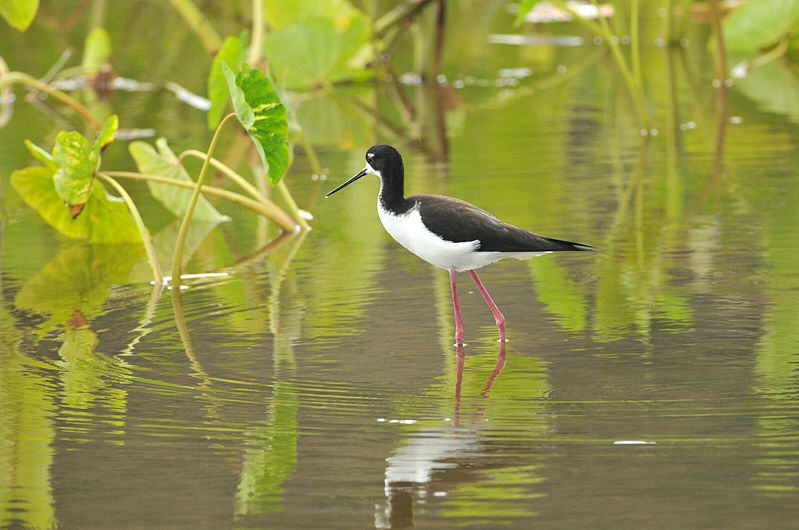
koloa [ko-lo-a]. s. A duck; specifically, a muscovy duck. koloa māpu. n. pintail duck (Anas acuta), a common migrant to the Hawaiian Islands. lit., wind-blown duck. koloa mohā, koloa mōhā. n. shoveler or spoonbill (Anas clypeata), a migrant. lit., bright duck (said to be named for the dark glossy green head of the male). koloa mōhā. n. var. spelling of koloa mohā, shoveler or spoonbill (Anas clypeata)... kolohala [kolo·hala]. pheasant (Phasianus colchicus torquatus), the showy ring-necked pheasant. lit., creep go on. kolokio [kolo·kio]. nvt. method of catching birds by means of a long stick with a crosspiece at the end; flowers were attached and smeared with sticky juice to which the birds stuck. The birds were first attracted by whistling. A bird catcher; to catch thus. lit., creep whistle. kolokio [ko-lo-ki-o]. s. Name of a person who catches by a long rod and bird-lime; kolokio manu o Kaile ka uka nahele o Laa. kololū [kolo·lū]. vi. soft, weak and helpless, as a newborn baby or newly hatched bird; soft and not yet hardened, as a new growth of bone; easily influenced and impressed, as an unstable person. kolo manu. var. of kono manu, to entice a bird, as by imitating its call, and then to snare it; a birdcatcher... ʻauliʻi kolo manudaintiness that attracts birds kolopao [kolo·pao]. n. a bird (no data). konelika, konerisa [kone·lika]. n. kite, a bird. (Bib.) kono₂. vt. to attract the attention of a bird, as by imitating its call, and then to snare it, as with gummed ʻieʻie roots. ʻUaʻu birds were snared thus. see kono ʻelepī, kono manu. kono [ko-no]. To set on, as dogs; to set one against another. See konokono. kono manu. n.v. to entice a bird, as by imitating its call, and then to snare it; a birdcatcher. cf. kono₂. koʻo₂. n. tail feathers, as. of a cock, or as below the tail of the mamo, a bird. koʻo manu₁. n. support for birds; bird islet. koʻo manu₂. n. long tail feathers. koʻo moa₁. n. long tail feathers of a cock. koomoa [koo-mo-a]. s. Koo and moa, a fowl. The long feathers in a cock's tail. adj. Long tailed; waiving like the tail feathers of a cock; long and bent like a cutlass. koʻo moa₂. n. support for chickens. koʻu₁. vi. to cluck. fig., to talk too much. E nuʻu a koʻu ka puʻu.Pile on until the throat clucks [eat all one can]. (saying) waha koʻugabbling mouth (ON 2896) kowaʻe. var. spelling of koaʻe, tropic bird. kū₁. vs. kū pololeito stand straight, sheer, perpendicular, vertical Kū!Whoa! Stop! Halt. E kū iho i hōʻike noʻu.Stand as a witness for me. hoʻokūto set up, make stand, establish, as a society; to brace a canoe with a paddle while sailing or coasting over waves in order to steer and steady the canoe; to carry on, as a family name (Kanl. 25.7) hoʻokū ākeato make known publicly kai kūquiet sea, especially at mid-tide Kū anahulu ka moku.The ship anchors every ten days. Kū i ke kui.Pierced by the needle; punctured by a nail [as a tire]. Kū ʻumi lau kānaka i ka make.Ten four-hundreds of men were struck dead. Mahea ke kaʻa e kū ai?Where will the car be parked? nā kānāwai e kū neiexisting laws Ua hoʻoholo ʻia ke kaula a kū maʻō.The rope was let out as far as over there. ku. v. NOTE.—This word has two distinct meanings and yet they run into each other; as, first, ku to rise up; second, ku to stand. To arise; to rise up, as from a sitting posture. Ioan. 11:29. To stand erect. To rise, as war. 1 Oihl. 20:4. To rise up to do a thing or for a specified purpose. Ioan. 1:2. To stand against; to resist; to act contrary to. Hoo. To excite; to stir up, as an insurrection. To raise up, as an eminent person. Kanl. 18:15, 18. To raise up; to propagate. Kanl. 25:7. v. To stand, i. e., to stop still; to let down, as an anchor (generally written kuu); ku iho la makou ia nei, we anchored (stood, stopped) at this place; to stand against or opposite to. To stand, as a ship, i. e., to come to anchor. Hoo. To cause to stand, i. e., to hold up; to stretch out, as the hand. 1 Nal. 8:22. To be placed or set in a state or condition. Iob. 20:4. Ku i ka wa, to stand in a space (between two parties); hence, to be free; to be uncommitted. 1 Kor. 9:1. kū. n. stand. Niʻihau. see kī kū, kukui kū, set shot, in basketball; floor lamp... Eng. (calque). kualo₂, sualo. n. swallow. Eng. kue₁. interj. call to attract ʻuaʻu, petrel birds, believed in imitation of their sound. kue manu. v. to attract ʻuaʻu, petrel birds, to a net by imitating their call, kue, kue, kue! kūhea manu [kū·hea manu]. n.v. bird imitator; fowler. (Sol. 6.5) kuhukukū [kuhu·kukū]. n. dove, turtledove (Kin. 15.9) ; cooing of a dove. ke leo o ke kuhukukūthe voice of the turtle (Mele 2.12) kuhukuku [ku-hu-ku-ku]. adj. Epithet of a dove, from its noise; manu kuhukuku, a dove. Kin. 15:9. s. A dove. Mel. Sol. 2:12. kūkaeʻiwa [kū·kaeʻiwa]. n. a form of gourd having fruit green with white splotches, still grown on Molokaʻi and East Maui. lit., dung of ʻiwabird. see ipu. kūkae manu. n. bird dung, guano. kūkae ʻuaʻu [kū·kae ʻuaʻu]. n. excreta and scent of ʻuaʻu birds, as left in their holes. kūkū₄ [kū·kū]. n. sea gull (RSV), cuckoo (KJV). (Oihk. 11.16) kuku [ku-ku]. The name of an unclean bird. Oihk. 11:16. Eng. The cuckoo. kukukukū [kuku·kukū]. rare var. of kuhukukū, dove. kukukuku [ku-ku-ku-ku]. s. The name of a bird; a turtle. Ier. 8:7. kukuluaeʻo₂ [kukulu·aeʻo]. n. Hawaiian stilt bird (Himantopus himantopus). Also aeʻo, fig., a thin, long-legged person. [(FJ) PPN *tuli, a wader, probably the pacific golden plover (pluvialis dominica fulva)] kukuluaeo [ku-ku-lu-a-e-o]. s. The name of a bird with long legs. kūkuluaeʻo [kū·kulu·aeʻo]. n. stilt, either the bird or the toy. kula manu. n. gathering place of birds, as near water or food; plain with birds; tree branch that is gummed or smeared to attract birds. hoʻokula manuto make into a bird place Ka wai e haʻakula manu, ka nahele o Kēhua i loa i ke kula o hoʻokula manu.The water that attracted birds, the forest of Kēhua, far on the plains attracting birds. (PH 220) kulukuluaeʻo [kulu·kulu·aeʻo]. same as aeʻo₂, stilt bird. PNP *tuli, PCP *tutul(i,u). kunuko. n. junco, a kind of bird. also manu kunuko. Eng. kūolokū [kū·olokū]. nvi. trilling song of a bird; to warble, trill. Kūolokū ka leo o ka manu kani leʻa.The voice of the bird singing joyfully is trilling. kūolokū [kū·olo·kū]. see manu kūolokū, warbler... kuoloku [ku-o-lo-ku]. v. See kuolo. To sing like a bird. s. The voice or song of a singing bird; kuoloku ka leo o ka manu kani leo. kūʻululū [kūʻulu·lū]. vs. chilled, shivering with cold; shy, abashed. Kūʻululū ka hulu o ka manu i ka ua pehia mai ma ka pali.Feathers of the bird are chilled by the rain beating down on the cliff. (dance) kuululu [kuu-lu-lu]. v. To be cold; to be contracted with cold; to shiver with the cold. adj. Cold; shivering with cold; chilled; hence, Fearful or abashed; kuululu na kahu ia oe i ke kahuna. kuwā₁. vi. to make a din, talk loudly, resound. See wā₃ and chant, kūmaumau₃. He leo paha no ka ʻiʻiwi e kuwā nei.Perhaps voices of ʻiʻiwi birds making a din.
Llaʻahia [laʻa·hia]. pas/imp. of laʻa₁, ₂, sacred, holy, devoted...; cursed, defiled... ʻAʻohe kani leo o nā manu o Olaʻa, ua laʻahia au me ke kuhi hewa.The voices of the Olaʻa birds sing no more, I am cursed by illusion [or: I have held myself apart for an illusion]. (song) laahia [la-a-hi-a]. v. Laa and ia, passive, h inserted. See laa, adj., 2. To be involved in what others do, especially of evil. To be reproached for others' faults on account of living or associating together; inu rama oe a laahia ma ka hewa makou i ka hohonu ia oe. lāʻau₁ [lā·ʻau]. nvs. hoʻolāʻauto form mature wood, as of a shrub; to gather in trees, as birds kumulāʻautree Ua hele ke kino ā lāʻau.The body is stiff in rigor mortis. laau [la-au]. s. A general name for what grew out of the ground; o na mea e ulu ana ma ka honua ua kapaia he laau. Wood; trees; timber; but not often fire-wood, which is wahie. A forest; a thicket of trees; ka mea ulu ma na kuahiwi. FIG. Strength; firmness; hardness. Laau palupalu, herbs; tender vegetables. Mat. 13:32. lāʻau kia. n. stick for snaring birds. cf. kia manu. laehina [lae·hina]. same as noio, a tern. lit., white brow. lae mamo. n. Mamo (bird) brow, a derisive name for kauā, outcasts, perhaps because the mamo, like some kauā, has a black mark on its brow (the yellow feathers of the mamo were prized, not the black). lahalaha [laha·laha]. redup. of laha₁, extended, spread out... also said of a hen covering her chickens with her wings. [(MP) PPN *lafa-lafa, flat and/or broad] hoʻolahalaharedup. of hoʻolaha lele hoʻolahalahato soar in the air with outspread wings; to hover without perceptible wing movement lahalaha [la-ha-la-ha]. v. The 13th conj. of laha. To spread out much or often. Hoo. The same; also, to open, as the wings of a bird in order to fly. To brood over or upon, as a bird upon a nest. laʻi. nvs. calm, stillness, quiet, peace, contentment, tranquillity; solace; serene, as of sea, sky, wind; quiet, silent, peaceful, pacific, tranquil, contented; to find peace. See ex., forecast. [(OC) PPN *laki, the westerly quarter; wind from that quarter and weather associated with it] hoʻolaʻito cause to be still; to poise aloft, as a bird; to quiet, as a mob; to cease talking; calm; peaceful, quiet ka laʻi o Hauola"Peace and comfort. There is a stone in the sea at Lahaina, Pōhaku o Hauola, where pregnant women went to sit to ensure an easy birth..." (ON 1425) Pō laʻi, ʻihiʻihi ē.Silent night, holy. lai. Any calm still place; e noho mai a i ka lai o Lele. Still, as water; pohu, malie o ka lai. See malino. Any still, silent place; he wahi mehameha, hakanu. v. To be calm; to make no noise; to be silent; ua lai loa ia po, it was very still that night. Hoo. To quiet; to appease, as a mob. Oih. 19:35. To be quiet, as the elements. adj. Calm; still; quiet; shining, as the surface of the sea in a calm. A calm still place in the sea where there is no ripple and the sea is like a looking-glass. laka₃. n. lark. Eng. laka [la-ka]. The name of a species of bird, perhaps; kani ka laka. Lalaʻo ka ʻikena i ka manu.See the bird all the time, as though in the eye. (song) lale₂. n. legendary bird mentioned in old tales and songs as a sweet singer. lale [la-le]. s. Name of a species of bird. lalu, laru. n. name of a ravenous sea bird, perhaps a gull (RSV); cuckoo (KJV). Gr. laros. (Kanl. 14.15) lau₆. n. thatched mountain hut, as used by farmers, canoe-makers, birdcatchers. laukanaka, laū kanaka [lau·kanaka]. nvt. densely populated, having many people; many people; to populate. hoʻolaukanakato have many people about one; to dispel loneliness with people I laukanaka au i nā leo kūpinaʻi.That I peopled with echoes. (Kel. 61) Ka manu hoʻolaukanaka, o ia uka ʻiu ano.The bird that dispels loneliness in that far, quiet upland. (song) laukanaka [lau-ka-na-ka]. s. See lau and kanaka, people. A place of people; where people live; laukanaka ole, a solitary place. laukia manu. fowler (EH) laukoa [lau·koa]. vi. to feather out, as young birds. hoʻolaukoasame as laukoa I malumalu ai kāna pūnua i manaʻo ai e hoʻolaukoa.To shelter their fledglings which they expect to feather out. (chant for Kawānanakoa) laukoa [lau-ko-a]. v. To be hatched out, as the eggs of any kind of fowls; pehea ka oukou mau hua? Ua laukoa, e lele auanei. lauwī [lau·wī]. same as ʻalauahio, a bird. lauwi [lau-wi]. s. Name of a species of bird, small and yellow; same as the alauwahio. lawa₆. vs. white, as of a cock or dog. moa lawa, moa lawa keawhite cock lawa [la-wa]. A white fowl; he moa keokeo; such as was offered in sacrifice. Laieik. 49. White; shining; he moa lawa, a white fowl. Laieik. 14. lawaiʻa₂. n. cormorant. (Oihk. 11.17) lawaia [la-wa-ia]. The cormorant, a bird that feeds on fish; an unclean bird. Oihk. 11:17. lawaiʻamanu [lawaiʻa·manu]. n. birdcatcher, birdcatching with a net. lit., to fish birds. lawaiamanu [la-wa-ia-ma-nu]. s. See lawaia, v., and manu, a bird. A hunter and catcher of birds; a fowler. Hal. 124:7. NOTE.—Catching birds was formerly practiced to a great extent on the mountainous parts of the islands. lawa uakea. white (as a chicken) (EH) lawekeō [lawe·keō]. interj. cry of the kioea, curlew bird: 'Kioea, kioea, lawekeō, lawelawekeō'. lawekeo [la-we-ke-o]. s. The song of a species of bird found on Molokai; kani mai la ua manu la, penei: kioea, kioea, lawekeo, lawelawekeo. lehua hāmau [lehua hā·mau]. poetic reference to the lehua tree. lit., silent lehua, so called because bird-catchers were silent when snaring birds on branches of this tree and this activity was taboo. lehuahamau [le-hu-a-ha-mau]. s. A species of the ohia ha, on the blossoms of which the birds feed. lehua mamo. n. a form of ʻōhiʻa lehua tree with yellow flowers. lit., mamo-bird lehua, so called because the mamo has yellow feathers. leleaoa [lele·aoa]. vi. flying away in groups, as migratory birds; to fly thus; to sail, as a canoe fleet. leleaoa [le-le-a-o-a]. s. The act of sailing rapidly away in a canoe or ship to another land. lele koaʻe₁. nvi. flight of tropic birds; to fly like a tropic bird. fig., sheer, steep. see koaʻe₁. lele manu. flight of birds (EH) lepe₂. n. rooster comb; turkey wattles. PCP *lepe. lepe [le-pe]. s. The comb of a cock; he kipaku o ka moa kane. lewa nuʻu. n. space in the heavens lower than the lewa lani; atmosphere reached by birds. lewanuu [le-wa-nuu]. s. Lewa and nuu, a high even place. Some indefinite place on earth, generally connected with or opposed to lewalani. liʻo₁. n. same as ʻaʻo, a sea bird. lio [li-o]. A species of bird. liʻo₂. same as liʻoliʻo₂, the sound made by the liʻo (ʻaʻo) bird. lio [li-o]. To utter a sound as the bird ao screams as it flies. liʻoliʻo₂ [liʻo·liʻo]. var. of liʻo; name of the sound made by the ʻaʻo bird; to call thus. liolio [li-o-li-o]. s. The sound or scream which the bird ao makes when disturbed, when she bristles like a hen with chickens. s. The name of a small bird. lopine. n. robin. Eng. luapoʻi [lua·poʻi]. n. prey. cf. poʻiiʻa. He luapoʻi ka ʻiole na ka ʻio.Mice are a prey of the hawk. lupe₁. n. kite. Four types of lupe were said to exist; lupe lā, a round kite, lit., sun kite; lupe mahina, kite with tapa covering cut in a crescent shape, lit., moon kite; lupe manu, kite with wings on the side, lit., bird kite; lupe maoli, kite suggestive of European kites in shape, lit., genuine kite. cf. kaʻiālupe. PPN *lupe. lupeʻakeke [lupeʻa·keke]. n. Hawaiian stormy petrel (Oceanodroma castro cryptoleucura). also oeoe. lupeakeke [lu-pe-a-ke-ke]. s. The name of a bird; the sea eagle.
Mmaʻakū [maʻa·kū]. vt. to sling with a sling and stone. Ua maʻakū aku lāua i ka manu.They slung a stone at the bird with the sling. maiʻa koaʻe. n. a Hawaiian variety of banana, beautifully striped leaves, trunk, and young fruit. Fruit is yellow and round; flesh yellow, edible cooked or raw. Also called maiʻa aʻeaʻe, maiʻa manini. lit., tropic bird banana. (HP 177) maiʻao. n. nail of finger or toe; hoof of an animal; claw of a bird. [(NP) PPN *maʻi-kao, finger, toe] maiao [mai-ao]. s. A toe or finger nail; the hoof of a beast; the claws of a bird or animal. See maiuu. maile₂. n. maile sticks attached to the end of the ʻaukuʻu (pole) used for catching birds (the maile was gummed with lime, and birds perching on it were caught); name of a snare used in catching plovers around the leg; rod or wand used in the games of pūhenehene and ʻume; piece securing an ox's neck to the yoke. mākaʻi₂ [mā·kaʻi]. [mān] also manu ʻulaʻula, cardinal, redbird makapā₁ [maka·pā]. vs. feeble, of light, as firelight in the daytime; shy, wild, as a bird. makapa [ma-ka-pa]. v. To be shy; to run away, as an untamed animal; e hoeno mau ia, he meo. s. One who goes about from house to house or goes here and there; he holoholo kauhale. mākole [mā·kole]. manu wiliō mākole. red-eyed vireo. mākūkoaʻe [mā·kū·koaʻe]. n. tropic bird phantom, a poetic name for death and the spirit of death; to hover, of this bird; also similar to akua hoʻounauna. Ua mākūkoaʻe ʻoia.The tropic bird phantom hangs over him [he is dying or the victim of sorcery]. makukoae [ma-ku-ko-ae]. s. The state of one just dying, formerly worshiped as a god. mālī [mā·lī]. n. mallee bird, of Australia. also manu mālī. Eng.
mamo₂. n. safflower or false saffron (Carthamus tinctorius), a branching annual, 30 to 120 cm high, from Asia, grown for its flowers, which are yellow, like the feathers of the mamo bird. (Neal 858) mamo [ma-mo]. The name of a tree with beautiful blossoms; he pua nani, he laau. manu₁. n. bird; any winged creature; wing of a kite. fig., person. [(MP) PPN *manu, living creature (excluding humans, fish)] ʻAi ka manu i luna.The birds eat above. [a poetic tribute to a handsome person, likened to an ʻōhiʻa tree with birds eating its lehua blossoms] He aha kāu i piʻi aku nei i ka lapa manu ʻole?Why did you climb the ridge without birds [go on a wild-goose chase]? he manu hulua feathered bird [a prosperous person] (ON 803) he manu hulu ʻolea featherless bird [a poverty-stricken person] ka nui manuthe people, the many people manu. n. bird. manu [ma-nu]. s. The general name for fowls or the feathered tribe. Kin. 1:20. All winged feathered animals; na mea eheu e lele ana. manu ʻaihue [manu ʻai·hue]. n. partridge. lit., thieving bird. (Ier. 17.11) manuaihue [ma-nu-ai-hu-e]. s. Manu, bird, and aihue, to steal. The thievish partridge. Ier.17:11. manuʻailaiki [manu-ʻai-laiki]. n. ricebird (Lonchura punctulata), introduced from the Malay Peninsula in about 1865. lit., rice-eating bird. manuʻaimīkana [manu-ʻai-mī·kana]. n. linnet, house finch, or papaya bird (Carpodacus mexicanus frontalis), introduced before 1870. lit., papaya-eating bird. also manuʻaipapaia. manuʻaipapaia [manu-ʻai-papaia]. n. linnet, house finch, or papaya bird (Carpodacus mexicanus frontalis), introduced before 1870. lit., papaya-eating bird. also manuʻaimīkana.
manu aloha₁. n. lovebird. manu aloha₂. n. parrot, so called because it extends greeting (aloha). manuhekili [manu·hekili]. n. thundercloud. rare. manu helekū. n. var. spelling of manuhelekū, penguin. lit., bird that walks upright. manuhelekū, manu helekū. n. penguin. lit., bird that walks upright. manu heu. vi. to feather out, of young birds. fig., to leave home, as young people. manuheu [ma-nu-he-u]. s. Manu and heu, wing. A breaking up; a flying away; a setting at variance, as a people; civil commotion or contention. manu hū. n. hummingbird. lit., bird (that) hums. manu huhū. n. wild, ravenous bird. lit., angry bird. (Isa. 46.11) manuhuhu [ma-nu-hu-hu]. s. Manu and huhu, angry. A wild ravenous bird. Isa. 18:6 and 46:11. manu humuhumu [manu humu·humu]. n. tailorbird. manu ʻinikō [manu ʻini·kō]. n. indigo bunting. lit., indigo bird. manu ʻioʻio. n. swallow. lit., chirping bird. (Ier. 8.7) , (Isa. 38.14) . manuioio [ma-nu-io-io]. s. Manu, bird, and ioio, to peep. Name of a small bird; a swallow perhaps. Ier. 8:7. manu ʻīpiki [manu ʻī·piki]. n. ibis, a flightless bird in prehistoric Hawaiʻi. Eng. manu kālā [manu kā·lā]. n. sparrow. Niʻihau. manu kamaʻāina. native birds (EH) manu kapalulu [manu kapa·lulu]. n. California valley quail (Lophortyx californicus californicus), an early introduction, common in the 1890s. lit., whirr bird. manu kelaka. n. thrasher, a bird related to the thrush. manu keluka. n. thrush. lit., thrush bird. manu keluka ululāʻauwood thrush manu kikakī [manu kika·kī]. n. chickadee. manu kū. n. dove, including Chinese dove (Streptopelia chinensis); rock or wild pigeon (Columba livia). lit., coo (Eng.) bird. manu kūolokū [manu kū·olo·kū]. n. warbler. lit., warbling bird. manu lawaiʻa. cormorant (EH) manu lawe ʻia mai. introduced birds (EH) manulele [manu·lele]. n. a native variety of sugar cane, the stems green striped with yellowish and reddish brown, the pith brown, the leaves purplish. Used medicinally, also in love sorcery. lit., flying bird. (HP 221), (Neal 79). see ex. kāʻawe. manu liʻiliʻi [manu liʻi·liʻi]. n. English sparrow; European housefinch (Passer domesticus); introduced before 1870; little bird. (Hal. 102.7) manu mai nā ʻāina ʻē. introduced birds (EH) manu mākaʻi [manu mā·kaʻi]. n. cardinal. [mān] also manu ʻulaʻula. manu malihini. introduced birds (EH) manu mele. n. songbird, especially canary (Serinus canaria). cf. kenele. manu mūkīkī [manu mū·kī·kī]. n. honeycreeper, general term. lit., bird (that) sucks. manunēnē [manu·nē·nē]. n. possibly a local name for a small sedge (Cyperus brevifolius). lit., goose bird. see kiliʻoʻopu. manu nūhata [manu nū·hata]. n. nuthatch, a kind of bird. manu nūnū [manu nū·nū]. n. dove. lit., cooing bird. (Hal. 55.6) manu nūnū lawe leka. n. var. spelling of manunūnūlaweleka, carrier pigeon. lit., dove carrying letters manunūnūlaweleka, manu nūnū lawe leka [manu-nū·nū-lawe-leka]. n. carrier pigeon. lit., dove carrying letters (Eng.). manu o kahiki. migratory birds (EH) manuokū [manu-o-Kū]. n. white tern, fairy tern, love tern (Cygis alba rothschildi), a small, friendly sea bird, pure white except for a black ring around the eye. lit., bird of Kū. Niʻihau. manu ʻoliō [manu ʻoli·ō]. n. oriole. manu pae. migratory birds (EH) manu palamiko [manu pala·miko]. n. flamingo. also palamiko. manu palekaiko [manu pale·kaiko]. n. bird of paradise, the bird. cf. pua manu. manu pao lāʻau [manu pao lā·ʻau]. n. woodpecker. lit., bird (that) pecks wood.
manu pīuīlāʻau [manu pī·uī·lā·ʻau]. n. wood peewee, a kind of bird. manu pōpoki [manu pō·poki]. n. catbird. manu pupē. n. puffin. also pupē. Eng. manu ʻū. n. crane. lit., groaning bird. (Ier. 8.7) manuu [ma-nu-u]. s. Name of a bird; perhaps a crane. Ier. 8:7. manu ʻulaʻula. n. cardinal, redbird. lit., red bird. manu ʻulaʻula [manu ʻula·ʻula]. n. cardinal. also manu mākaʻi. manu wiliō [manu wili·ō]. n. vireo, a kind of bird. manu wiliō mākolered-eyed vireo maʻo₅. same as ʻōmaʻo, thrush. [(NP) PPN *mako, a small land-bird] maʻoha. vs. grayish, especially when contrasted with black, as of bird feathers, cloud-capped mountains, graying hair. Ka ʻiwa he manu nui ia, he ʻeleʻele kona hulu, he maʻoha kahi hulu.The ʻiwa is a big bird, its feathers are black, some are gray. maoha [ma-o-ha]. adv. Appearing gray or whitish, as tops of mountains at a distance; kupu maoha ke kilakila o na kuahiwi; applied also to a person when he begins to grow gray. adj. Grayish, as the whitish feathers of a black bird; ka iwa, be manu nui ia, he eleele kona hulu, he maoha kahi hulu. An affectionate salutation between persons for some time absent. -māpu. see koloa māpu, pintail duck... māpumāpu [māpu·māpu]. redup. and intensifier of māpu. ʻO ka ʻio lele māpumāpu.The hawk that flies swooping. (For. 6:381) mapumapu [ma-pu-ma-pu]. v. See mapu. To fly upwards; to float off in the air. s. A rising upward; a moving off; o ka mapumapu aloha o Waialoha e. mea lele. n. bird, flying insect. meamea₁ [mea·mea]. redup. of mea₄, to say... hāʻawi hoʻomeameato pretend to give [with the intention of taking back] hoʻomeameacaus/sim.; to bluff, pretend, disguise meamea₂ [mea·mea]. redup. of mea₇, reddish-brown... He manu hulu meamea ʻo Keawe.A yellow-feathered bird is Keawe. meamea [me-a-me-a]. adj. Yellowish; whitish; ke poae ula, ke koae nui hulu meamea. meʻeu. vi. rising up; to rise up, as from sitting; to start up, as a frightened bird; to rise, as hair in terror; startled. ʻAkahi au ā ʻike, ka meʻeu hoʻi o kuʻu oho.I've never felt my hair rise in terror like this before. (chant for Kalākaua) meeu [me-eu]. v. To jump; to run; to fly; to run away. mio₁. nvi. E holo pololei ai kona waʻa ma ka mio a ke kai.His canoe sails straight with the current of the sea. (Nak. 114) ʻIo o mio lani.Hawk disappearing into the sky. (For. 6:395) Maʻō i mio aku nei.Went swiftly that way. Ua mio ʻia aku nei ke kālā a Paulo.Paul's money was quickly stolen. mio [mi-o]. To wallow; to roll; to tumble about in the water; to sink out of sight. To move easily; to move softly; to make no noise. E kio, e mohai ke ananio, e hai ke anau. To flow strongly and swiftly, as water confined in a narrow channel. s. A place where a stream of water is confined within very narrow bounds, and hence runs very swiftly, like water in a millrace. The flowing or running of water on the above condition. The moving of the arm in water, as in swimming. moa₁. n. chicken, red jungle chicken (Gallus gallus), fowl, as brought to Hawaiʻi by Polynesians; for some people, an ʻaumakua. [PPN *moa, fowl (gallus gallus)] moa ʻawapuhiginger chicken (NKE) moa laiki loloachicken long rice (NKE) ʻO luna, ʻo lalo, ʻo uka, ʻo kai, ʻo ka moa kona a me Kākuhihewa.Above, below, inland, seaward, the chicken is his and Kākuhihewa's. (For. 4:510) [moa here probably represents supreme rule: cf. Kawelo's chant, below: ] cf. (ON 2504, 2505) He liʻi ka moa, kau ana ka moa i luna o ka hale.The chicken is a chief, the chicken perches at the top of the house. (FS 101) moa [mo-a]. s. A fowl of the hen species; moa kane, a cock; moa wahine, a hen. moa kākala [moa kā·kala]. n. cock with sharp spurs. fig., warrior who is a good fighter. moakakala [mo-a-ka-ka-la]. s. Moa and kakala, points; spurs. A cock with sharp spurs; he moa kane, ua wini kakala. moa kāne. n. rooster, cock. lit., male chicken. moa keiki. little chicken (EH) moakinana [mo-a-ki-na-na]. s. Moa and kinana, a hen. A hen that has laid eggs; he moa wahine i hanau i na hua. moa kuakahi [moa kua·kahi]. n. first cock crow. lit., chicken rising first. also moa kū kahi. cf. moa kualua, second cock crow. moa lawa. same as moa mahi, fighting cock. fig., successful warrior...; white chicken (EH) moa mahi. n. fighting cock. fig., successful warrior. moamahi [mo-a-ma-hi]. s. A cock that conquers. A conqueror of any kind. moa nēnē [moa nē·nē]. n. speckled chicken, so called because of resemblance to the nēnē, goose. moa pua hau. n. a chicken with yellow feathers. lit., hau-flower chicken. moa uakea. chicken (white) (EH) mōhā₂ [mō·hā]. see koloa mohā, kind of duck...
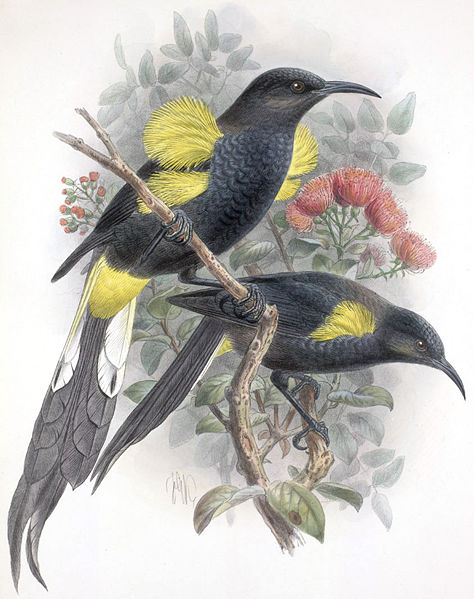
moho [mo-ho]. s. Name of a species of bird; he moho ka mea kani iloko o ka weuweu, the moho is a bird that crows in the grass; it seldom flies, but walks about. mohoea [moho·ea]. same as moho₂, Hawaiian rail (Pennula sandwichensis), an extinct flightless bird... moho lele ʻole. n. flightless rail. lit., nonflying rail.
moli [mo-li]. The name of a large bird. mū₉. n. name of a small, yellow bird (no data). mu. Name of a small bird with yellow feathers; he mu kekahi manu, he lena kona hulu. mūheʻe koaʻe [mū·heʻe koaʻe]. n. pearl-shell lure with three streaks like those in the tail of the koaʻe bird. muimuia₁ [mui·muia]. pas/imp. of muimui, redup. of mui₁, assembled, mui₂, silent...; var. of muli, after, behind... He kumu lehua muimuia i ka manu.A lehua tree covered with birds [an attractive person]. (ON 713) muimuia [mu-i-mu-i-a]. v. Passive of muimui. To be collected together; to be in a compact mass. mūkī [mū·kī]. nvi. sucking noise made by pursing the lips and expelling or drawing in the air, as in kissing; to play on the hōkiokio, wind instrument; to squirt water through the teeth; to suck into the mouth, as when lighting a pipe; to sip, as birds sip honey. cf. mūkā. Ka poʻe mūkī.People that peep [as wizards]. (Isa. 8.19) Lele aku ai e honi iāia, ā hāʻawi i nā mūkī hoʻomaʻūmaʻū ʻana o ke aloha.Leapt up to kiss her and give moist smacks of love. (Kahala 103) muki [mu-ki]. v. To apply the lips or mouth to; to kiss; e muki baka, to kiss or suck the tobacco pipe; to take a whiff of tobacco smoke; e muki i ka wai, to squirt water through the teeth. To peep; to speak indistinctly, as an enchanter. Isa. 8:19. SYN. with namu. To play on the hokiokio or pipe, a wind instrument. mukiki [mu-ki-ki]. v. See mukii. To suck into the mouth, as in smoking. To suck in or drink, as water; to swallow up. To drink or sip water, as a bird drinks from a flower. To squirt water through the teeth. To make mouths at one. Mukiki ka ia lelehuna a ka manu, Ka awa ililena i ka uka o Kaliu, Ka manu a haihai kanu awa—e— Aia ka laau ka awa o Puna, Mapuna wale mai ana no kona aloha la. s. A mouth made at one as a matter of reproach; hoomaka ko oukou mukiki i mea henehene, a i mea akaaka. mūkīkī₂ [mū·kī·kī]. manu mūkīkī. honey-creeper, general term. lit., bird (that) sucks. mulei₁. n. bird name (no data).
Nnanahea [nana·hea]. vs. animated, as birds; lively. cf. ʻīnana. rare. nanana₁. vi. to flutter, as wings. cf. nana₂. hoʻonananacaus/sim Hoʻonanana ka manu e lele.The bird flutters its wings to fly.
nene [ne-ne]. s. A goose, a species of which is found on the high lands of Hawaii. nēnē₆ [nē·nē]. probably same as nēnē ʻau kai, sea gull nēnēʻau kai. n. var. spelling of nēnē ʻau kai, sea gull... niku₂, nisu. n. hawk. (Oihk. 11.16) noio. n. Hawaiian noddy tern (Anous tenuirostris melanogenys), smaller than noddy tern; subspecies is widespread in the Central Pacific. also ʻekiʻeki, laehina. [(CE) PPN *ŋoio, common noddy (anous stolidus) (clk): *go(o)io] noio [no-i-o]. s. Name of a small black bird that lives on fish. nūhata [nū·hata]. see manu nūhata, nuthatch, a kind of bird... nui₁. nvs. big, large, great, greatest, grand, important, principal, prime, many, much, often, abundant, bulky; plenty, a lot, maximum, most, size, number, amount, bulk, volume, magnitude, quantity, dimension, extent, area, entirety, greater part, enough, sufficiency. Before a noun, nui may mean ‘group’, as nui manō, group of sharks, or nui manu, flock of birds. cf. ʻano nui, haʻanui, hapa nui, mea nui, nui kino. [(NP) PPN *nui, big] Aloha nui loa, aloha ā nui.Very much aloha. [common salutations to letters] hoʻonuito enlarge, increase, multiply, magnify, exaggerate, add to, dilate; multiplication; to increase in volume, of music; crescendo mark in music hoʻonui ʻōlelowordy, verbose, padded, prolix; to exaggerate, boast, enlarge on the truth; to talk excessively Ka nui mai auaneʻi kona kino.What a large body he has. Nui ʻino lākou.They were very many. nui loa, nui ʻino, nui hewahewavery much or many, abundant, too much, very large, immense, huge nui lua ʻoleimmeasurably large, tremendous Ua hele nui aku nei i kahakai.The many of them went to the beach. Ua hoʻi aku nei ka nui kamaliʻi.The great part of the children have returned. nui. n. dimension, in math. also ana. nui [nu-i]. v. To be great; to increase in size; to swell; to be more; to enlarge; to raise, as the voice; heaha kou mea e nui nei kou leo? Laieik. 22. Hoo. To add to; to increase; to multiply. Isa. 59:12. To magnify; to extol, as one's kindness. Kin. 19:19. Haa. To speak proudly; to vaunt; to brag. s. Size; increase; multitude; magnitude; greatness; fullness. NOTE.—Nui often takes ke for its article instead of ka; aole paha o ke nui o na kino wale no. nūkea₁ [nū·kea]. same as ʻalae kea, Hawaiian coot, a marsh and pond bird... nukea [nu-ke-a]. adj. White, as the white billed alae. NOTE.—The alae is of two varieties, the white bill and the red bill. Muku, keokeo, alae nukea. nūkea₂ [nū·kea]. vs. white-beaked, as the nūkea bird; white around the mouth or snout, as an aging animal. ʻO ka lani ka hiapo kama kapu, ka hānau mua i Hawaiʻi, ka ʻīlio nūkea ma ka lanithe chief is a sacred first-born one, the first born in Hawaiʻi, the white-mouthed dog in the heavens [probably clouds indicative of a chief]. (chant) nuku₄. n. see below for nuku sequences as names of taros, a legume, sweet potatoes, jackfish, and birds. nuku ʻekue. n. King Kong finch (Chloridops regiskongi). see hona, ʻainohu Kauō, ʻainohu Nīhoa. nuku manu₁. n. bird's beak. nuku manu₂. n. a variety of taro. The corm is pointed like a bird's beak. Used on Kauaʻi only. nuku peu. n. name of a bird (no data); perhaps same as nuku puʻu. nukupuʻu. n. var. spelling of nuku puʻu₁, group of Hawaiian honey creepers (Hemignathus lucidus lucidus... nūnū₁ [nū·nū]. n. introduced rock pigeon or wild pigeon (Columba livia); dove. see saying, dove. (Mele 2.14) nunu [nu-nu]. A dove; a pigeon from the noise they make; nunu opiopio, a young pigeon. Oih. 1:14. An endearing epithet like my dear chicken. Mel. Sol. 2:14. nunulu. vi. nunulu [nu-nu-lu]. v. To sound, as the singing of birds; to chirp; to sing, as a bird; to warble. To grunt; to growl. See mele below. I ka leo o ka manu—a— E nunulu mai ana—a— E nonolo mai ana—a. nūpolupolu [nū·polu·polu]. vs. scattered, thick, as flowers. ʻO aʻu lehua i ʻaina e ka manu a māui i ke kai, nūpolupolu akula i ke kai o Hilo.My lehua blossoms picked by the birds and bruised by the sea, scattered there on the sea of Hilo. (prayer to Kapo)
Oʻoā₃, ʻowā₃. nvi. cry of the ʻaukuʻu, heron, which suggests ʻoā; to cry thus. oeoe₃ [oe·oe]. same as lupeʻakeke, a bird, Hawaiian stormy petrel. [(CE) PPN *oi, petrel sp] ʻōhā kēpau [ʻō·hā kē·pau]. n. a native lobelia (Clermontia hawaiiensis), a shrub or small tree; the gum was used to catch birds which yielded feathers for featherwork. lit., gum ʻōhā. also ʻōhāhā wai nui, ʻōhā wai nui. (Neal 816–7) ʻohana manu. brood (of birds) (EH) ʻohelo huki manu, ʻōhelo huki manu [ʻo·helo huki manu]. n. flexible gummed rod used for extracting ʻuaʻu fledglings from their holes. lit., rod for pulling birds. ʻōhelo huki manu. n. var. spelling of ʻohelo huki manu, flexible gummed rod used for extracting ʻuaʻu fledglings from their holes. lit.... ʻōhiʻa ʻāpane [ʻō·hiʻa ʻā·pane]. same as ʻōhiʻa lehua except that the blossom is dark-red. Perhaps the name refers to the redness of the ʻapapane, a bird. ohi moa wahine. pullet (EH) ʻōhinu₁ [ʻō·hinu]. nvs. shiny, greasy; piece of roasted meat; roast; grease. [(??) PPN *koo-sinu, ?? (problematic)] Ka ʻōhinu lele uahi manu ē.The grease coming from the bird smoke. (chant) ohinu [o-hi-nu]. s. The piece of meat roasted as above, or a piece for roasting. 1 Sam. 2:15; Isa. 44:16. Ka ohinu Iele uwahi manu e O ka manu ai leleu. The name of the stick which turns while the meat is roasting. oho₂. nvi. hoʻōhoto exclaim, cheer, shout, halloo. cf. hoʻōhooho below and kiko hoʻōho (Puk. 24.3.) ke oho ʻālanathe proclaimed offering (For. 6:377) ʻōlelo hoʻōhointerjection, exclamation, whoop oho [o-ho]. v. To cry out; more often hooho; to exclaim, cry out, as many voices; to cry out, exclaim, as a single voice; hooho ae la ia leo nui, a pane mai la ia me ka hooho ana, auwe! pau! See hooho. To cry out, as a flock of birds on being frightened; oho ae la ka auna manu i ka ilio. ʻoio. rare var. of noio, a tern. oio [oi-o]. Name of a species of small bird. ōkea₃ [ō·kea]. n. a bird. (KL. line 432, no data) ʻōkū₄ [ʻō·kū]. n.v. live bird used as decoy; to decoy. rare. oku [o-ku]. To set a bird near a snare to catch or tempt another; e hooku aku i ke poo, e oku aku i ka lima. ʻōkuʻu₁ [ʻō·kuʻu]. vi. hoʻōkuʻuto cause to squat, crouch, perch; to crouch, perch okuu [o-kuu]. v. To sit up because one has no place or conveniences for lying down; to sit up, as one on the deck of a vessel when the water dashes over, because it is better than to lie down; the idea is to keep the head up. To sit in a meditating posture with the head reclined. To sit with a covering over the shoulders, and arms across the breast, as if cold. ʻōkuʻu₄ [ʻō·kuʻu]. n. a method of catching birds by gumming artificial lehua blossoms made of leʻie to a tree. ʻolēhala [ʻolē·hala]. n. cheerful singing, as of birds in treetops. rare. ʻoliō [ʻoli·ō]. see manu ʻoliō, oriole... oloʻa. n. reported as a bird name (no data). olokē [olo·kē]. vs. clamorous, incoherent, excited in speech or sound. cf. holokē. Olokē, oloolokē, piʻoloke ka leo o ka palila.Agitated, agitating, frightened the cry of the palila bird. oloke [o-lo-ke]. adj. Clamorous and incoherent, as the constant talk of one deranged; oloke ka waha. See pioloke. olokele hōkiʻi [olo·kele hō·kiʻi]. n. immature olokele, bird. olokele pōpolo [olo·kele pō·polo]. n. immature olokele, bird. olomaʻo [olo·maʻo]. n. the endangered Lānaʻi thrush (Phaeornis obscura lanaiensis), and Molokaʻi thrush (Phaeornis obscura rutha). [(CE) PPN *koro-mako, bird sp., a honey-eater] ʻōmaʻo₃ [ʻō·maʻo]. n. Hawaiʻi thrush (Phaeornis obscurus obscurus). [(CE) PPN *koo-mako, a kind of bird, honeyeater sp] omao [o-mao]. s. Name of a species of small bird; it resembles the ou only; its feathers are dark colored. ʻonoʻū. same as ʻōʻū, the bird. onou [o-nou]. s. The name of a small bird; o ka onou he manu eleele ia.
ʻōʻō ʻāʻā. n. the endangered Kauaʻi species of ʻōʻō, honey eater (Moho braccatus); on Hawaiʻi, said to be the name for the male ʻōʻō. lit., dwarf ʻōʻō. ʻōʻō kūpīpī [ʻōʻō kū·pī·pī]. n. a name for the female ʻōʻō, honey eater. Hawaiʻi. ʻoʻolomaʻo [ʻoʻolo·maʻo]. n. variety of bird, perhaps the maʻo, thrush. oʻoʻō, ʻoʻoʻō. redup. of ʻoʻō, to crow. ʻoʻoʻō. var. spelling of oʻoʻō, to crow... ʻōpaʻipaʻi₂ [ʻō·paʻi·paʻi]. n. a sea gull (very rarely seen). ʻōpeʻapeʻa₂ [ʻō·peʻa·peʻa]. n. bat. [(CE) PPN *koo-peka, swiftlet, a kind of bird] lele ʻōpeʻapeʻato fly like a bat, i.e., to flutter wings, as would a frightened bird. opeapea [o-pea-pea]. s. A bat, an animal between fowls and quadrupeds. Kanl. 14:18. So called from the shape of the wings being similar to the ancient sails (pea) of their canoes. ʻōpū₁ [ʻō·pū]. n. Mahola aʻela ka ʻōpū o ka ʻupena.The bag of the net opened out. ʻO kuʻu ʻōpū, ʻo kuʻu ʻōpū! Ua hoʻokaʻawili ʻia au ma kuʻu naʻau.My bowels, my bowels! I am pained at my heart. (Ier. 4.19) opu [o-pu]. s. A protuberance with an enclosure, as the belly, stomach, bladder, &c.; as, opu o ke kai, the heart, belly (midst) of the sea; the crop of a bird. Oihk. 1:16. The maw of animals. Kanl. 18:3. The womb. Lunk. 16:17. A round, liver-like substance in the hog and other animals. ʻōpū ʻaiʻai. n. stomach; craw, as of a bird. ōpuhe [ō·puhe]. n. finch, general term. see English entries under finch. Kaulana ka pae moku ʻo Galapagosa no ka nui a me ka laulā o nā ʻano manu ōpuhe o ia wahi.The Galapagos Islands are famous for the many and varied types of finches that are found there. ōpuhe pao lāʻauwoodpecker finch ʻou₂. n. Bulwer's petrel (Bulweria bulwerii), a small sea bird; for some people, an ʻaumakua. also ʻouʻou. ʻōʻū₂. vi. to perch, as on a tree. fig., lazy. hōʻōʻūto cause to perch ʻŌʻū ō loa nā manu o Kaupeʻa.The birds of Kaupeʻa [sing] long as they perch. (chant)
ʻAuhea wale ʻoe, ē ka manu ʻōʻū ʻoe o ka nahele.Listen, O bird, you honey creeper of the forest. (song) ou. s. Name of a species of bird on the mountains; o ka ou, ua like ia me ka moa opiopio; he omaomao kona hulu. ʻōʻū holo wai. n. Kauaʻi ʻākepa (Loxops coccinea caeruleirostris), a bird. ʻoukuʻu [ʻou·kuʻu]. rare var. of ʻaukuʻu, a heron. ʻōʻū lae oʻo. n. a variety of ʻōʻū, a bird similar to ʻōʻū poʻo pāpale. lit., mature-headed ʻōʻū. ʻouʻou₃. same as ʻou₂, Bulwer's petrel. [(CE) PPN *koukou, bird sp. (owl or petrel)] ʻōʻūʻōʻū. same as ʻōʻū₃, a finch-like Hawaiian honey creeper... ʻōʻū poʻo lapalapa [ʻōʻū poʻo lapa·lapa]. n. a variety of ʻōʻū, a bird. lit., square-headed ʻōʻū. ʻōʻū poʻo pāpale [ʻōʻū poʻo pā·pale]. n. variety of ʻōʻū, a bird. lit., head-crested ʻōʻū. ʻowā₃, ʻoā₃. nvi. cry of the ʻaukuʻu, heron, which suggests ʻowā; to cry thus. ōwī₃, oī [ō·wī]. nvi. cry of the bird ʻōʻū; to cry, of the ʻōʻū.
Ppae₂. vi. ʻAʻole e pae nā waʻa o ke aliʻi iāʻoe.The chief's canoes cannot land because of you. (Nak. 56) E ʻai kākou Mahalo, ua pae kēia waʻa.Let's eat. Thanks, this canoe has landed. [i.e., I have eaten] hoʻopaeto cause to land, reach shore hoʻopae malūto smuggle, bring in secretly manu paea bird that lands from afar, as a migratory bird pae i ka naluto ride a wave into the shore waiwai hoʻopae malū ʻiasmuggled goods pae. To be carried along by the surf towards the shore; to play on the surf-board; to come to a land, as a boat or canoe; to go ashore from a vessel; to cross a river to the opposite shore. Ios. 4:18. To float ashore from the sea; no na laau hao i pae mua mai, for the timber with iron that had previously floated ashore. Hoo. To land; to put ashore, as a person or goods from a vessel. 1 Nal. 5:9. pākalakala₁ [pā·kala·kala]. n. gray-backed tern (Sterna lunata), also called the bridled, spectacled, or gray wide-awake tern. The forehead is white, as is a broad stripe over the eye; the nape, the top of the head and a stripe through the eye are black; the upper parts are dark ashy, with white beneath. pakele. vt. hana kinai ahi hoʻopakelefire-protection work hoʻopakeleto rescue, save or deliver from danger, free; to protect; to help escape I pakele mai au i ka nui manu.I escaped from the many birds. (song) ka poʻe pakele i ka ʻauhaupeople exempt from taxes Na wai, na wai nō ʻoe aʻe pakele aku?Who, who can escape you? (song) pakele mai ka hopu ʻiafreedom from arrest pakele [pa-ke-le]. v. Pa and kele, to slip. To escape from some evil; to escape punishment. Heb. 2:3. To be free from. Hoo. To deliver; to cause to escape. Puk. 6:6. pakūkaʻā [pakū·kaʻā]. n. kingfisher. Ute pagūcaʻā. palahū₂ [pala·hū]. n. same as pelehū, turkey. palahu [pa-la-hu]. s. The sickness of fowls. The epithet of a cock-turkey from the soft elastic red substance on and about his head. A turkey generally. See pelehu. palalū₁ [pala·lū]. nvi. a low rolling or rumbling sound, as cooing of a dove or low blare of a trumpet; sound of the moho, wingless rail; to make such. hoʻopalalūto sound thus palalu [pa-la-lu]. v. Pala, soft, and lu, to scatter. To burst out suddenly; to snort like a horse. E puhuluhulu, e palali. Hoo. To imitate the palalu or voice of the moho, &c., as men do. s. The noise of the dove as made in the throat; also the voice of the moho; applied also to other noises. palamiko [pala·miko]. n. flamingo. also manu palamiko. Eng. manu palekaikobird of paradise, the bird palekona, falekona [pale·kona]. n. falcon. (Oihk. 11.14) palekona kāluʻu [pale·kona kā·luʻu]. n. peregrine falcon. lit., falcon (that) sweeps and swerves. pali. nvs., nvi. cliff, precipice, steep hill or slope suitable for olonā or wauke; full of cliffs; to be a cliff. fig., an obstacle, difficulty; haughty or disdainful. see ex., puʻupuʻu₁ and saying, haʻakoaʻe. [(FJ) PPN *pali, cliff] E pali paha wau?Shall I become [magically] a cliff? He pali lele koaʻe.A cliff where tropic birds fly [i.e., very high]. (ON 879) Pali kaulu ʻole ka lani.The chief is a cliff without a jog [of very high rank]. (Laie [152]) Pali ke kua, mahina ke alo.The back is a cliff, the front a moon. [said of handsome persons] (ON 2595) Pali mai nā maka o ka hoa.The companion's eyes are a haughty cliff. (song) pali [pa-li]. s. A precipice; the side of a steep ravine; a steep hill. Puk. 14:22. Whatever stands up like a precipice. adj. Full of deep ravines or precipitate hills; he aina pali. palila. n. an endangered gray, yellow, and white Hawaiian honey creeper (Psittirostra bailleui, P. kona); endemic to the island of Hawaiʻi. Its bill is especially suited for opening māmane tree pods. Its only home is on Mauna Kea, Hawaiʻi. see ex. olokē, piʻoloke. pāloke [pā·loke]. n. parrot. also manu pāloke. Eng. pālokeʻiʻi [pā·loke·ʻiʻi]. n. parakeet. lit., under-sized parrot. panohiʻiaka [pano·hiʻi·aka]. n. a bird (no data).
pauʻaka₄. n. quail, so called because of its song. see manu kapalulu. rare. pāuma₄ [pā·uma]. vi. to turn, move along, push; to turn into the wind, to face the wind, as a ship, bird. Kīkaha koaʻe, lele pāuma ka hulu māewaewa.The tropic bird soars, the tousled feathers beat against the wind. (PH 206) pauma [pau-ma]. v. To draw; to move along; to push. To turn, as a person turns a canoe to the wind to empty it of water. pehe₁. n. owl snare. rare. pehe [pe-he]. s. A snare; a kind of trap for catching owls. See peheapueo. Pehe ma ke kino. pelehū₁ [pele·hū]. n. turkey (Meleagris gallopavo). lit., swollen swelling. also pōkeokeo. Wahine hulu pelehū.Turkey-feathered woman [said of women with mercenary interest in white men; the call of turkey hens (pelehū) is pōkeokeo, cluck, cluck, which also means prosperous]. (ON 2900) pelehu [pe-le-hu]. Epithet of a turkey, from pele, to swell, and hu, to swell or puff out. See palahu. peleita. see manu peleita, mejiro, Japanese white-eye... pelekana [pele·kana]. n. pelican. Eng. pelikana [peli·kana]. n. pelican. Eng. (Kanl. 14.17) pelikana [pe-li-ka-na]. s. Eng. A pelican, an unclean bird. Kanl. 14:17. pene ʻioʻio [pene ʻio·ʻio]. n. brooder. lit., cheeping pen. penekuina, peneguina [pene·kuina]. n. penguin. Eng. pia₈. n. stork. pia [pi-a]. The name of a bird in Ier. 8:7; Lat. pius; the stork.
pihea. pas/imp. of pihe, din of voices, crying, shouting, wailing... Ka wawā pihea a nā manu.The loud din of the birds. (chant) Pihemanu [pihe·manu]. n. Midway island. lit., loud din (of) birds. pīkoka [pī·koka]. rare var. of pīkake, peacock (1 Nal. 10.22) pikoka [pi-ko-ka]. s. Eng. A peacock, a foreign bird having a long tail. Oihl. 9:21. A peacock. 1 Nal. 10:22. s. See pikaka. pīlali₁ [pī·lali]. nvs. pīlali kukui kau lāʻaukukui gum on the trees (song) pipili ka pīlali i ke kumu kukuithe gum sticks to the kukui tree [a person who stays close] (ON 2662) pīlali₂ [pī·lali]. n. white and black feathers under the tail of the ʻōʻō, a bird; used for kāhili, feather standards. piʻoloke [piʻo·loke]. nvs. alarmed, startled, perturbed, vexed, disturbed, confused and excited, agitated, harassed; in noisy consternation; confusion, alarm (sometimes preceded by ke). E hoʻopiʻoloke au i ka naʻau o nā kānaka.I will vex the hearts of the people. (Ezek. 32.9) hoʻopiʻoloketo cause confusion, consternation, vexation Piʻoloke ka leo o ka palila.Frightened is the voice of the palila [bird]. Ua piʻoloke loa koʻu ʻuhane.My soul is sore vexed. (Hal. 6.3) pioloke [pi-o-lo-ke]. v. To gabble; to make a great noise by confused talking. To be teased or harassed by unnecessary talk. To be in confusion or trouble of mind, as a weak person. Hal. 6:3. To be ashamed, as a person confused in mind. To make a mistake; to commit a blunder in confusion. Hoo. To vex; to disturb. Ezek. 32:9. s. Art. ke. A talk; a confused sound of voices; a gabble; a nui loa ae ke pioloke ana; an inquiry about something. A great excitement among people through fear or any cause. Haste without thought or carefulness. adj. Confusedly; without order; e hee pioloke, to flee in disorder. Lunk. 20:41. piopio moa wahine. pullet (EH) pīpī₃ [pī·pī]. n. female ʻōʻō, a honey eater. [(CE) PPN *pii, young, immature (problematic)] pipi [pi-pi]. The hen or female of the bird oo. pipipi kōlea [pipipi kō·lea]. n. periwinkle (Littorina pintado, L. scabra). lit., kōlea-bird shell, perhaps so called because ot its color. also pūpū kōlea. pīuīlāʻau [pī·uī·lā·ʻau]. see manu pīuīlāʻau, wood peewee, a kind of bird pīwai₁ [pī·wai]. n. a variety of wild duck. piwai [pi-wai]. s. A distinctive name of a species of wild duck; manu koloa piwai. pō₁. nvs. He aha ka puana a ka pō?What declares the night? [Any revelation from the gods? What is to happen in the future?]. hōʻike a ka pōrevelation from the gods [as in dreams or omens] hoʻopōto behave in an ignorant manner, perhaps purposely; to keep out of sight, to stay in the dark; ignorant Iho i ka pō, ā i ke kolu o ka pō, ola hou mai.Descended into hell, the third day rose again from the dead. inoa pōname suggested for a child in a dream Kāne o ka pō, wahine o ka pō.Husband of the night, wife of the night [spirit lover: it was believed that a child born of such a mating might resemble an eel, lizard, shark, or bird, or might have supernatural powers;. Sometimes death or sickness followed nightly visits]. kēlā pō ā ao aʻe i nehineinight before last; lit., that night until dawned yesterday Kou pō ua moe ʻia, ʻo koʻu nei lā, ʻaʻole.You slept during the night, but not I. (song) mai ka pō maifrom the gods; of divine origin (ON 2067) nā pō o ka mahinadays [lit., nights] of the month ʻO ʻakahi ka pō, ʻo ʻalua ka pō … lele wale ka pō.One night spirit, two night spirits … the night spirits fly off. (FS 47) ʻO ke kumu o ka pō i pō ai.The source of the night that was dark. (KL. line 8) Pō ʻahia kēia?What day of the week [or month] is this? pō i ka lāʻaudarkened by the tree Pō nui hoʻolakolako.The great night that supplies [the gods revealed their will in revelations and dreams at night]. Pō pouli ʻaʻaki.A night so dark it bites with the teeth. Ua hana māua ā ao ka pō.We worked until daylight; lit., until the night lighted. Ua hana māua ā pō ka lā.We worked until night; lit., until the day darkened. Ua hiamoe akula kona pō.He spent the night sleeping. (FS 99) Ua pō.It's late (not necessarily night, but usually said if one is in danger of not being home by dark]. po. s. Night; the time after the going down of the sun; the time of the twenty-four hours opposite to ao, day. Darkness; the time when the sun gives no light. Chaos; the time before there was light; mai ka po mai, from chaos (darkness) hitherto, that is, from the beginning, from eternity. The place of departed spirits; the place of torment. NOTE.—Hawaiians reckon time by nights rather than by days; as, Po akahi, first night, i. e., Monday; Po alua, second night, Tuesday. Po was counted as a god among the poe akuanoho. v. To be dark; to darken; to become night; to be out of sight; to vanish; hence, to be slain; to be lost; e po i ke kaua, to be lost in war. FIG. To be ignorant; to be wild; to be rude; to be uncultivated. To overshadow, as the foliage of trees. FIG. Ignorant; rude; wild; savage. Unsocial; sour; unfriendly; crabbed. poʻi₄. vt. to catch between cupped hands, as a small bird or butterfly; to pounce, as a cat on a mouse; to snatch. [PPN *poo-kia, seized, pounced on, grabbed] he ʻio poʻi moachicken-catching hawk [a thief] (ON 641) poi [po-i]. To catch flies with the hand; to catch as an owl does mice or small birds; e poi no laua (ka pueo ame ke kaio) i ka iole. pōkeokeo₁ [pō·keo·keo]. nvs. turkey gobble, turkey, sound of a turkey hen's cluck. Niʻihau. More commonly called pelehū. pōkeokeo kāne. gobbler (EH) pokia. n. pole smeared with gum so that birds lighting on it will be caught. pokia [po-ki-a]. s. Po and kia, a post. A post set up for birds to light on when they are caught; he kia manu, he laau lawaia manu. pōlāʻau [ʻakia pō·lāʻau]. same as ʻakihi poʻo lāʻau, the nuku puʻu honey creeper of pōlena₁ [pō·lena]. vs. yellowish, as bird feathers or muddy water. cf. ʻiʻiwi pōlena. lena, pōlena, ā kī lenayellow, yellowish, and yellow polena [po-le-na]. v. To be mixed, as dirt or coloring matter with water; to be discolored, as water; ina e hookomoia ka lepo iloko o ka wai, alaila, ua polena ka wai. Aole lua o ke ki lena i ka ua, Lena makalena ka maka o ka lehua, Lena, polena a ki lena I ka hoowiwo e ka makani, Laaua wiwo ka pua, ka pua makahala, Hala aku no oe, owau aku no. s. A species of the bird oo, yellow feathers made into the aahu alii, royal robe. O ka polena hulu manu hulu la. poʻomahiole [poʻo·mahi·ole]. n. crest, as of a bird. lit., helmet head. poʻopāpale [poʻo·pā·pale]. n. a drooping crest, as of some birds. lit., hat head. poʻouli [poʻo·uli]. n. honeycreeper (Melamprosops phaeosoma), discovered in 1973 by Tonnie Casey and James Jacobi, upper Hāna rainforest, Maui, named by Kawena Pukuʻi. lit., black head. puaea [pua·ea]. vi. to expire, breathe one's last. Puaea ka manu o Kaʻula i ke kaiThe bird of Kaʻula expires at sea [utter destruction, as of birds dropping dead while flying overseas] puaiohi [puai·ohi]. n. small Kauaʻi thrush (Phaeornis palmeri). pua lēʻī. n. flower that attracts many (lēʻī), as a lehua that attracts birds. puapoʻo [pua·poʻo]. n. comb or crest of a bird, as of a chicken. lit., head issue. puapoo [pu-a-poo]. s. Pua, blossom, and poo, the head. A head blossom, i. e., the comb of a cock or other bird; a tuft of feathers on the head of a bird; i ka puapoo o ka manu puukoa. puapua₁ [pua·pua]. n. Aia ʻoia i hea? Aia i ka puapua.Where is he? Gone to get tail feathers. kuka puapuaswallow-tailed coat puapua [pu-a-pu-a]. To hang down like the tail of an animal. To project like the tail feathers of a cock. To be glorious; to be beautiful. puapua moa [pua·pua moa]. n. tall feathers of a chicken. pue₂. n. feathers on the back of a bird above the puapua, tail feathers. puehu₁. vs. ʻAi ā lawa, inu ā kena, puehu ʻoe.Eat until satisfied, drink until replete, all gone! hoʻopuehuto scatter, disperse, rout, blow away, whisk, crumble; blown away, fluff; gone no Hanamāʻulu ka ipu puehuan empty calabash at Hanamāʻulu [no hospitality at Hanamāʻulu, probably a play on māʻulu, tired] (ON 2320) Ua puehu ka hulu o ka manu.The feathers of the bird have scattered [said of one who has left in a hurry]. (ON 2711) puehu [pu-e-hu]. v. To blow away; to scatter; to disperse. PASS. To be scattered, as dust or light substances by the wind. Hal. 1:4. To be routed and scattered, as an army. Oihk. 26:36. To be scattered or separated from each other, as a fleet of canoes in a storm. Hoo. To scatter or drive out, as a people. Nah. 33:5. s. A dispersion; a scattering; a flurry of wind when it strikes suddenly anything and puts in motion whatever cannot resist it, as small dust or bits of paper before the shake of a fan.
keiki a ka pueochild of an owl [one whose father is not known] pueo [pu-e-o]. s. An owl. Isa. 34:11. He manu lele hihiu. NOTE.—The pueo was formerly worshiped as a god: one of the poe akua mana. pueo₃. same as ʻaho pueo, main purlin of a house Kuʻu manu noho pū me ke kanaka: pueo.My bird living with people: owl [pun on ʻaho pueo]. (riddle) pueo kiwi hulu. n. great horned owl. lit., owl (with) feather horns. puhaakakai [pu-haa-ka-kai]. s. A species of bird like the noio; a small black bird. See noio. puhaakakaiea. (Malo)'s spelling of pūhakakaiea, a sea-bird... (Malo 40) puhaakakaiea [pu-haa-ka-kai-e-a]. s. A species of bird like the noio; a small black bird. See noio. pūhakakaiea [pū·haka·kai·ea]. same as noio, a sea bird. rare. pūhalalū₂ [pū·hala·lū]. vi. to cry out, as a bird. rare. puhalalu [pu-ha-la-lu]. v. To burst or break forth suddenly, as the voice. See palalu. To imitate the voice of a bird. pukaka, busada. n. buzzard. Eng. pūkōkō [pū·kō·kō]. vi. to cackle, coo; cackling, cooing. See more common kokō. pukoko [pu-ko-ko]. v. To cackle like a cock; ka uwe ana a ka moa kane me ka pukoko. pulehua [pule·hua]. vt. to gum lehua flowers for the purpose of catching birds. pulepule₂ [pule·pule]. vs. spotted, speckled with various colors, as a chicken. PPN *pulepule. pulupulu₅ [pulu·pulu]. to keep warm, as a bird on its nest. (And.) pulupulu [pu-lu-pu-lu]. v. To warm; to cherish; to brood over, as a hen her chickens; e hoopunana me he makuahine moa la i kana mau keiki. pūnana₁ [pū·nana]. nvs. nest, gathering place, shelter, hive; to nest. fig., home. [PPN *punaŋa, refuge, hiding-place] E make auaneʻi au i loko a kuʻu pūnana.I shall die within my nest. (Ioba 29.18) He aikāne, he pūnana na ke onaona.A friend is a nest of fragrance. (ON 516) hoʻopūnanato make a nest, to settle in a nest or over young; to sit on eggs, as a hen; to take shelter hoʻopūnana ka manaʻoto set the mind on, plan, focus attention on pūnana ka manu i Hailithe bird nests at Haili pūnana [pū·nana]. n. nest. see hoʻopūnana, to make a nest, to settle in a nest or over young... punana [pu-na-na]. v. To sit on a nest, as a bird; to hatch eggs. Hoo. To brood over; to cherish. Isa. 34:15. To nestle; to cherish one's self in a comfortable place; ke hoi nei makou e hoopunana i ka poli o ko makou mau makua. To live; to dwell; applied to birds. s. A nest; a bird's nest; punana manu. Kanl. 22:6. FIG. The enjoyment of comforts. Iob. 29:18. A place of residence. Hab. 2:9. pūnana manu. n. bird nest (KAN) pūnanamanu [pū·nana·manu]. n. a fern (Asplenium caudatum), 60 cm high or more, known from Polynesia west into Africa. It resembles the kupukupu, but the narrow-oblong divisions of the frond taper to sharp points, and the spores are borne in oblique lines, not in dots. lit., bird nest. pūnua [pū·nua]. n. young bird, fledgling. fig., young child or sweetheart. [PPN *punua, young (especially of birds), nestling] Ka pūnua peʻe poli.Fledgling hiding in the bosom [a young sweetheart]. punua [pu-nu-a]. v. To be without hair or feathers, as some young birds. puʻoa. pas/imp. of puʻō, bluster, onslaught, as of high wind or dashing waves... Mehe kapa kea lā ka ʻale o ka moana, ka puʻoa a ke kai i nā moku manu.Like white pupē. n. puffin. also manu pupē. Eng. pupua₁. var. of puapua₁, tail feathers... ʻEuʻeu kōlea i ka pupua.The plover stirs with his tail feathers. (FS 81) pupua [pu-pu-a]. s. The rump or tail feathers of a fowl. pūpū koaʻe [pū·pū koaʻe]. n. a rare land shell (Succinea olaaensis). lit., tropic-bird shell. pūpū kōlea uka [pū·pū kō·lea uka]. n. a land shell (Partulina confusa). lit., inland-plover shell. puʻu₁₂. n. a method of catching plover: a sharpened bone was half buried and anchored on a string tied to a rock. The bone would become lodged in the throat (puʻu) of a plover attempting to eat it, which was then held by the string. [(FJ) PPN *puku, hold something in mouth (rby)]
Ttūkana [tū·kana]. n. toucan. Eng.
U
uau [u-au]. A species of bird that dives in the water. ʻuaʻu kani. n. wedge-tailed shearwater or moaning bird (Puffinus pacificus chlororhynchus). lit., calling ʻuaʻu. also hōʻio. ʻuaʻu kēwai [ūaʻu kē·wai]. n. a variety of ʻuaʻu, petrel... (Malo text, chapter 13, section 23) uaukewai [u-au-ke-wai]. s. The name of a large bird the size of a turkey; breast and wings white, back black. uhai. same as hahai, follow, pursue, hunt, accompany... Ka uhai manuthe bird hunter (Kep. 89) uhai [u-hai]. To follow; chase; pursue. Laieik. 71. To overrun; to treat with contempt. See hahai. ʻūhā moa [ʻū·hā moa]. n. chicken thigh. see pālaumoa. uhau ʻupena. v. to strike with a net, as a bird-catching net on a long handle. uipouila [uipo·uila]. n. whippoorwill. also manu uipouila. Eng. uiui [ui·ui]. redup. of ui₁, ₂, ask; stir up... Hoʻolaʻi nā manu ke ʻike i ka wai hoʻouiui kino.The birds are calmed when they see the liquid that excites the body. (chant) hoʻouiuicaus/sim uka. loc.n. inland, upland, towards the mountain, shoreward (if at sea); shore, uplands (often preceded by the particles i, ma- [usually written mauka], or o). (Gram. 8.6) [(AN) PPN *ʻuta, shore (from sea), inland (from shore)] hele i ukago inland; go ashore [if at sea] kō ukathose belonging to the uplands; mountain folk uka manuuplands where birds are found ʻUwā ʻo uka.Those inland shouted. (FS 259) uka [u-ka]. s. The shore; the country inland; opposed to kai. ūkākā [ū·kā·kā]. n. female of ʻōʻō and ʻōʻū, birds. ukaka [u-ka-ka]. s. The female of the bird oo. ʻukeke₁. same as ʻukekeke, ʻakekeʻe, a bird. ukeke [u-ke-ke]. s. A species of bird. ʻukekeke [ʻuke·keke]. n. same as ʻukeke, ʻakekeʻe, a bird. ukekeke [u-ke-ke-ke]. s. A species of bird. ʻūkihi₂ [ʻū·kihi]. n. name of a bird (no data). (KL. line 314) ʻula₂. n. short for koaʻe ʻula, red-tailed tropic bird. [PPN *kula, bird spp] ʻula₆. same as ʻula ʻai hāwane, small red honeycreeper... ʻulaʻaihāwane, ʻulaʻaihāwane [ʻula-ʻai-hā·wane]. n. a small red Hawaiian honey creeper, with black crown, wings and tail and gray neck (Ciridops anna), formerly endemic to the island of Hawaiʻi, probably now extinct. lit., red bird eating hāwane fruit. ʻula hiwa. nvs. purplish red, dark red, as of a Rhode Island Red chicken; a red cock; formerly, a black cock with red neck feathers and red rump feathers. see ex. uakea₂. ʻulaʻula₂. n. various red snappers of the family Lutjanidae as Etelis marshi. Varieties are qualified by the terms hiwa, koaʻe (tropic bird, perhaps named because of the long streamer on the fishʻs tail thought to resemble the bird), maoli, ʻōpūlauoho. ulaula [u-la-u-la]. s. Name of a species of fish. ʻulaʻula₄. the cardinal, Kentucky cardinal (Cardinalis cardinalis), established in about 1930 ʻulaʻula [ʻula·ʻula]. also manu mākaʻi. ʻuleʻuleu [ʻuleʻu·leu]. redup. of ʻuleu. Ke ʻuleʻuleu nei nā manu inu wai lehua o Panaʻewa.The birds that sip lehua honey at Panaʻewa are lively now. (song)
hoʻūlilito act like the tattler bird ulili [u-li-li]. s. A species of bird. ulu₃. n. grove (see
ululā [ulu·lā]. n. ostrich (RSV), owl (KJV). Lat., ulula. (Kanl. 14.15) ulula [u-lu-la]. s. Name of a bird translated owl. Kanl. 14:15. ulu manu. n. flock of birds. umauma moa. n. chicken breast. unana₃. n. a bird (no data). (KL. line 321) uōuō, uwōuwō [uō·uō, uwō·uwō]. redup. of uō, bellow, roar... hoʻūouocaus/sim uōuō leoshouting voices, especially said of noisy pickers of mountain apples (ʻōhiʻa ʻai), contrasting with the silent people snaring birds on the branches of the ʻōhiʻa hāmau trees uouo [uo-uo]. adj. See uo, to cry out. Roaring; crying; having a strong voice; he kanaka uouo o Kamehameha. ʻupaʻi. vi. Mehe ʻupaʻi na ke koaʻe lā.Like the flapping of a tropic bird's [wings]. (PH 101) ʻūpalu₃ [ʻū·palu]. n. a bird (no data). ʻūpoʻi₁ [ʻū·poʻi]. to move, as a bird its wings. (Isa. 10.14) upoi [u-poi]. To move, as a bird moves its wings; to cover with the wing. Isa. 10:14. ʻūpoʻi₂ [ʻū·poʻi]. same as poʻi₁, cover, lid; to cover... upoi [u-poi]. to spread or cover over, as any large covering. Laieik. 104. ʻūpoʻi₃ [ʻū·poʻi]. same as poʻi₂, top or crest of a breaking wave; to break, of waves... upoi [u-poi]. To break over, as the surge forming the surf ʻūpoʻi₄ [ʻū·poʻi]. same as poʻi₃, container, basin, as for liquids... ʻūpoʻi₅ [ʻū·poʻi]. same as poʻi₄, to catch between cupped hands, as a small bird or butterfly; to pounce, as a cat on a mouse; to snatch... upoi [u-poi]. To bring one's legs together, as when there is need of concealing; applied to men or women when discovered without a pau or malo on. See poi and popoi. ʻūpoʻi₆ [ʻū·poʻi]. same as poʻi₅, to mound up, hill up... upoi [u-poi]. v. To sink, as in water; to sink deep. upupā [upu·pā]. n. sandpiper; lapwing (KJV), hoopoe (RSV). (Oihk. 11.19) upupa [u-pu-pa]. s. The name of an unclean bird in Kanl. 14:18; the lapwing; also Oihk. 11:19.
uwau [u-wau]. s. A species of bird; a kind of water fowl.
Wwalea₁. same as nanea, interesting, relaxed... PCP *walea. E walea, nanea ana paha i ka leo nahenahe o nā manu.Relaxing at ease with the gentle voices of the birds. (song) hoʻowaleacaus/sim Ka peue, pepeue, hoʻowalea o loko o ka hale.The stupid ones, the stupid, stupid ones, passing the time within the house. (For. 6:402) Kaʻina mai ke akua pākanaka, he akua kanaka, ua walea wale, he akua kanaka, ʻo ʻoe ia, ē Kalani.Coming along is the god who knows mankind, a human god who pleases himself, a human god, such are you, O heavenly one. (chant for Kalākaua) walea [wa-le-a]. v. To indulge in ease; to please one's self; to dwell in quiet free from care. To be satisfied with one's circumstances. Puk. 2:21. waluhia₂ [walu·hia]. n. bird name (no data). wī₆. n. a female kīkī, a bird. wili₄. n. a bird (no data). (KL. line 420) wiliō [wili·ō]. see manu wiliō, vireo, a kind of bird... |