| Pukui & Elbert - 1986
Māmaka Kaiao - 2003-10 Lorrin Andrews - 1865 |
updated: 12/18/2016 |
music 745
references mentioning songs, chants, instruments...
Aaʻe₅. replacement of e in songs (commonly written a e, but a glottal stop is pronounced before ʻe). ʻAʻole mākou aʻe minamina i ka puʻu kālā a ke aupuni.We do not care about the government's sum of money. (song) aeae₁ [ae·ae]. nvi. a prolonged sound, wail; to prolong, stretch. hoʻāeaea style of chanting with prolonged vowels and fairly short phrases, much used in love chants; to chant in this fashion; to read or recite Bible passages or multiplication tables āēīē [ā·ē·ī·ē]. interj. chant refrain. āēī eia [ā·ē·ī eia]. interj. chant ending. ʻaeko₂, aeto. n. alto. see ʻaleko, alto Eng. aeto₂. n. var. spelling of ʻaeko₂; alto. see ʻaleko, alto Eng. ʻaha₂. nvi. E kiʻi i ke kaula e ʻaha ai.Get a cord to stake out the house with. hōʻahato make or braid ʻaha; to tie up a calabash Ua like nā ʻaha.The sides are of equal length [as of a rectangle]. aha [a-ha]. s. A cord braided from the husk of the cocoanut. A cord braided from human hair. Strings made from the intestines of animals; ka naau i mea aha moa, the intestines for strings to tie fowls with; he aha, pulu niu; he aha waa a me ka aha hoa waa, a cord for tying and strengthening a canoe in a storm; he aha palaoa, he lauoho i hili nilo ia. v. To stretch the cord by which the first posts of a house were put down or set straight; e kii i ke kaula e aha ai, fetch the rope to make straight with. FIG. Aha, oia ka ana a me ka aha pololei no ke anpuni, aha, that is, to measure and direct straightly the government. s. Used in the expressions, ua like na aha, the sides are equal; aha like, meaning side—measure perhaps. ahahana₁ [aha·hana]. interj. syllables repeated in chants, usually at ends of verses, similar to ēhē; also ahana and ahana kōkō lele, both meaningless. ʻĀ ʻoia a e lilo ana ʻoe iaʻu, ahahana!That’s right, I am going to win you, oh, oh! (song, "ʻĀ ʻOia" written by John Kameaaloha Almeida) ʻUhene ahahana kaʻu lei, naʻu ia.Oh joy, oh boy, she's my darling. ʻaha hīmeni [ʻaha hī·meni]. n. song festival, concert. ʻaha mele. n. concert, song concert, song festival. ahi lele. n. fire fountain, firebrands thrown over cliffs at Kamaile, Kauaʻi. see ahi and chant, Kauahae. aho₂. nvi. breath; to breathe. see ahonui, pauaho, paupauaho, patience, patient, enduring, long suffering, to tolerate...; out of breath, breathless, gasping for breath, panting, worn out...; redup. of aho loato hold the breath for a long time, as divers and chanters, or as children playing in the water (cf. nāʻū); a long breath (cf. aholoa) hoʻāhoa narrow escape; to escape by a slim margin; to have courage; to put forth great effort aʻi₂. part. replacing i often in songs; usually written a i. cf. aʻe, aʻo. malihini ka ʻikena aʻi nā Konaseeing the Kona districts for the first time ʻai haʻa₁. nvi. hula step danced with bended knees; the chanting for this dance is usually bombastic and emphatic (UL 266) ; to dance thus. lit., low style. -ʻailona. cf. hailona. PPN *fakaʻilonga. hōʻailonasign, symbol, representation, insignia, emblem, mark, badge, signal, omen, portent, target, credential, token of recognition, a lot that is cast; title (legal); depth sounding; to mark; to take a depth sounding; to draw lots hōʻailona heluplural sign or marker, algebra hōʻailona kūʻauhau, hōʻailona no ke kūlanafamily crest or coat of arms hōʻailona lanakilaemblem or trophy of victory, trophy hōʻailona mahelemeasure signature in music hōʻailona manawatime signature in music hōʻailona mōʻībadge or emblem of royalty, sceptre Ka pana ʻana aku i ka hōʻailona.Shooting at the mark. (1-Sam. 20.20) Kēlā pūʻā kao … i hōʻailona ʻia me koʻu kila.That flock of goats … marked with my brand. ʻakoʻako₃. nvi. crest of a wave; to break or swell, as waves. Pipipiʻi i ka ʻakoʻako nā liʻi nui i ka ʻakoʻako, i ka ʻiu lani.The great chiefs ascend to the crest of the waves, to the crest, to the heavenly height. (chant for Kuakini) ala₂. vi. to waken, stay awake; awake. [(FJ) PPN *ʻara, awake] hoʻālato awaken someone hoʻoalasame as hoʻāla, to awaken someone mele hoʻālaa chant intended to awaken a sleeper ala₃. vi. to rise up, arise, get up, come forward. Ā na lākou nohoʻi kēia hoʻāla iaʻu.This summon to me was from them. (GP 10) ala kūʻēto rise in revolt. cf. ala hou hoʻālato arouse, stir up, incite, renew, restore, revive, raise; to restore, as a building; summons hoʻāla i ke kumuhanato bring up a subject hoʻāla kuahua chant said at the construction of a hula altar (kuahu hula), calling on the gods, especially Laka, to possess the altar Ke hoʻāla mai nei ʻoia i koʻu ʻuhane.He restoreth my soul. (Hal. 23.3) alakaʻi [ala·kaʻi]. nvt. to lead, guide, direct; leader, guide, conductor, head, director. (Gram. 6.6.4) [(FJ) PPN *hala-taki, to lead] alakaʻi hīmeni, alakaʻi melesong leader alakaʻi hoʻopaipaicheerleader kumu alakaʻileading teacher; exemplary teacher, pattern, or example kumu alakaʻiprecedent, , i.e. something done or said that may act as an example to justify it being done again. leo alakaʻione who sings the melody of a song puke alakaʻiteacher's guide, manual ʻalalā₃ [ʻala·lā]. nvt. a style of chanting with open mouth vibration and tremor of the voice, and prolonged vowels; to chant thus [PPN *kalalaa, sizzle (problematic)] alapiʻi [ala·piʻi]. n. stairs, steps, ladder, stile, doorstep, ascent, scale (musical). Kau ke alapiʻi a ka ʻoʻopu.The ʻoʻopu fish form a stairway. [ʻoʻopu are said to jump over rocks from pool to pool] alapii [a-la-pii]. v. Ala, path, and pii, to ascend. A ladder; stairs. 2 Nal. 9.13. An ascent. 1 Nal. 10:5. He alahaka, he alaulii; he alapii pali ino o Wahinekapu. alapiʻi mele [ala·piʻi mele]. n. musical scale: pā, kō, lī, hā, nō, lā, mī, pā. also pākōlī. ʻaleʻa. vs. sweet-voiced. ʻaleko, aleto. nvs. alto. Eng. aloalo₃ [alo·alo]. loved and served by many persons, as a chief or favorite child; esteemed. cf. alo. Haku o Hawaiʻi he inoa, hānau aloalo aʻu a Keʻelikōlani.His title is Prince of Hawaiʻi, child of Keʻelikōlani, mine, born with many to serve and love [him]. (chant for Prince of Hawaiʻi) ʻaloʻalo₂. redup. of ʻalo₂, one who follows, escorts, accompanies. He ʻaloʻalo ua au no ke Koʻolau.I am one who follows rainfall in the Koʻolau [mountains]. (chant) aloha. nvt., nvs. aloha, love, affection, compassion, mercy, sympathy, pity, kindness, sentiment, grace, charity; greeting, salutation, regards; sweetheart, lover, loved one; beloved, loving, kind, compassionate, charitable, lovable; to love, be fond of; to show kindness, mercy, pity, charity, affection; to venerate; to remember with affection; to greet, hail. Greetings! Hello! Good-by! Farewell! Alas! The common greetings follow:
Aloha ʻoe, Aloha ʻoe, ē Maria, ua piha ʻoe i ka maikaʻi.Hail, Mary, full of grace. Aloha aʻe ana mākou i ke ehu wāwae o ka lani.We remember fondly the footprints of the king. (chant for Kalākaua) aloha akualove of god; divine love, pity, charity aloha aliʻiroyalist, royal love Aloha ʻino!What a pity! Alas! [Expression of regret, either great or small] aloha makuaconsiderate and thoughtful of parents and elders, filial Aloha nō ia mau lā o nā makahiki he kanalima i kūnewa akula!Affectionate [memories] of these days of fifty years past! aloha pumehanawarm aloha, affection E aloha aku au i ka mea aʻu e manaʻo ai e aloha aku.I show mercy to those I want to show mercy to. (Puk. 33.19) Ē Maria hemolele, e aloha mai ʻoe iā mākou.Holy Mary, have mercy on us. hōaloharare var. of hoʻālohaloha. cf. hoaloha kinipōpō alohaaloha ball, in volleyball Me ke aloha o Kawena.With the love (or greeting) of Kawena. ʻO wau iho nō me ke aloha.I remain, with very best regards. amaumau [amau·mau]. similar to maumau₁, redup. of mau₁, frequent, often... Ke amaumau aʻela i nā kīkīao.Gusts blow steadily. (chant) ana manawa. n. tempo marker in music; Maelzel's metronome marker. Anianikū [Aniani-kū]. PH. street, Pauoa, Honolulu, named for Anianikū Stillman, wife of James Robinson Holt II. Their son, Valentine Holt, gave this name to the first hybrid hibiscus developed in Hawaiʻi. (TM) lit., stand beckoning (a Papakōlea girl stood at this place beckoning to a girl in Mānoa who was chanting). ʻanoʻai₃. part. perhaps. ʻAnoʻai aia paha i laila ka hale noho a ka ʻiʻini.Perhaps there the dwelling house of desire. (chant for Kalākaua) ʻanuʻu₄. n. a step between two notes on a musical staff. pili ʻanuʻuto go up an interval (in music) anuu [a-nuu]. In music, a tone. ʻanuʻu hapa. n. half-step in music. anuuhapa [a-nuu-ha-pa]. s. In music, anuu, a tone, and hapa, a part. A semitone. ʻanuʻu hapa a me nā ʻanuʻu maoli. n. an augmented second in music. ʻanuʻu maoli. n. full step in music. ʻaʻoe. same as ʻaʻole, not. See chant, wāhia. ʻAʻoe au e hele.I will not go. ʻAʻoe hoʻi e ʻole!Absolutely not! ʻapo leo₂. n.v. magical voice snatching (a sorcerer was believed able to snatch a victim's voice so that he could not chant or sing); to snatch a voice thus. au₁₅. n. mood. see au manaʻo, tone, as of a literary work... Naue ka manawa i ke au o ka puolo.The time moves to the mood of the music. ʻO ka hoʻāeae, he au pilialoha kōna.The hoʻāeae (style of chanting) has a romantic mood. aukahi₂ [au·kahi]. vs. united, flowing together. Ua aukahi mai nā ʻale, ua malino ka Pākīpika.The waves move with one accord, the Pacific is calm. (chant for Kalākaua), ʻaukaʻi pāna [ʻau·kaʻi pāna]. n. signal baton, as used by a marching bandleader. lit., baton (for directing) bands. ʻāwaʻahia [ʻā·waʻa·hia]. pas/imp. of ʻāwaʻa₁, trench, ditch... Papaioa ʻāwaʻahia ka lani.The high chief is a furrowed reef. (chant) ʻawaikū [ʻawa-i-kū]. n. kava root dug ceremonially by a priest and held up (kū) towards heaven while chanting a prayer of consecration and eulogy, after which the root was termed ʻawailani. aweawe₁ [awe·awe]. vs. tenacious, sticky, threadlike, adhesive; glueyness, threads. cf. aweawe poi. hōʻaweawecaus/sim Ke aweawe ʻōnohi i ke kulaThe sun's rays on the plain (chant) ʻāwihi [ʻā·wihi]. vi. to wink, ogle. See saying, lihilihi₂. Kō ʻoukou poʻe ʻāwihi hoʻowalewaleyour deceiving enchanters (Ier. 27.9)
Ddukima [du-ki-ma]. s. Chald. A dulcimer, an ancient instrument of music. Dan. 3:5.
Eʻē₄. n. key of A (music). Eng. ʻea. n. melody, tune. also leo. see mū hōlapu pale ʻea pau, ʻōnaehana pale ʻea, ʻukulele ʻea honu. Eng. (air). ʻeāʻeā. interj. at end of verses in some chants that maintains rhythm and affords pleasure in repetition, something like English tra-la-la. Nani wale nā hala, ʻeāʻeā, o Naue i ke kai, ʻeāʻeābeautiful indeed the pandanus, tra-la, of Naue by the sea, tra-la (song) ʻeʻekeloi [ʻeʻeke·loi]. vt. to tap a drum slowly, as to accompany a chant. ʻeʻele₁. same as ʻeleʻele₁, black, dark... but used chiefly in old chants. Ka manu ʻeʻele koi.The black bird begged. (For. 5:99) ēhā [ē·hā]. same as ēhē, syllables repeated in chants... He wahi maʻi ēhē, ēhā, no ʻIolani, ēhē, ēhā.A genital chant, oh, oh, for ʻIolani, oh, oh. (chant) ēhē [ē·hē]. interj. syllables repeated in chants at ends of verses, affording pleasure by repetition or sameness of sound harmonizing with repetition of sameness of drum beat; similar in function to English tra-la-la but different in mood, tending to be more serious. cf. ēhā, ahahana. Eia nō ʻo Kāwika, ēhē, ka heke aʻo nā pua, ēhē.Here is David, ah, ah, the greatest of descendants, ah, ah. (chant for Kalākaua) ehehene₂ [ehe·hene]. interj. syllables repeated for musical effect at end of verses, similar to ēhē. ʻehu₁. n. spray, foam, mist. (Many older people say ehu for ʻehu₁,₂,₃,₄, which is probably the older form; note lack of glottal stops in such forms as ehuehu, ʻehuehu, kaiehu, kēhu, kuehu, luehu, puehu.) ʻehu moifoam of sea where moi fish are found He moi ka iʻa, ehu ka lani.Moi the fish, misty the sky. [of easy victory]. I ka ʻehu nō o ka lāʻau.In the spray of the war club [of a swift or terrible blow]. ka ʻehu kēhauthe dew spray (Kel. 48) Kū ka ʻehu.To send spray flying [to lose one's temper]. Na ke kea ka ʻai, kū ka ʻehu o nā waʻa liʻiliʻi i ke keiki o Kuaihelanithe white [pebble] wins, the child of Kuaihelani stirs the spray of small canoes [an old kōnane game chant] (For. 4:57) ʻele hiwa. nvs. coal-black, jet-black, all black. See chant, ʻelemoe. ʻelekū₃ [ʻele·kū]. nvs. entirely black, coal-black, said jokingly of dark people, including Negroes. See chant, ʻelemoe. ʻelemoe₁ [ʻele·moe]. vs. dark, still, as sea or forest. kai ʻōmaʻo, ʻelekū, ʻele hiwa, ʻelemoe, ʻelewawāsea green, jet-black, sacred black, silent black, tumultuous black (chant for Kalākaua) ʻelewawā [ʻele·wawā]. nvs. dark and tumultuous, as sea or forest. See chant, ʻelemoe. emi₃. n. flat (in music). emi [e-mi]. s. In music, aflat; the character b. ʻenaʻena₁. redup. of ʻena₁, ₂, glowing, red-hot, raging...; shy; to shy... PCP *kenakena. ʻenaʻena pilauunbearable stench ʻEnaʻena ulu o Malama i ka ʻilima.Growth at Malama glowing with ʻilima [leis]. (chant) hōʻenaʻenato cause heat, heat; to rouse to anger Ua hoʻaʻā ʻia ke ahi e kuʻu inaina, a e ʻenaʻena ʻia.A fire is kindled by my anger and shall burn. (Kanl32.22), eō₁. interj. yes, I am here (in answer to a call by name, or to a name chant in one's honor). e ue. (this is sometimes said today as a chant ending, but is probably an innovation.) see ue, hula step. ʻeuʻeu. vs. exciting, rousing, alert, lively, animated, aroused. PPN *keukeu. ʻeuʻeu ka puapua o ka moaanimated tall feathers of the chicken [full of exuberance] hōʻeuʻeuto encourage, stir, rouse, excite; vivacious, spirited. See chant, puʻuwai kō maʻi hōʻeuʻeuyour animated genital (chant)
Hhā₈. n. fourth note in the musical scale, fa. Eng. hā. n. fa, the fourth note on the musical scale. see pākōlī. ha. s. In music, name of the fourth note from the key. haʻaheo [haʻa·heo]. nvi. proud, haughty; to strut; to cherish with pride; pride, vanity, haughtiness. cf. heo₃, proud, haughty... Ā e wāhi aku au i ka haʻaheo o kō ʻoukou mana.And I will break the pride of your power. (Oihk. 26.19) haʻaheo aka me ka hanohanomaestoso (musical term used by Henry Berger) haʻaheo Kaimana Hilapride in Diamond Head hele haʻaheowalk proudly, strut hoʻohaʻaheocaus/sim.; to act haughty haaheo [haa-heo]. v. See heo. Haa is the causative for hoo. Gram. § 212, 3d. See Tahitian Dict., art. haa. To strut; to exhibit pride in dress or movement. s. Pride; haughtiness. See heo. Oihk. 26:19. He haaheo, he mea anei ia e pono nona iho? haughtiness, is that a thing to benefit himself? adj. Proud; lofty; haughty; magnificent; applied mostly to persons. haʻanipo [haʻa·nipo]. var. of hoʻonipo. Na ka ua Kuahine o Waʻahila e noho haʻanipo lā i ka wao.By the Kuahine rain of Waʻahila [Mānoa, Oʻahu] that dwells in love with the uplands. (chant) haʻanoʻu [haʻa·noʻu]. nvt. to exaggerate, gush, boast, speak forcefully; to chant with emphasis and force on stressed syllables. haʻi kūpuna, haʻi kupuna. n.v. to tell of ancestors; a chant concerning ancestors, genealogy. Haʻinakolo₁, Haʻi [Haʻina-kolo]. a forest-dwelling goddess of tapa makers and bird catchers, sometimes referred to in chants as Haʻiwahine or Haʻi. hākī [hā·kī]. same as hoʻokī, to cause to shoot; to sick on, as a dog; to make a cat spit; to snort; emitted... ʻO kō lāua ʻiʻo, hākī koko nei ʻo Kalua.Their own flesh was Kalua, [their] blood issue. (chant) hakukoʻi [haku·koʻi]. vt. disturbed, agitated, excited; to surge, excite, rush. e hakukoʻi nei i ka puʻuwaipulling at the heart Hakukoʻi ka wai i ka pali.The water rushes over the cliff. (chant) hakukole [haku·kole]. nvt. to defame, ridicule, as in figurative language and chant; defamer. haku mele. nvi. poet, composer; to compose song or chant; those that speak in proverbs. cf. haku o ke mele, owner of the chant, the one for whom a chant was composed rather than the composer. (Nah. 21.27) haku mele. vt. composer; to compose songs or chants. Hakuohawaiʻi [Haku-o-Hawaiʻi]. n. Prince Albert, only son of Kamehameha IV and Queen Emma who died at the age of four in 1862, "leaving his father and mother heartbroken and the native community in desolation". lit., lord of Hawaiʻi. See chant, kiakahi. Daws:158 Ke kai hālaʻi lana mālie.The calm sea floating peacefully. (chant) halakea₂ [hala·kea]. n. a yellowish tapa dyed with coconut oil. i hoʻoluʻu halakea ʻia e Kapuatapa dyed by Kapua (chant) hālau₁ [hā·lau]. n. long house, as for canoes or hula instruction; meeting house. [(FJ) PPN *falau, canoe shed: *f(a,o)lau] Ā ua nui Hilo, hālau lani i ke ao.And Hilo rains so much, a heavenly shed in the clouds. (chant) malu hālau loashade of the long house; fig., shade of trees hana₁. nvt. ʻAʻohe kona he maʻi maoli, he maʻi hana ʻia.His is not a natural sickness, it is induced by sorcery. E hana nō ke anaina kanaka o ʻIseraʻela a pau ia mea.The whole community of Israel must celebrate it. (Puk. 12:47) hana ʻiamade, completed, wrought Hana ʻia maila ka wai ā ʻono.The waters were made sweet. (Puk. 15.25) Hana maikaʻi i ka ʻāina.Clear the soil well. hoʻohanato use, employ, cause to work, carry out, administer, manage, encourage; use, employment, management, administration i … hanawhen; as; while; at the time that I hele aku kona hana, ua lilo ka pāpale.When he went, the hat was gone. ka haʻi ʻana i ka hana akuactive voice ka haʻi ʻana i ka hana ʻia maipassive verb Ka hana ia a ka loea, ʻo ke akamai paheʻe ʻulu.That is the way an expert does, smart in bowling. (chant) Ke hana mai ʻo Pele i kāna hana.When Pele does her work. luna hoʻohanamanager, administrative head mea hanatool; task; offering to ʻaumākua gods nā mea hoʻohanatools, implements, or anything to work with noho hoʻohanato act or serve as manager ʻO ka hana, ua hana ʻia.The work has been done [a completed task]. Hanakeaumoe. PH. island mentioned in old chants. lit.: the late night bay. hāneʻe, haneʻe [hā·neʻe]. vi. to fall, as a building; to collapse, slide, cave in, slip. see chant, hanuʻu. hāneʻe ka maunalandslides on the mountain hoʻohāneʻeto cause an avalanche, slide; to flatten hano₂. nvs. hoarse; humming sound of chanting. cf. hanopilo. [(NP) PPN *faŋo, blow or speak through nose] hano₃. n. same as ʻohe hano ihu. nose flute. Probably PPN *fangu. hanuʻu₁. nvi. to flow in spurts, ebb, fluctuate; fluctuation, ebb. Ka pali mākō i hāneʻe, i hanuʻu.The rock cliff that slid, that moved in spurts. (chant) Kaha i ka hanuʻu.To mark fluctuation, as the high water mark of the tide. haohaoa [hao·haoa]. redup. of haoa₁, ₂, pas/imp. of hao₃, to scoop, pick up, to grasp, plunder..., hao₄, to come with force, as wind or rain...; scorching, bitter, heartburn, sour stomach... haohaoa laniroyal heat [taboo of a chief] He ahi kāoko o nā aliʻi, loaʻa i ka pili haohaoa.Hot fire of the chiefs obtained by the [one who] approaches the heat [dangerous to approach a taboo chief]. (chant) hao hoʻokani [hao hoʻo·kani]. n. tuning fork. Niʻihau. also ʻō hoʻokani (preceded by ke). ʻukulele hāʻoibaritone ʻukulele haole, Haole. nvs. white person, American, Englishman, Caucasian; American, English; formerly, any foreigner; foreign, introduced, of foreign origin, as plants, pigs, chickens; entirely white, of pigs ((Malo 37); perhaps (Malo) actually means of foreign introduction). See kōlea₁. References in traditional literature are few, but these have been noted. (Marquesan haoʻe is probably a loan from Hawaiian) [(MQ) PPN *haore, ??] Hānau ke poʻo haole, he haole kēlā.Born was the stranger's head, that was strange. (KL. line 505) He haole nui maka ʻālohilohi.A big foreigner with bright eyes [referring to Kamapuaʻa, the pig demigod]. (FS 201) hoʻohaoleto act like a white person, to ape the white people, or assume airs of superiority [often said disparagingly, especially of half-whites] hoʻohaole ʻiaAmericanized, Europeanized; to have become like a white person or have adopted the ways of a white man hoʻokahi o Tahiti kānaka, he haoleonly one people in Tahiti, foreigners (For. 4:375, Kualiʻi chant) ʻōlelo haoleEuropean language, especially English hapa₃. n. A-minor in music. see lele₇. hāpa. n. harp. see pila hāpa. Eng. hāpa. n. harp, the musical instrument. see nīʻaukani. pila hāpaautoharp. also hāpa paʻa lima hapahapai [hapa·hapai]. redup. of hāpai₁, to carry, bear, lift, elevate, raise, hoist, hold up...; Nou paha ka inoa e kaʻikaʻikū ana, pā i ka nuku ā hapahapai aʻe.Yours perhaps the name chant carried to and fro, and that is on everyone's lips in praise. hapaina. n. carrying, lifting, carrier; pregnancy. He hoa manu nēnē, he hapaina ʻino.A goose bird companion, carrier of filth. (chant) cf. (ON 584) haua₁. pas/imp. of hau₃, to snort, bray, puff; to chatter, as the teeth; to choke with sobs...; a blow, stripe; to whip. Haua iho nei au e kō aloha.I've been smitten by your love. (chant) ʻO ka haua hoʻi no ke kua o ka poʻe lapuwale.Stripes indeed for the backs of fools. (Sol. 19.29) haui. a word known only in the chant called Haui ka lani, (For. 6:368–410) ; according to Andrews (For. 6:368) , an ancient, poetical name for hāʻule which he translates "fallen" but more probably hau, to strike + -i, transitivizer. A more accurate translation of the chant's title is "the chief is struck down." A less plausible interpretation is hau i ka lani, offer to the royal chief. (Gram. 6.6.4) hea₁. vt. to call, name; to sing or recite a name chant; to give a name to. cf. ʻauihea, kāhea. PPN *sea. Ke hea mai ʻoukou iaʻu, he kumu.Ye call me, teacher. (Ioane 13.13) Ua hea aku au i kona inoa ʻo Laʻakea.I named him Laʻakea. hea inoa. nvi. to give a name; to chant a name chant; to call a name in hospitable welcome; to call the roll; roll call; name chant. hea mele inoa. to recite a name chant (EH) hehehewa [hehe·hewa]. redup. of hewa; a mistake by many. I hehehewa kākou iāia lā, i ke koi huhuki a ka manaʻo.We were in the wrong because of him, and the insistent urging of the thought. (chant) heheleleʻi [hehele·leʻi]. redup. and intensifier of heleleʻi, falling; scattered, as rain, tears, grain; crumbling... Ua wāwahia, ua nāhāhā, ua heheleleʻi ka papa i Pualei ē.Shattered, broken, the foundation at Pualei crumbles. (chant by Hiʻiaka) hei₁. nvt. E hoʻohei aʻe ʻoe i kānaka.You shall catch [by fishing] men. (Luka 510) hoʻoheito snare, tangle, rope, lasso; to beset with difficulties; to infatuate, be enraptured hoʻohei manaʻoto infatuate, beguile; spellbound hoʻohei manaʻoto cast a spell, enchant, beguile ka hoʻohei ʻana i nā puacatching fish fry heke₁. n. best, greatest, foremost. see ex. manomano. Eia nō ʻo Kāwika, ēhē, ka heke o nā pua, ēhē.Here comes David, oh, oh, the greatest of descendants, oh, oh. (chant for Kalākaua) hele mua₂. da capo (musical term). helu₁. nvt. He lehulehu loa kēia poʻe, ke helu ʻia nā kāne, a me nā wāhine.These people are very many, counting men and women. he mau mea helu bālotaelection tellers helu ʻole ʻianot counted, excluded hoʻohelucaus/sim.; numerator, in fractions; a telling, explanation mīkina heluadding machine; comptometer poʻe helu ukanashipping clerks helua. pas/imp. of helu₁, ₄, ₅, to count; scratch; grumble... [(CE) PPN *seru, scratch the earth, as a fowl does, scrape, dig] ua helua e ka manawa a weluweluscratched and torn by time (chant) helu pāʻani. n.v. counting game with chants; to play this game. heʻu₂. deep-throated sounds made in Hawaiian chants and prayers; to chant thus. hiaʻai. vs. pleased with, delighted with; delightful, pleasing. Hiaʻai ka manaʻo ke honi aku i kou ala.Thought is delighted when inhaling your fragrance. (song) hoʻohiaʻaito delight, enchant, entrance hihiki. redup. of hiki, to come, go. ʻAkahi a hihiki ka makemake.At last has come desire. (chant) hiʻia. pas/imp. of hiʻi₁, to hold or carry in the arms, as a child; to bear; to nurse or tend a child... E nā keiki o … Hawaiʻi, hiʻia i ka hana mau ʻia e ka makani anu Kalaʻiākea.O children of Hawaiʻi, sustained by the constant action of the cool Kalaʻiākea wind. (chant) hiku₃. vt. to pick, as an ʻukulele or guitar. [mān] also panapana.
Ā hīmeni aku ka poʻe hīmeni.The singers sang. (2-Oihn. 29.28) hīmeni waeselected hymn or anthem himeni [hi-me-ni]. s. Eng. from Gr. A hymn; a song in sacred worship; a mele in praise of Iehova. 2 Oihl. 29:28. v. Eng. from Gr. To hymn; to sing a hymn. hīmeni kūlauna like [hī·meni kū·launa like]. vt. to sing in harmony. hīmeni kū pākolu [hī·meni kū pā·kolu]. n. trio (musical). Hina₈. mother of Kamapuaʻa by Kahikiʻula and referred to in chants by her mother, Kamaunuaniho, in order to save Kamapuaʻa in time of peril (FS 196-203). When she failed to recognize her pig son, Kamapuaʻa, in human form, she exposed herself in humiliation (FS 242-249). hinihini₂ [hini·hini]. n. a variety of land shell. See hinihini konouli, hinihini kua mauna. see ex. māpu. Mehe leo no ka hinihini, ka pā hane i ke ahe mālielike the voice of a hinihini, blown softly by the gentle breeze. (chant) hiohio haole [hio·hio haole]. vi. to jibber jabber in the white man's language, so called because English seemed full of whistling (hiohio), sibilant sounds. Palalē ka leo o ka ua i luna o ka nahele, e hiohio haole ana.Indistinct voice of rain on the plants, shishing English. (chant for Kahakuohawaiʻi) hoʻāeae [hoʻāe·ae]. n. a style of chanting with prolonged vowels and fairly short phrases, much used in love chants; to chant in this fashion; to read or recite Bible passages or multiplication tables see aeae₁, a prolonged sound, wail; to prolong, stretch... hōʻailona manawa. signature (time, in music) (EH) hōʻailona mele [hō·ʻai·lona mele]. n. clef, in music. lit., song sign. hōʻailona mele leo kānebass clef. (also leo kāne) hōʻailona mele leo wahinetreble clef. (also leo wahine) hoa kanaka. n. fellow man. E ʻike iā kāua hoa kanaka, o kipa hewa ke aloha i ka ʻīliorecognize us [who are] fellow men, lest love be wasted on a dog. (chant) hoʻāla kuahu. kind of chant (EH) hoʻāla kuahua. nv. chant said at the construction of a hula altar (kuahu hula), calling on the gods, especially Laka, to possess the altar hoehoene₁ [hoe·hoene]. redup. of hoene₁. Kai hoehoene i nā palisea singing softly to the cliffs (chant) hoholu. redup. of holu₁, springy, pliable, resilient... Hoholu ka ʻāhihi i ka makani.The ʻāhihi shrub sways in the wind. (chant) hoʻi₃. n. a parting chant to which hula dancers dance as they leave the audience. hoʻi hou₂. n. repeat sign in music. hoihou [ho-i-hou]. s. In music, name of the character signifying a repeat. hōkio [hō·kio]. n. small gourd whistle; flute (RSV), pipe (KJV) (1-Sam. 10.5) ; to whistle. s. A pipe; a whistle; some musical wind instrument played with the mouth. 1 Sam. 10:5. hokiokio [ho-ki-o-ki-o]. v. For hookiokio. To pipe; to play on the pipe. s. An ancient wind instrument among Hawaiians, the pipe; among the Hebrews. Isa. 5:12. hola₃. n. groin (rare, in chants, (Kam. 64.124)) holahia [hola·hia]. pas/imp. of hola₁, same as hohola, to spread... PPN *folasia. He kapa kea i holahia lā i ke kaia white tapa spread over the sea (chant) holohiʻa [holo·hiʻa]. vi. to dart this way and that, as children at play; to veer at an angle, miss. Hoʻokūkū, hoʻonānā, nānā kō maka i ka mahina, holohiʻa aku, holohiʻa mai, nui nō ʻoe, nui kō kino.Stand about, look about, let your eyes see the moon, run this way, run that way, you are big, big your body. (child's game chant) holona₂. n. a double bar to show the end of a piece of music. holona [ho-lo-na]. s. In music, a close; the end of a tune. hone₁. vi. hoʻohonecaus/sim Kani hone kēia keiki.This child keeps up a teasing cry. Ke kani hone a ka waiolina.The sweet sound of a violin. Na ka moani lā i hali mai, hone ana i ke kai.Brought by the moani breeze, spreading sweetly to the sea. (song) hone [ho-ne]. v. See ne. To be saucy; to be playful; to be trickish; to tease one; to run upon. s. Mischief; a trick; teasing; he mea hookanikani o ka moku. honu peʻekue₁ [honu peʻe·kue]. n. a variety of thick-shelled turtle. lit., coarse turtle. Ka honu peʻekue wakawaka, pipiʻi ka unahi ma ke kua, hiolo ka unahi ma ke alo.Turtle with rough, coarse shell, scales climb up the back, scales slide down the front. (turtle dance chant) hooheihei [hoo-hei-hei]. v. To sound or strike on the drum. s. A drum; a playing on the drum. hoʻokani [hoʻo·kani]. vt. to play a musical instrument or drum; to cause to sound, honk; to crack, as a whip; to ring up on the telephone. see kani₁, sound or noise of any kind; pitch in music; to sound, cry out, ring, peal... [(NP) PPN *faka-taŋi, play (musical instrument)] hoʻokani piheto shout, roar, wail, as by a crowd hoʻokani pilato play music (see pila₁) hoʻokani ponoto tune, as a musical instrument hoʻokani. see hao hoʻokani, mīkini hoʻokani pāleo, mīkini lola. hookani [hoo-ka-ni]. v. See kani, to make a musical sound. To sing; to sing for joy; to make a musical sound. To ring a bell; to play on an instrument of music. hoʻokauō. to cause to be dragged; to prolong vowels in chanting. see kauō₁, to drag, haul, draw along, tow. hoʻokio mele. n. recorder (musical instrument) (HE) hoʻokūamuamu. caus/sim of kūamuamu, to revile, blaspheme, curse, swear, damn, insult; to chant a curse or reviling song... hoʻokuolo. caus/sim of kuolo₂, to tremble, as the voice; to shake, as with palsy; to vibrate, resonate, as a chanting voice... adj. Anything pleasing; soothing, as music. Laieik. 79. hoʻolele kī. A game played only at Malamakī, Puna, Hawaiʻi. A player would hold a ti leaf in his hand, chant ʻO kēlā kī, ʻo kēia kī, na Kamohoaliʻi kaʻu kī, lele!. That ti, this ti, my ti is for Kamohoaliʻi, fly! If the wind was right and the chant correctly rendered, the ti would fly off and return to the sender. lit., make the ti fly see -lele kī. hoʻomaha [hoʻo·maha]. hoʻomaha ai ma nā kānāwaito rest with the laws [obey them] (For. 6:159) Hoʻomaha ʻia mai au i kuʻu hāʻawe.I am relieved of my burden. hoʻomaha poʻoʻelea quarter rest hoʻomaha poʻomanaan eighth rest hoʻomaha poʻomanakolua thirty-second rest hoʻomaha poʻomanaluaa sixteenth rest Ua hoʻomaha nā kula.The schools are having a vacation. hoʻomaha [hoʻo·maha]. n. rest, in music. hoʻomaha hapahā [hoʻo·maha hapa·hā]. n. quarter rest, in music. hoʻomaha hapa kanakolu-kūmālua [hoʻo·maha hapa kana·kolu- kū·mā·lua]. n. thirty-second rest, in music. hoʻomaha hapalua [hoʻo·maha hapa·lua]. n. half rest, in music. hoʻomaha hapa ʻumikūmāono [hoʻo·maha hapa ʻumi·kū·mā·ono]. n. sixteenth rest, in music. hoʻomaha hapawalu [hoʻo·maha hapa·walu]. n. eighth rest, in music. hoʻomaha ʻokoʻa [hoʻo·maha ʻokoʻa]. n. whole rest, in music. hoʻomele. to cause to sing or chant see mele₁, song, anthem, or chant of any kind; poem, poetry; to sing, chant (preceded by both hoʻopaʻa [hoʻo·paʻa]. vt. hoʻopaʻa haʻawinastudy the lesson; studious hoʻopaʻa i ka hauto freeze [i.e., ice solidifies] Hoʻopaʻa i kāna ʻae.Holding back his consent. Hoʻopaʻa ihola lāua ā ʻelua i berita.The two together sealed a covenant. (Kin. 21.27) hoʻopaʻa inoato register, enroll hoʻopaʻa kuleanato copyright, establish ownership hoʻopaʻa lehoto get calluses from work hoʻopaʻa manawato make an appointment hoʻopaʻa moʻoleloto keep the minutes; to record a story I hoʻopaʻa mai iā lākou iho.To bind themselves [as under contract to a chief] (Nak. 27) leka i hoʻopaʻa ʻiaregistered letter mea hoʻopaʻabrake, holder, fastener, cast Ua hoʻopaʻa au i mau noho no māua i ka ʻaha mele.I reserved some seats for us at the concert. hoʻopuka₂ [hoʻo·puka]. Hoʻopuka i kai ka lā i Unulau.Let the sun rise at the sea at Unulau. Ua hoʻopuka ʻia paha mamuli o ka palapala hoʻopiʻi kūpono.Acquitted after a proper indictment. hoʻoulu kauō. to inspire canoe haulers by chant and prayer see -ulu kauō. hoouweuwe [hoo-u-we-u-we]. v. To sound, as a bell; to sound, as a musical instrument. hū₆. n. commoners as a mass. Ē ka hū, ē ka makaʻāinana, aloha ʻoukou.O commoners, O citizenry, farewell to you. (chant by Kamāmalu bidding farewell to Hawaiʻi) hua₆. nvi. Ā hua ā pane.It has been spoken, now answer (said after a riddle is told). (ON 11) Ā hua.Then speak. (For. 5:43) Kāne kū i ke kala, kala i ka hua o ka waha.Kāne stand to forgive, forgive the words of the mouth. (prayer) hua [hu-a]. Hua with huaolelo, to speak; to utter; to produce words. Kin. 49:21. A letter of the alphabet; ma ka hua o ke kanawai, i. e., literally; hua kena, an order; a word of command; no keia hua kena a kana wahine. Laieik. 198. hua alakaʻi [hua ala·kaʻi]. n. a leading note in music, the major seventh of any scale, a semitone below the tonic. hua hapa. n. half note, as in music. hua hapahā [hua hapa·hā]. n. quarter note, as in music. hua kani. n. tone in music. huakani [hua·kani]. n. tone, in music. hua kōkua [hua kō·kua]. n. grace note in music. hua liʻiliʻi₂ [hua liʻi·liʻi]. nvs. grace note in music. hua mele. n. notes in music; words of a song. hua mele. n. note, in music or on music staff. see kī, kōkua hua mele. laina o ke kōkua hua melehorizontal line on a musical staff. also laina o ke kōkua wā o ke kōkua hua melespace between horizontal lines on a musical staff. also wā o ke kōkua huamele [hu-a-me-le]. s. Hua, letter, and mele, to sing. The notes in music; a modern term. hua mele hapahā [hua mele hapa·hā]. n. quarter note, in music. hua mele hapahā kiko [hua mele hapa·hā kiko]. n. dotted quarter note, in music. hua mele hapalua [hua mele hapa·lua]. n. half note, in music. hua mele hapalua kiko [hua mele hapa·lua kiko]. n. dotted half note, in music. hua mele hapa ʻumikūmāono [hua mele hapa ʻumi·kū·mā·ono]. n. sixteenth note, in music. hua mele hapawalu [hua mele hapa·walu]. n. eighth note, in music. hua mele ʻokoʻa. n. whole note, in music. hua ʻokoʻa. n. whole note in music. huhue. possibly a redup. of hue₂, fast. Huhue nā keiki paniolo.The cowboys were fast. (chant) huhulu iʻi. intensifier of huhulu, bristling, tousled, as feathers, fur, body hair... Huhulu iʻi ka hulu o ka manu i ka ua kakahiaka.Tousled were the feathers of the bird in the morning rain. (chant) hui₇. var. of huli, to turn, seek. Hui iho nei ka waʻa a Kamohoaliʻi.Kamohoaliʻi's canoe turned. (chant) huina₄. n. tie or slur (music). huina [hu-i-na]. In music, a close of a tune. hui puhi ʻohe. n. band (musical). see puhi ʻohe, to play a wind instrument; a player of a wind instrument; a flute... hūkaʻa [hū·kaʻa]. n. resin, for musical instrument strings. huki₁. vt. to pull or tug, as on a rope; to draw, stretch, reach; to support, as a political party. See ex., below. [(AN) PPN *futi, pluck hair or feathers, pull up weeds, pull on a line or rope] hoʻohukicaus/sim.; to pull gently Huki i ka lani, ka lae o Kalāʻau.Reaching to the sky is Kalāʻau Point. (chant by Hiʻiaka) O huki mamuli o kona ʻaoʻao.Lest preference be shown to his side. hula₂. nvt. song or chant used for the hula; to sing or chant for a hula. hulahula Palani. n. ballet (HE) hula kuolo. n. sitting chant dance; the performer beats the gourd drum (ipu) and chants. also pā ipu. hula peʻepeʻemakawalu [hula peʻe·peʻe·maka·walu]. n. a spider dance with stiff legs, dancers hopped, right foot forward and left in reverse; then opposite, keeping time with a boisterous chant and with hands fluttering vigorously. hulu₂. nvs. esteemed, choice, precious; esteemed older relative, as of parents or grandparents' generations. (This meaning may be connected with the value attached to featherwork.) He hulu aliʻi.An elderly chief who is loved and esteemed. hoʻohuluto esteem, prize Inā hoʻi ʻoe he manu lele i luna, hoʻohulu aku ua hoa nei.If you then were a bird flying above, this companion would nurse great esteem. (chant for Kamehameha III) Nā hulu makaʻāinana o nā aliʻi.The most precious of the chiefs' citizenry. huluhulu₄ [hulu·hulu]. n. feathers. cf. kauila huluhulu. PPN *fulufulu. Kū ā huluhulu Panaʻewa.Panaʻewa has trees like plumes. (chant) huluhulu weo [hulu·hulu weo]. vs. bristling, glowing. ʻEleʻele ka lani huluhulu weo.The sky is dark and bristles and glows. (birth chant for Kamehameha III) O humea ka malo lani o Līloa.Gird on the divine loincloth of Līloa. (chant)
Iʻiʻi₂. n. admired deep, rasping sound in chanting; tremor; guttural quality of some sounds, as back vowels or strongly aspirated "h". Inā e hoʻokoʻikoʻi i ka leo.E loaʻa nō ka ʻiʻi, if the voice is, stressed, the guttural quality is obtained. ii [i-i]. s. A rejoicing with an audible voice, like a chant; o ka mea lea i ke olioli, aia a loaa ka ii iloko o ka puu; a singing in the throat, like the gurgling of water running from a calabash; e olaola ana me he huewai la; oia ka ii. ʻiʻī₁. vs. tight, difficult to extract, as a plug; stiff. [(EP) PPN *kiki, stiff (borrowed)] E ʻiʻī ana, ēhē, āhā, e mamau ana, ēhē, āhā.Fitted tightly, tra-la, remaining firm, tra-la. (chant for Kamehameha IV) hōʻiʻīto strain and grunt as during real or false pain or exertion; labor pains. Fig., stingy No ka nui o ka iʻa, hō ʻiʻī nā lawaiʻa i ka huki ʻana i ka ʻupena.Because of the great number of fish, the fishermen groaned as they pulled on the net. ila₂. vs. dark. Pau ka wao maiʻa a pala ila.All the bananas of the uplands are ripened black. (chant) ʻili kala. n. skin of kala, a fish, sometimes stretched over a coconut shell to form the top of the small pūniu, knee drum. ilikala [i-li-ka-la]. s. Ili skin, and kala, rough; epithet of the shark skin. The skin stretched over and fastened to a cocoanut shell, which formed a kind of drum; penei e hana'i, o ka puniu, o ka ilikala (shark skin paha,) ka pili me ka pilali o ke kukui, a paa, kakoo me ke kaula, a maloo, waiho a maloo, alaila, hookani iho me ka uhane. also ilikani. inaina₂. rare redup. of ina₂, to vary or modulate the tone of voice; to sound, as from a distance... hoʻoinainato sooth as by soft music inaina₃. redup. of ina₁, to pry, as with a lever... inoa₄. n. name chant or song. (in fast speech often preceded by ke) He inoa no ka lani.A name chant in honor of the chief. (chant) iōē [iō·ē]. vi. to respond to a chant. Iōē maila ʻo Kawelo.Kawelo answered. (FS 39) ipu hula. n. dance drum made of two gourds sewed together. cf. ʻolo.
Kkaʻakua [kaʻa·kua]. nvi. Kaʻakua ka lani, hoʻīloli ka honua.Heaven leans back in pain, earth is in travail. (chant for Kamāmalu) kaʻalani [kaʻa·lani]. n. those about a chief; members of the royal court. Honi nā kini i ka makani Paʻalaʻa, he hanu no ke kaʻalani ē.The multitude smell the Paʻalaʻa breeze, a breath of air for those about the chief. (chant for Kamehameha I) kaʻalolohi [kaʻa·lolohi]. vs. slow-moving, slow to anger. Kū i ka ʻena o ka lani nei aliʻi, ʻo ka lani kaʻalolohi, kaʻa ka lani.This chief is filled with regal fury, the chief usually slow to anger, the way of a chief. (chant for Kamehameha I) kāʻeke. same as kāʻekeʻeke, bamboo pipes; drum. kaeke [ka-e-ke]. v. To beat the drum. See hooekeeke. s. Drum beating; the skill of drumming; he poe akamai i ke kaeke. Laieik. 112. kāʻekeʻeke. nvt. bamboo pipes, varying in length from .3 to about 1 m; usually with one end open. A player held one vertically in each hand tapping down on a mat or on the ground. The tone varied according, to the size of the tube. Several musicians might play at once. (UL 143–4) , (Roberts 53) Barrèrre suggests (Barrère 1980:11) that kāʻekeʻeke as the name for bamboo pipes seems to have originated with Emerson. She quotes Andrews (who refers to (Laie)) as saying the name applied to coconut-tree drums. It is also used as a verb. Also ʻohe kāʻekeʻeke or pahūpahū. kaekeeke [ka-e-ke-e-ke]. v. To beat or play the drum, as in ancient times; e pai pahu, e hookanikani. s. A kind of drum made of the cocoanut tree. The art of drumming; oia ka wa i laha mai ai ke kaekeeke. kāʻeleloi [kāʻele·loi]. n. roll, ruffle, as of a drum. kaeleloi [ka-e-le-loi]. s. The sound of the drum in ancient times; the roll of the drum; kaekeeke. kahahui [kaha·hui]. n. bracket combining two items, as male and female voices in music; tenor clef; plus sign in arithmetic. lit., joining mark. kahahui [ka-ha-hui]. s. Kaha, a mark, and hui, to unite. In music, a brace. Kahaukomo [Ka-hau-komo]. PH. hill above the sacred rock, Kapōhakuluahine, in Kamana Nui Valley, Moanalua, Oʻahu, named for a kahuna, the grandfather of a famous chanter, Nāmakahelu, who died in 1940 at the age of 83. A heiau may have been here. A young chief, Kamokulanialiʻi, was strangled in a stream near here because he refused to fight the invader, Kamehameha I. lit.: the hau trees begin. kāhea [kā·hea]. nvt. to call, cry out, invoke, greet, name; recital of the first lines of a stanza by the dancer as a cue to the chanter; to recite the kāhea; to give a military command; to summon; a call, alarm (kā, caus. + hea, call). kāhela₃ [kā·hela]. n. gourd drumbeat: the gourd is thumped down on a pad; it is then raised with the left hand and is struck with two quick slaps of the fingers of the right hand.
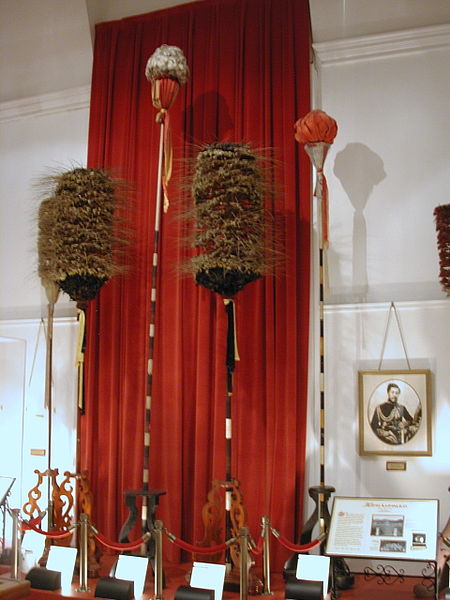
Haku ʻia naʻe hoʻi ka hulu o ka moa i kāhili i mua o nā aliʻi; kāhili ʻia naʻe hoʻi kō kua.Chicken feathers indeed are woven into a standard for the presence of the chiefs; your back is brushed by the kāhili. (FS 101) hoʻokāhilicaus/sim., to brush or fan gently kāhili puluto clear away mulch kū kāhilione standing by a kāhili or carrying it kāhiwa, kahiwa [kā·hiwa (uli)]. n. dark pupil, as of the eye (kā- + hiwa). ʻO ka ʻōnohi o ka lani nui, ʻo ke kāhiwa uli o ka ʻōnohi lani.The eyeball of the high chiefess, the dark pupil of the royal eyeball. (chant for Liliʻuokalani) kāhoa₃ [kā·hoa]. nvt. beginning of a chant, with others then joining in; to begin a chant. kahu₃. similar to kahukahu, offer to a god... kahu ma ka paha ʻanapray in chant (GP 52) kahua o Maliʻo. n. place of happiness, comfort, pleasure (named for Maliʻo, a mythical woman renowned for entertaining with music and for her ability in love magic). kahuaomalio [ka-hu-a-o-ma-lio]. s. Kahua, foundation, and malio, the first dawn of morning light. Literally, the source of light and comfort. Figuratively, the source of life's enjoyments, such as food, fish, mats and all the fruits of the land. kaʻi₁. nvt. Hou mai ua ihe āu, a kaʻi aʻe i ka pola o ka malo.Thrust your spear, directing towards the flap of the loincloth. (FS 87) Kaʻi … i ke kaʻa.To drive … a cart. (2-Sam. 6.3) kaʻi ʻāunato move in a flock, herd, company Ua kaʻi ka ʻaha.The prayer is rendered. kaʻi₇. the chant during which dancers appear and leave; to come dancing out before an audience; see kaʻi₁, to lead, direct... kāʻiʻī, kāʻīʻī. vi. hard, rigid; stingy, close-fisted, hard-hearted, harsh; to refuse help; to deny a request; to strut pompously; persistent. cf. ʻiʻī, hard. [(NP) PPN *taiki, hard (of timber), heartwood] ʻOluʻolu ʻole au e noho nei ke kani kāʻiʻī a ke oeoe.I sit here in discomfort, with the persistent, hard blowing of the whistle. (chant for Kapiʻolani) kaʻinapu [kaʻi·napu]. nvi. graceful prancing motion; to toss, as a ship. ʻAkahi ka nani ua ʻike ʻia, i ka holo kaʻinapu a nā lio.Nothing as pretty has been seen, as the graceful running of the horses. (chant for Kuhiō) kakahi. vs. solitary, unique, outstanding. see pākakahi. Kakahi Lahaina i ka malino.Solitary Lahaina in the calm. (chant for Kamehameha I) kakalaʻihi. redup. of kalaʻihi. He mana kūkulu kakalaʻihi.Power established oppressive. (chant) kake₁. n.v. chants with mixed or garbled words, for and by chiefs, with inserted syllables and some secret words (as: nohouwō o luhunā, nohouwō o lahalō, for: noʻu ʻo luna, noʻu ʻo lalo, mine are the chiefs, mine are the commoners); to use this language; play language used for amusement and intrigue; code. cf. holokake, hōkake. [(MQ) PPN *tate, garbled speech] hoʻokaketo speak kake; to speak unclearly hula kakehula danced to a garbled chant kakopone [kako·pone]. n. saxophone. also pū kakopone. Eng. kalaau [ka-la-au]. s. The striking of one stick upon another, as a part of the music in a hula; he kalaau ka hula nui a na 'lii e hana ai. Kalaʻiākea [ka-laʻi-ā·kea]. n. wind name. lit., the peace spread far. See chant, hiʻia. cf. the island Raʻiatea. kālaipuolo [kā·lai·puolo]. n. musicology. kālaipuolo lāhuiethnomusicology kanaka kālaipuolomusicologist mea kālaipuolomusicologist kalakupua [kala·kupua]. nvs. under control of a mysterious or supernatural power; magic. see kupua. [PPN *tala-tupuʻa, myth, traditional story (clk) (problematic)] he ikaika hoʻokalakupuaextraordinary or supernatural strength hoʻokalakupuamagic; to do wondrous acts; a magician, enchanter, witchcraft; extraordinary fisherman, elusive thief kalapu₄. n. small band (as for Hawaiian music, rock music) (NKE) kalapu hīmeni. n. band (musical) (KAN) kalioneke, kalionete [kalio·neke]. n. clarinet. Eng. kalokalo [kalo·kalo]. nvi. conversational prayer (informal appeal and not a memorized prayer or chant); to pray thus. [(CP) PPN *talo, invoke supernatural assistance, pray; spell, incantation, prayer] kānaenae [kā·nae·nae]. nvt. chanted supplicating prayer; chant of eulogy or praise (the chanter hesitates at regular intervals to recover breath; tone variation is greater and pitch may be higher than in the olioli); to pray thus; to sacrifice; dedication. Eia nō ka ʻula lā, he ʻūlāleo, he kānaenae aloha iāʻoe, ē Laka.Here is a sacred thing, a calling appeal, a chant of affection for you, O Laka. (chant) He kānaenae aloha naʻu iāʻoe, ē Laka ē, ē Laka ē, e hoʻoulu ʻia.This is a prayer I lovingly offer to you, O Laka, O Laka, inspire! (hula prayer) pule kānaenae olaprayer supplicating restoration of life Kāne₂. n. the "leading god among the great gods" (HM 42) ; a god of creation and the ancestor of chiefs and commoners; a god of sunlight, fresh water, and forests (Thrum, p. 82) to whom no human sacrifices were made. In prayers to Kāne (HM 53-55) his name is followed by more than seventy epithets. Kanaloa was his constant companion, but Kāne's name always preceded. Twelve sacred paradisic islands lay off the Hawaiian group "within easy reach," visible on the distant horizon at sunrise and sunset. One is Kāne-hūnā-moku (Kāne hidden island) where Kāne and Kanaloa lived. (HM 67) The twenty-seventh night of the lunar month was sacred to Kāne. See (UL 257-259) for a famous chant to Kāne. lit., male. PCP *Taane. kani₁. nvi. sound or noise of any kind; pitch in music; to sound, cry out, ring, peal, jingle, tinkle, toll, whir, resound, reverberate; roar, rumble, crow, resonance; to strike or tick, of a clock, to sing, as birds; voiced. cf. leokani. [(AN) PPN *taŋi, cry, weep] hoʻokanito play a musical instrument or drum; to cause to sound, honk; to crack, as a whip; to ring up on the telephone. See ex., pila₁ hoʻokani piheto shout, roar, wail, as by a crowd hoʻokani ponoto tune, as a musical instrument kani ā hiaʻāto grieve and moan so sorrowfully that one cannot sleep kani ā ʻuʻinaflash of lighting followed immediately by a peal of thunder Kani ka moa.The rooster crows. Kani ka papa waʻa.The canoe floor sounds [a poetic expression applied to aged persons just before death, as the dead were sometimes laid in canoes which were placed in burial caves]. Kani nā peleJingle bells (song) kani ʻōkalakalascreech ke kani ʻana o ka leothe sound or tone of the voice, intonation leo kanisweet or pleasant voice Mākaukau, kī, kani.Ready, aim, fire. Ua pūhā kēia lāʻau, ke kani ʻia ala e ka manu.This tree is rotten, [it] is being made to sound by the bird [said of a tree not suitable for a canoe: see ʻelepaio₁]. (Nak. 36) ʻUmi minuke i koe, kani ka hola ʻewalu.Ten minutes before eight; lit., ten minutes remaining strikes the hour eight. kani. n. sound effects, as on a computer. see kani keaka, pīpa. kani [ka-ni]. v. To make a sound more or less musical; to hum, as a tune. To strike, as a clock; kani wale ka wati me ka hookani ole ia aku e ka lima kanaka. To sound, as a trumpet. Puk. 19:13. To explode, as a pistol. To crack, as a whip. To rumble, as thunder. To squeak, as shoes. To crow, as a cock; ke kani mai nei ka moa. Hoo. To sing; to praise; to play on an instrument of music. 1 Sam. 16:18, 23. To cry out, as a multitude; to exclaim; hookani aku la na kanaka penei, the people exclaimed thus. To be unpleasantly affected, as the ears at hearing bad news. 1 Sam. 3:11. Na mea kani, musical instruments. s. A singing; a ringing sound; a report, as of a gun; the sound of a trumpet, or of musical instruments. adj. Sounding; singing; squeaking; making a noise. kani₃. vt. to satisfy a need, particularly thirst; to drink. cf. Kanilehua. E ʻeleu like aʻe kākou, e kani wai ā hoʻi aʻe.Let's all hurry together, drink water and go home. (chant for Kapiʻolani) kanihapa [kani·hapa]. n. half-step interval in music, a minor second. kanihia [kani·hia]. pas/imp. of kani₁. PPN *tangisia. Ka poʻe nāna ke aliʻi e noho nei, e noho kanihia aloha aʻe ana iāʻoe.The people whose chief is present express their great affection for you. (chant for Kuakini) kanikaniʻāʻula₂, kanikaniāʻula [kani·kaniʻāʻula]. vi. to mourn in chanting. E ʻai aku ʻoe i ʻole hoʻi kēlā e kanikaniʻāʻula wale mai.Eat or he will mournfully chant. kanikau₁ [kani·kau]. nvt. dirge, lamentation, chant of mourning, lament; to chant, wail, mourn. (Bib.) kanipiha [kani·piha]. n. whole-step interval in music, a major second. kāohi₂ [kā·ohi]. nvt. style of chanting in which prolonged vowels are cut off with glottal stops; to chant thus. rare. kapakē [kapa·kē]. vi. to splash, as raindrops on water. Kāoʻo ihola ka ua o Kahana, kapakē aʻela ka wai ma Loʻikeʻe.The rains gather at Kahana, splashing on the water of Loʻikeʻe. (chant) kapakū [kapa·kū]. vs. overwhelmed, destroyed. Hiki ke Kona, ka makani kulaʻi kauhale, kapakū ka moku me ka ʻāina.Comes the Kona, the wind that pushes over houses, overwhelms the island and the land. (chant for Kekāuluohi) kapolakā [kapola·kā]. vs. mysterious, unfathomable. No Kū, no Lono, no Kāne ma lāua ʻo Kanaloa, no Papa nui āiwaiwa ā kapolakā.In honor of Kū, Lono, Kāne and Kanaloa, in honor of great Papa, mysterious and unfathomable. (old chant) kau₃. nvt. a sacred chant, as Hiʻiaka's chants of affectionate greeting to persons, hills, and landmarks; a chant of sacrifice to a deity; to chant thus. see kaukau₁, kanikau₁, kauna₃, chant of lamentation...; dirge, lamentation, chant of mourning...; chanting... PPN *tau. Kau akula ia i kēia kau ma ke oli.He offered this sacred chant in the chanted song. (FS 275) Kaʻū. n. name of a district on Hawaiʻi. See epithets, kua₁, Kuehu Lepo, mākaha₁, wehi₃, and chant, kiʻekiʻe. PNP *Takuu. Kauahae [Ka-ua-hae]. n. wind name. lit., the raging rain. Ē ka wahine noho i ka makani, i ka makani Kauahae, i ke ahi lele o Kamaile.O lady dwelling in the wind, in the raging rain and wind, in the firebrands of Kamaile. (chant) Kauaohāʻao [Ka-ua-o-Hāʻao]. PH. a Congregational church at Waiʻōhinu, Kaʻū, Hawaiʻi. lit.: the Hāʻao rain. This rain name was used in poetic expressions and made famous by the chant of Kuakāhela announcing the killing of the Kaʻū chief, Keōuakuahuʻula, by Keʻeaumoku: kuʻu haku i ka ua o Hāʻao, my lord in the Hāʻao rain. Kuakāhela was Keōua's kahuna. kauʻeliʻeli. vt. to dig up the past, to review the past. ʻO kaʻu ia e kauʻeliʻeli nei, e kaumoʻo nei mamuli o kā Lono.This is why I am reviewing the past, joining on to Lono's account. (chant for Kuakini) kaukau₁ [kau·kau]. nvt. He kaukau aloha naʻu iāʻoe.A loving heart-to-heart talk with you. kaʻukaʻulele [kaʻu·kaʻu·lele]. nvs. nimbleness, joy; nimble, agile, active, joyful, as one leaping for joy. Ke kaʻukaʻulele a ka ua.The joyful leaps of the rain. (chant) kau kepa. vi. to fall or lie on a slant, as rain; slanting. Mehe manu lā ka ua e kau kepa nei, e wili nei i luna o ka lāʻau.Like a bird the rain falls slanting, whirling about on the tops of trees. (chant for Kahakuohawaiʻi) kaulaʻi iwi [kau·laʻi iwi]. v. to talk too much of one's family affairs or ancestors, to tell the cherished stories, and chants of one's ancestors (a taunt to those who reveal too much of the Hawaiian past). lit., to dry out the bones, meaning to expose the bones of the ancestors, a crime. cf. kaulaʻi lā. kaulani [kau·lani]. vi. to rely on the chief, to support the chief, to put confidence in the chief. I ke kapu, ʻaʻole e pono, ʻo ka pono o ka ʻāina e kaulani.In the taboo there is no salvation, the salvation of the land is in upholding the chief. (chant for Kekāuluohi) kaulele₂ [kau·lele]. nvt. exclamation, stress; to accent in music. kaulele ikisecondary stress, in music Kaulele ma ka pana malalo.Accent the down beat. kaulele iki. secondary stress in music (EH) kaumuku₁ [kau·muku]. vi. too short; shrinking away, as in distaste. ʻEʻeke ka piʻi pali o Mauna Hina, kaumuku ʻekekeʻi i ka wai o ka liko.The climber of Mauna Hina cliff shrinks away, draws away, shrinks from the moisture of the leaf buds. (chant for Kuakini) kauna₃. n. chanting. Kaunā. PH. point, Hoʻōpūloa qd., Kaʻū, Hawaiʻi. (For a chant, see lulumi.) Kaunuohua [Ka-unu-o-Hua]. PH. ridge, Waimea district, Kauaʻi. Peak (4,535 feet high), Pelekunu Valley, Kamalō qd., Molokaʻi. The body of Pele is said to lie here. The name is abbreviated in some chants as Unuohua. A ridge in Māʻalaea qd., West Maui, spelled Kauno-a-Hua, should perhaps be Kaunu-o-Hua. lit.: Probably lit., the altar of Hua (a war leader of Molokaʻi; (RC 70) ). A aloha wale ʻia kā hoʻi ʻo Kaunu-o-Hua, he puʻu wale nō.Even Kaunu-o-Hua is loved, just a hill [how much more so a human being!]. (PH 115) kauō₁, kauwō [kau·ō]. vt. to drag, haul, draw along, tow. hoʻokauōto cause to be dragged; to prolong vowels in chanting kauō huluhuluto drag along roughly, as a canoe hull that is shredded (huluhulu), or a child who is bruised kauō ka hikipossible to move by dragging kauōlani₂, kauwolani [kau·ō·lani]. vt. to express admiration or praise of a chief, as in chant. kaupoku₁ [kau·poku]. nvs. ridgepole, highest point, roof, ceiling, attic; to set up a ridgepole. fig., greatest. (Often used without ke; see ex., home, ʻōlepe pū.) also kaupaku. [PPN *tau-patu, upper ridgepole above the *taqufufu] Kāhiko ka nani i Kamaʻe, ke kaupoku lā o ke ʻala.Beauty adorns Kamaʻe, the greatest fragrance. (chant for Liliʻuokalani) Kiʻekiʻe kaupoku o Hanalei.The high ridgepole of Hanalei [said of conceited or willful persons; a pun on a place name at Hanalei]. papa kaupokucanopy layer of vegetation between papa hapamalu and papa ʻoiʻoi kāwā₁. n. distance between two points; length of time. (Kel. 129) ʻO ke kuʻi kēia, ʻo ka holo kēlā, moe kāwā, hāpala ka ʻele.This is a stroke, that is a run, a space lies between, the black is blotted. (For. 4:57, kōnane chant) Pehea ke kāwā mawaena o nā hale?What's the distance between the houses? kāwele₁ [kā·wele]. nvi. kind of chant with clear, distinct pronunciation, somewhat like kepakepa but slower; to chant thus. kāwelu₂ [kā·welu]. nvi. a hula step, to do this step, which is said to be named for the grass: one foot taps time with the heel, the toes being stationary, while the other foot, flat, steps forward and then a little back, twice or more; the step is repeated reversing the feet. In English this is called the Kalākaua nō he inoa, ka pua mae ʻole i ka lā.A name chant for Kalākaua, the flower that wilts not in the sun. keikei [kei·kei]. redup. of kei, glory, take pride in... hoʻokeikeicaus/sim Keikei kūlana hale wili, ʻaʻohe mea hana o loko.Nice-looking spot has the sugar mill, but nothing doing inside. (ON 1702) (chant) kekele, degere [ke·kele, kē·kelē]. n. degree, as in latitude, music; an academic degree. Eng. ʻelua kekele o ka pepehi kanakasecond-degree murder mea hōʻike kekelesundial; lit., thing showing degrees (2-Nal. 20.11) kēkelē laeoʻomaster's degree. also palapala laeoʻo kēkelē laepuabachelor's degree. also palapala laepua kēkelē laeʻuladoctorate degree. also palapala laeʻula n. degree, as referring to temperature. ʻEhia kēkelē ph ke anu [ka mahana, ka mehana, ka wela] o ka poʻahā?How many degrees Fahrenheit was the temperature on Thursday? ʻelima kēkelē Palanaheikafive degrees Fahrenheit he ʻumi kēkelē Kelekiaten degrees Celsius kelopahone. n. xylophone. (HE) kepakepa₃ [kepa·kepa]. nvt. conversational chant, fast rhythmic chant or recitation, with every syllable clearly pronounced and without prolonged vowels and not requiring too much breath. The paha chants are in this style. To chant thus. kī₆. nvt. key, latch; key, pitch, and clef in music; to lock, as a door; to wind or set, as a clock; to roll up, as a mat. Eng. E kī aku i ka puka ā paʻa.Lock the door fast. kī. n. key, in music; peg, as for tuning stringed instruments; to tune, as a stringed instrument. Niʻihau. see hua mele, kiʻeleo. ki. s. Eng. The key of a lock. Lunk. 3:25. The lock itself. Neh. 3:3. kiakahi [kia·kahi]. nvs. person of fixed purpose; with one accord or purpose; in unison, constant; alone, unique, supreme, only one. ʻAkahi lani a ʻoukou e ʻike ai, he lani kiakahi ka lani o nā moku.You know but one chief, a single supreme chief is the chief of the islands. (chant for Hakuohawaiʻi) kī alakaʻi [kī ala·kaʻi]. n. tonic, keynote (music). lit., leading key (Eng.). kia manu. n.v. birdcatcher, birdcatching by gumming; to catch birds by gumming. Ea mai ke aliʻi kia manu, ua wehi i ka hulu o ka mamothe birdcatching chief arises, adorned with the feathers of the mamo (hula chant for Kalākaua) kīʻapu. nvt. ti leaf folded into a cup and used for dipping water; the two hands rounded to form a cup for drinking water; to cup the hand; to catch with cupped hands, as tiny fish; ladle. cf. ʻapu, cup. Ua ʻike aku au i ka wai, me ka iʻa kīʻapu i ka lima.I saw the water, and the fish caught in cupped hands. (chant for Kapiʻolani) kīauau₂ [kī·au·au]. interj. encouraging workers, as in drawing an unfinished canoe hull from the forest to the shed at the seashore where it was to be completed. Kīauau, kīauau, kīauau! holo auau, holo auau, holo auau!Fast, fast, fast! run quick, run quick, run quick! (canoe-hauling chant) Pau kēia kīauau ʻana a ke keiki.After the boy's chant urging fast action. (Nak. 62) kiʻekiʻe [kiʻe·kiʻe]. nvs. height, tallness, Highness; high, tall, lofty, exalted, majestic, superior, prominent; altitude. In 1845 the legislature conferred the title Mea Kiʻekiʻe upon the premier, probably best translated His Excellency. [(CE) PPN *tike, lofty, high, exalted, elevated] hoʻokiʻekiʻeto elevate, promote, lift up; proud, lording it over others, overbearing, disrespectful or disobedient to seniors, vain; promotion, elevation, conceit Ka Mea Kiʻekiʻe, Kamāliʻi wahine Luisa.Her Highness, Princess Louise. Kiʻekiʻe Kaʻū, kua makani, he umauma i pā ʻia e ke Aʻe Loa.Majestic Kaʻū, wind [blown] back, breast blown upon by the Aʻe Loa tradewind breeze. (old chant of Kaʻū chiefs) kiʻekiʻe loamaximum, highest, supreme kiʻeleo [kiʻe·leo]. n. pitch, in linguistics and music. kī hōʻalu. n. slack key (the first and last strings of the guitar are tuned to D, instead of E; the strings are picked individually and are not chorded). kī hoʻoikaika [kī hoʻo·ikaika]. n. staccato mark (music); small dot or wedge placed over a musical note. kī hoʻokuʻu [kī hoʻo·kuʻu]. same as kī hōʻalu, slack key... kiʻi hua. nvi. to make gestures in the hula pūʻili and hula ʻulīʻulī imitative of the words of the chant; these gestures. kika₁. vs. slippery, slimy, as with mud. E ua ana ka ua a kika malama, ʻōlali kika ana kikika i ka ua.The rain rains so that the month is slippery, bright, slippery, slippery in the rain. (chant) kīkā [kī·kā]. n. guitar; cigar. for guitar parts, see ʻukulele. see also ʻukulele pahu kīkā. kīkīkoʻu₁ [kī·kī·koʻu]. n. chirping or screeching, as of a flock of birds; deep tone in chanting; tapping noise. cf. koʻu, to cluck. He nahenahe ma kekahi wahi, ā he kīkīkoʻu ma kekahi wahi o ka mele.Soft in some places, deeptoned in other parts of the chant. kikina₁. n. urging, insistence. cf. hoʻokina. hoʻokikinaredup. of hoʻokina Kō kikina ua laki.Your insistence has good luck. (chant) kiko₁. nvt. hoʻokikoto hatch ke aʻo ʻana i ke kau ʻana i nā kikoinstruction in the placing of punctuation marks kiko. n. point, a unit of measurement for type size. no abbreviation. He ʻumikūmālua ka nui maʻamau o kēlā kinona hua.Twelve point is the standard size for that font. kiko [ki-ko]. v. To reach after; to stretch out the hand to take a thing. To pluck; to pull off; as fruit from a tree. To pick up, as a fowl does its food. To peck or break the shell, as a chicken in hatching. To mark on a roll opposite one's name for absence. s. A small spot, dot or point. A spot on the skin. The figure marked on the skin in tatooing. The general name given by Hawaiians to the marks used in punctuation. The dot or mark made as a sign of absence in a school roll. adj. Striped; spotted; speckled. kilu₁. nvt. a small gourd or coconut shell, usually cut lengthwise, as used for storing small, choice objects, or to feed favorite children from. Used also as a quoit in the kilu game: the player chanted as he tossed the kilu towards an object placed in front of one of the opposite sex; if he hit the goal he claimed a kiss; to play this game. (Malo 216-18: ch. 42). In the Bishop Museum are stone quoits labelled kilu. See ex., eo and (FS 275–83). Nā kilu a Lohiʻau.Kilu hulas by Lohiʻau [name of some hulas performed for the coronation of Kalākaua]. Nā kilu a Pele.Kilu hulas by Pele [performed for the coronation of Kalākaua]. kilu₂. same as pūniu, knee drum. kimepala, kimebala [kime·pala]. n. cymbals. also kumepala. Eng. kimo₁. nvi. a game similar to jacks: a stone is tossed into the air by the player, who quickly picks another off the ground before he catches the other; jackstones; to play kimo. The players often chanted. kinai₂. vi. to continue, persist. cf. -kina. ʻO Hilo ia lā o ka ua kinai, kinakinai ka ua o Hilo, ka ua mao ʻole o Hilo.That is Hilo of the constant rain, the rains of Hilo go on and on, the rain of Hilo that never clears. (chant)
kinora [ki-no-ra]. s. Heb. Name of a musical instrument. Hal. 57:8. He ua nō, he kulu ua no ka liko … ke hoʻokiʻoa i nā kikawaiō.It is rain, rain-drops for the buds … water settling on the kikawaiō fern. (chant for Kamehameha III) kiohoa [kio·hoa]. vi. spoiling, as a flower too long in the rain. Pala kiohoa i ka ua ka pua kou.Yellowed, spoiling in the rain are the kou blossoms. (chant) kīʻoki. nvs. striped; creased with fat; stripes. He kākau kīʻoki ʻōniʻo i ka lae, he kīʻoki ʻo ke kīkākapu, ʻo ka iʻa kapu.Marked with bars and streaks on the forehead, the kīkākapu is [a fish] with bars [of color], a sacred fish. (chant) s. Name of a musical instrument; also, with hoo, the names of instrument players; poe hookiokio, players on instruments. Hal. 87:7. Kiʻowao [Kiʻo-wao]. n. cool mountain rain accompanied by wind and fog, sometimes associated with Alakaʻi swamp on Mt. Waiʻaleʻale, Kauaʻi, as well as Nūʻuanu Valley, Oʻahu. see chant, kohāhā. kipola. n. tiple, a musical instrument with ten strings. Eng. kipona₄. vt. mixed, mingled; varying in color or texture, as of the sea; to add to, as something of different character, as ferns to a lei . ka wai kipona me ke kaiwater mixed with sea water Kipona paukū i ka lauaʻe, ka pua o ka ʻilima nono i ka lā.Add a section of lauaʻe fern [to] the flower of the ʻilima, bright in the sunlight. (chant for Kaʻiulani) kō₂. nvi. I aloha i ke kō a ka wai, i ka ʻī mai "Anu kāua".Beloved is the [current] pulling in the stream, saying “we are refreshed.”. (chant) Kō mai ana ke ʻala o ka pua o ka pīkake.The fragrance of the jasmine flower is wind-borne. kō₅. n. second note in musical scale, re. kō. n. re, the second note on the musical scale. see pākōlī. ko. In music, the second ascending note. koʻa₁. nvs. coral, coral head. also ʻākoʻakoʻa. [PPN *toka, rock, as a submerged rock or reef] Ke koʻa mokumoku o Heʻeia.The broken coral beds of Heʻeia [an expression used in songs and chants referring to Heʻeia, Oʻahu]. koʻana wai. n. small pool from which most of the water has evaporated. cf. koʻana₁. E holoi ʻia mai ka pū niu, i ke koʻana wai ʻākōlea.Wash the coconut cup in the tiny pool amid the ferns. (hula chant) koekoe [koe·koe]. vt. to strum, as an ʻukulele or guitar. cf. koe. kohāhā [kohā·hā]. redup. of kohā, crack of a whip, report of a pistol... Kohāhā ka leo ka ua Kiʻowao.Loud sounds the rain Kiʻowao. (chant) kōheoheo₆ [kō·heo·heo]. n. nose flute (hano is more common). koheoheo [ko-he-o-he-o]. An instrument to assist in mourning or wailing along with other sounds; he mea kanikani pihe me ka uwalaau. kōhia [kō·hia]. pas/imp. of kōhi₄, to hold back, check, restrain... Kōhia aku ka ʻīlio.Hold back the dog. Kōhia mai mākou e ka makani Moaʻe.We were held back by the Moaʻe wind. (chant) kō hua mele. n. duration, in music. lit., hold (a) note in music. koʻihonua₁ [koi·honua]. nvi. genealogical chant; to sing such chants. koʻihonua₂ [koi·honua]. vs. presto (in music). kokoe. redup. of koe₂, remain, exclude... Hōʻināʻinau mea ipo i ka nahele, hoʻokokoe ana ka maka i ka moani.Lovers are wooing in the woods, casting shy glances at the wafted fragrance. (chant) hoʻokokoecaus/sim Kokoe akula nā maka i ka ʻike i kona ʻenemi.The eyes glared at seeing her enemy. (Laie 491 [97]) kokoe makato frown, cast shy glances nānā kokoeto look with disapproval kōkō lele [kō·kō lele]. meaningless syllables occurring in chants... see ahahana. kōkua hua mele [kō·kua hua mele]. n. musical staff. laina o ke kōkua hua melehorizontal line on a musical staff. also laina o ke kōkua makua laianaalso koʻokoʻo, kumu ʻākōlī wā o ke kōkua hua melespace between horizontal lines on a musical staff. also wā o ke kōkua koleneka, koreneta [kole·neka, koreneta]. n. horn (RSV), cornet (KJV). Eng. (1 Oihn. 15.28) kolia₂. pas/imp. of kō, to draw. pull... Hukia mai ke kaula i kūpono, kolia mai ke kaula i māloʻeloʻe.Pull the rope till it fits right, draw the rope till taut. (chant for Kalākaua) koliana₁ [koli·ana]. n. accordion. Eng. kolineka, korineta [koli·neka]. var. of koleneka, horn... koneka₁. n. cornet. Eng. koʻo₃. nvs. force, strength; strong, rough (rarely used except after kai). Lilo aʻela ke koʻo makani o Lehua.The force of the wind of Lehua is spent. (chant) koʻokoʻo₁ [koʻo·koʻo]. n. He koʻokoʻo haki wale.An easily broken staff [a weak leader]. (ON 702) hoʻokoʻokoʻoto push, brace, resist, lean back and brace oneself koʻokoʻo [koʻo·koʻo]. see kōkua hua mele, musical staff kookoo [koo-koo]. s. A staff; a cane for supporting a weak person; kookoo hao, an iron rod; a rod; a shepherd's crook. Oihk. 27:32. FIG. A stay; a staff; a supporter; that is, means of livelihood. Isa. 3:1. koreneta [ko-re-ne-ta]. s. Eng. A cornet, a musical instrument. 1 Oihl. 15:28. kuaehu [kua·ehu]. vs. silent, still, lonely. ʻAʻohe māʻalo kanaka o Hoʻokū ano, kuaehu, mehameha i ka wahine.No one passes at Hoʻokū, awesome, silent, lonely because of the woman. (chant for Pele) kuahaka [kua·haka]. vs. surging, swelling, as waves. Ke kai kuahaka o Koʻokoʻolau.The surging sea of Koʻokoʻolau. (chant) kūʻai. vt. to buy, barter. lit., to stand up food. cf. kūkālā. kūʻai aku kūʻai maibuying and selling, trade kūʻai heleto go shopping; to go about buying or selling; shopping. [In older usage directionals were not used with kūʻai; in such cases ‘bargain’ is a good translation.] kūʻai hoʻēmi kūikawāa special sale kūʻai hoʻēmi, kūʻai emireduction sale kūʻai hoʻopauclose-out or clearance sale kūʻai liʻiliʻiretail buying or selling; lit., little buying, selling kūʻai malūto buy secretly, as contraband or as on a black market kūʻai nuiwholesale buying; lit., big buying kūʻai nui, kūʻai kāʻokoʻawholesale kualau [kua·lau]. n. shower accompanied by sea wind. see ex. pāuli. (UL 258) ʻAuhea wale ʻoe, ē ke kualau, ka ua nū hele ma ka moana.Listen, o kualau shower, rain moaning over the open sea. (chant) Kūaliʻi. one of the last great chiefs, a descendent of Līloa's wife Pineʻa, said to have subjugated first his own Oʻahu, and then the remainder of the Hawaiian Islands. He was succeeded by his son Peleiōhōlani (Pele at Hōlani [a mythical realm] ). (Kam) says he died in 1730 at the age of 175 (For. 4:432) . In a 610-line chant he is praised as a mortal (kanaka), a god (akua), one who flies from heaven (ulele mai ka lani), and a foreigner (haole) from Tahiti (For. 4:394-395) . lit., royal Kū. see Nāpēhā₂. (For. 4:364-434) kūamuamu [kū·amu·amu]. vt. to revile, blaspheme, curse, swear, damn, insult; to chant a curse or reviling song. see amu₁, amuamu, to curse, revile...; redup. of hoʻokūamuamucaus/sim kuanalio, kuanalia [kuana·lio, kuana·lia]. vt. northern heavens and its stars. Me ka liʻa lā i kuanalia, i kuanalipo ka newa ʻana.Desire in the northern skies, dizzy in the southern skies. (chant) kuene. nvt. e kuene pono iho ai no kona kūlanato keep up his reputation (GP 66) E kuene pono iho ana lā, i paʻa pono ke kaula waha.All was fitted perfectly, so that the reins could be firmly held. (chant for Queen Emma) hoʻokuenecaus/sim.; all meanings kuene haleknowledge of house building, one skilled in house building; house waiter kuhi [ku-hi]. s. A gesturing with the hand to regulate singing, time, &c.; the use of the baton or hand in directing music; a na lakou (ka poe hula) e ao i ke kuhi a paa ke kuhi o ua mau mele la. kuʻi₇. vs. sheer, steep, tall. Kuʻu kaikuaʻana o ka pali hiʻi, pali kuʻi o Kaliuwaʻa.My older brother of the sheer cliff, steep cliffs of Kaliuwaʻa. (chant by Kamapuaʻa) kū … kā. used only in the idiom ʻo kū! ʻo kā! This originated in Wahineʻōmaʻo's chant: ʻO kū, ʻo kā ʻo Wahineʻōmaʻo, wahine a Lohiʻau ipo (PH 184), bam! boom! Woman-in-green, wife of Sweetheart-Lohiʻau. Wahineʻōmaʻo did not know how to dance or chant; her song was merely a rhythm beat to which she marched about comically. Hence the idiom has come to mean 'a lick and a promise, do it as quickly as possible and get it over with.' kū kahi₂. vs. standing alone, outstanding, unique, first. Ka wohi kū kahi.Outstanding one of wohi high rank [applied to Kalākaua in chants]. (ON 1667) kukima₂, dukima. n. bagpipe (RSV), dulcimer (KJV). Eng. (Dan. 3.5) kūkū₁, tūtū [kū·kū]. n. (usually pronounced tūtū.) Granny, grandma, grandpa; granduncle, grandaunt; any relative or close friend of grandparent's generation (often said affectionately; apparently a new word as it has not been noted in legends and chants). kūkulu puolo [kū·kulu puolo]. vt. music arranger; to arrange music. lit., arrange music. kukupu. redup. of kupu, to grow. see prayer, hōʻeu₁. He mau lāʻau hoʻolaha aliʻi ke kukupu nei.These were trees from which chiefs were propagated, that put out new sprouts now. (chant) kulaʻina. nvi. pushing over, flattening; overthrow, breakdown. I kulaʻina e ka wai o Hina, hina ke oho o ka hala.Flattened by the water of Hina, the leaves of the pandanus fall. (chant) kūlauna [kū·launa]. vs. in harmony, in music. comb. see hoʻokūlauna. E hoʻolohe kākou i nā leo kūlauna.Letʻs listen to the harmonizing parts. hīmeni kūlauna liketo sing in harmony Kūlauna ka hīmeni ʻana o lākou.Their singing is in harmony. kulina. n. deafness, disobedience, noise. Ka lono mamua, ke kulina mahope kulikuli wale i ka makani o Kaʻū.Hearing before, deafness afterwards, deafening in the wind of Kaʻū. (chant for Kaumualiʻi) kūlokuloku [kū·loku·loku]. redup. of kūloku, falling, flowing, as rain or stream... also kūnokunoku. Pakapaka ua, paka ua, kūlokuloku.Rain of many drops, drops of rain, running, running in streamlets. (chant) kumalauā, kumalauwā [kuma·lau·ā]. vi. to rise above. ʻAkahi, ʻalua, ʻakolu, ka heluna kupuna o lākou, ʻaʻeʻaʻe kumalauā i ka moʻo kanaka.Once, twice, thrice the enumeration of their ancestors, stepping high over commoners. (chant) kūmaumau₂ [kū·mau·mau]. same as maumau; constant, continuous, together. Hai kūmaumau ē, hai kuwā!follow together, follow shouting! (chant for those carrying a log to shore to be made into a canoe) kumebala [ku-me-ba-la]. s. Gr A cymbal; a musical instrument. 1 Kor. 13:1. Kumebala walaau. kumuleomele [ku-mu-le-o-me-le]. s. Kumu and leo, voice, and mele, a song. The rules of music. kumulipo [kumu·lipo]. n. origin, genesis, source of life, mystery; name of the Hawaiian creation chant (see (KL) and (Johnson 1982). written kumu uli po in (Malo text, ch.1, sec. 11). [Malo (2005 ptg): ch.1, sec. 11 (p.2) has kumulipo.]
kumu pākōlī [kumu pā·kō·lī]. n. staff or five lines on and between which music is written. cf. pākōlī.
kumupakoli [ku-mu-pa-ko-li]. s. Kumu and pa-ko-li, three of the syllables used in solmization in practicing vocal music. The staff or five lines on which music is written. See pakoli.
ʻO ka lani hoʻokūʻoi kapu.The superior sacred chief. (chant)
kuolo₂. vi. to tremble, as the voice; to shake, as with palsy; to vibrate, resonate, as a chanting voice. see hula kuolo. [(CE) PPN *tuu-oro, resonate, sound: *tu(u)oro]
hoʻokuolocaus/sim
kuolokani [kuolo·kani]. n. timbrel (Puk. 15.20) , psaltery (Hal. 92.3) .
kuolokani [ku-o-lo-ka-ni]. s. See kuolo above and kani, to sound. An ancient musical instrument among Hawaiians, used at hulas and on other occasions of amusement and dissipation; a timbrel. Puk. 15:20. Translated psalteries in 2 Oihl. 9:11.
kupa₈. tuba Eng. (HE)
kūpaloloi [kū·palo·loi]. vt. to vibrate, as the ruffle of a drum; to trill; to drum with the fingers.
Kūpaloloi ka leo o ka pahu.The drum produces a vibrating sound.
kupaloloi [ku-pa-lo-loi]. v. To drum with the fingers on the drum or pahu at a hula or other gathering; kupaloloi ka leo o ka pahu e kani i Mauoni.
kuʻu₁. nvt., vs. hihia ua hoʻokuʻu ʻiacase [of law] settled
hoʻokuʻuto release, let go, put down, dismiss, send away, abandon, disperse, adjourn; to expel, as from school; to discharge, as from work; to free, acquit, let, permit, excuse, exempt, liberate; to settle, clear up; slope of a hill (rare)
hoʻokuʻu ʻia mai ka hopu ʻia ʻanaexemption from arrest
hoʻokuʻu kāualet's stop [as a meeting]
hoʻokuʻu maikaʻihonorable discharge
ke kuʻu ākea ʻana i nā paʻahaoparole of prisoners
kuʻu i ka luʻuluʻuput down the burden
kuʻu i ka ʻuhaneto give up the ghost [die] (Kin. 35.29)
kuʻu ka hanubreath is abandoned [death]
kuʻu ka luhito be freed from cares, to rest [die] (ON 1934)
kuʻu ka naeto get one's breath, rest
kuʻua. pas/imp. of kuʻu₁; see chant, ʻalaneo₁.
kuwā₁. vi. to make a din, talk loudly, resound. See wā₃ and chant, kūmaumau₃.
He leo paha no ka ʻiʻiwi e kuwā nei.Perhaps voices of ʻiʻiwi birds making a din.
lā₉. n. sixth note on the musical scale, la. Eng.
lā. n. la, the sixth note on the musical scale. see pākōlī.
lāʻau alakaʻi. n. conductor's baton (HE)
laʻehana [laʻe·hana]. interj. syllables repeated in chants at ends of verses to mark time and for gay effect, similar to ehehene.
Nā kai laʻia.The tranquil seas. (chant)
laina o ke kōkua hua mele [laina o ke kō·kua hua mele]. n. horizontal line on a musical staff. lit., line of the musical staff. also laina o ke kōkua. cf. wā o ke kōkua hua mele.
ʻAuhea wale ʻoe, ē ke ānuenue e lalaʻi maila i Haleola.Hearken to me, O rainbow, so serene at Haleola. (chant)
lama kea. n. a tree mentioned in a chant in (Kam. 76:118).
Lanipōlua [lani·pō-lua]. n. rain name. see chant, lanipō.
lapakū [lapa·kū]. vs. excessively active.
Lapakū i Hawaiʻi ka wahine, aʻo Pele.The woman Pele is most active on Hawaiʻi. (chant)
lauana wā [lau·ana wā]. n. meter, in music. lit., time pattern.
laukoa [lau·koa]. vi. to feather out, as young birds.
hoʻolaukoasame as laukoa
I malumalu ai kāna pūnua i manaʻo ai e hoʻolaukoa.To shelter their fledglings which they expect to feather out. (chant for Kawānanakoa)
lawalawaiʻa [lawa·lawaiʻa]. redup. of lawaiʻa; to fish here and there.
Anu ke kupa lawalawaiʻa o Hoʻolehua.Cold are the native fishermen of Hoʻolehua. (chant)
lawea. pas/imp. of lawe, take, bring...
Lawea mai ā pau pono nā ʻike kumu o Hawaiʻi.Bring every last bit of the original wisdom of Hawaiʻi. (chant for Kalākaua)
lawelawe₁ [lawe·lawe]. vt. ʻIke pono i nā mea e lawelawe ʻia ana.To see clearly what happened.
ka lawelawe ʻanathe service, performance, procedure, execution, carrying out, administration
Ka loio nāna e lawelawe nei i ka hihia.The lawyer who is handling the law case.
kanaka lawelawe, mea lawelaweservant, waiter, steward [this term does not carry the opprobrium attached to kauā]
Ke lawelawe lā naʻe hoʻi; ā make akula ʻoe iā Kuʻikaʻa.The [job] is being done; Kuʻikaʻa [the war club] slays you. (victory chant of Kawelo, FS 63)
lawelawe hoʻopiʻi kalaimacriminal procedure
lawelawe ʻoihanato conduct business
wahine lawelawewaitress, maid, stewardess
Lehua₇. n. name of the small island just west of Niʻihau. As the westernmost of the Hawaiian Islands (except for the Northwest Hawaiian Islands), Lehua is associated with a setting sun (see chant, kalakalaʻihi). In poetry, the extent of the Hawaiian Islands is shown by coupling Lehua Island and Haʻehaʻe and Kumukahi on East Hawaiʻi . A breeze is named for this island.
Mai ka piʻina a ka lā i Haʻehaʻe ā ka welona a ka lā i Lehua.From the rising of the sun at Haʻehaʻe [East Hawaiʻi] to the setting of the sun at Lehua Island. [a poetic reference to all Hawaiʻi] moku kāʻili lāsuns-snatching island [Lehua Island or sometimes Kauaʻi, since they lie to the west] lehua ʻāhihi [lehua ʻā·hihi]. n. a variety of lehua (Metrosideros tremuloides), noted in songs and chants of Nuʻuanu Valley, Oʻahu. also ʻāhihi. lele₇. n. an interval of music, the difference in pitch between two tones, always followed by a number from one to six, especially lele kolu, an interval of a third, as from C to E, or lele lima, an interval of a fifth. Minor intervals are followed by hapa, as lele kolu hapa, an interval of a minor third. Lele may also be followed by pā- and a number, to skip that number of notes. Lele in this sense also occurs as a verb, to sing thus. -lele kī. hoʻolele kīA game played only at Malamakī, Puna, Hawaiʻi. A player would hold a lelekoluhapa [le-le-ko-lu-ha-pa]. s. In music, a minor third. lele lima. an interval of a fifth see lele₇. lelelimahapa [le-le-li-ma-ha-pa]. s. Lele and lima, five, and hapa, part. In music, a minor fifth. lele lua₁. vi. an interval of a second in music. cf. lele₇. lelelua [le-le-lu-a]. s. Lele and lua, two. In music, a second. lele pā-. n. singing intervals in music (pā is followed by a number). cf. lele₇. lelepuni₁ [lele·puni]. n. a musical interval of an octave. cf. leo lelepuni. leo alakaʻi [leo ala·kaʻi]. n. one who sings the melody of a song. Niʻihau. leo ʻekahi. n. soprano. lit., first voice. ʻukulele leo ʻekahisoprano ʻukulele leo ʻekolu. n. tenor. lit., third voice. ʻukulele leo ʻekolutenor ʻukulele leo hoʻānuʻunuʻu. trilling voice (Hawaiian style) (EH) leo lele puni. n. var. spelling of leo lelepuni, a musical interlude of a full tone. leo lelepuni, leo lele puni [leo lele·puni]. n. a musical interlude of a full tone. cf. lelepuni₁. leo mele. n. song tune; notes on the scale. leomele [leo-me-le]. s. Leo and mele, a song. Musical sounds; music generally. leo mele kanikau. requiem (EH) leo nahenahe. sweet voice (EH) leo uwō. n. bass or baritone notes or voice; roar, as of a lion. leouwo [le-o-u-wo]. s. Leo, sound, and uwo, to bellow. The lowest notes in music; the name of the base notes. leo waena. n. second treble, middle or alto voice. leowaena [le-o-wae-na]. s. Leo and waena, middle. The middle voice in music; a second treble. leo wahine. n. soprano, soprano voice, feminine voice, falsetto. leowahine [le-o-wa-hi-ne]. s. Leo and wahine, a woman. In music, the highest voice; the air of a tune. leu. n. loins. (Kam. 64:124, in a chant)rare. lī₄. n. third note in musical scale, mi. lī. n. mi, the third note on the musical scale. see pākōlī. li. s. In music, the third note of the scale; pa, ko, li. likoliko [liko·liko]. redup. of liko₁, ₂, ₃; fresh, young, oily. PPN *litolito. He ahi likoliko o ka wela.Glowing fire of heat. (chant) kai likolikogravy full of fat or grease; oily sea water lila₂, lira. nvs. lyre, harp (Kin. 4.21) ; lyric. Latin or Gr. lyra. lira kamaliʻichildren's lyrics [a book of songs] lile₂. vs. in unison, as chanting. rare. Liliʻu. Liliʻu [Liliʻuokalani] ʻukulele.... also ʻukulele Liliʻu. liliʻu₁. nvs. scorching, burning, smarting, as salt in a raw wound or pain in the eyes. (Queen Liliʻuokalani was said to have been so named because at the time of her birth her foster mother's aunt, Kīnaʻu, was suffering with pain in the eyes.) hoʻoliliʻucaus/sim Ka hoʻoliliʻu ʻana a ke aloha.The burning love. (chant) lira. nvs. lyre, harp (Kin. 4.21) ; lyric. see lila₂. Latin or Gr. lyra. lira [li-ra]. s. Gr. A lyre, a musical instrument; a harp. Kin. 4:21. loaʻa. nvs. to find, get, obtain, discover, acquire, have, take, earn, gain, incur, locate, procure, reach, receive, catch, win, succeed; gain, earnings, profit, spoils, harvest, revenue, income, winnings, receipts, wealth, product, property, success, solution, answer; to have or beget a child; to be born; to find none to compare with; unequalled, incomparable, successful (often pronounced loʻa: (Gram. 2.7) ). This extremely common word is a model for loaʻa-stative verbs. see haʻiloaʻa, huina loaʻa. (Gram. 4.4) [(CE) PPN *roaka, obtained] ʻAʻole e loaʻa mai keiki o ke kaona.None as fine as boys of the town. (song) E nānā wāhine aʻe nō wau, ʻaʻole ʻoe e loaʻa.I look at all other women, there's not another your equal. He mau maka loaʻa ʻole.Eyes not easily obtained [said affectionately of a high chief not easily approached]. (ON 810) He mea loaʻa wale nō kēlā iā mākou.That's something we can easily get. He mea pili o ka loaʻa.One to whom gain clings. hoʻoloaʻato obtain, find, get; product, answer, etc ka manawa e loaʻa anaany convenient time ka mea e loaʻa ana (ka mea e loʻana)anything at all, whatever is to be had Kanaka loaʻa ʻole.A person who gains little, has little. Kaʻu kāne i loaʻa ai ʻoe.My husband by whom you were begot. Loaʻa au i ke anu.I caught a cold; lit., the cold catches me. Loaʻa ka hale i ke aliʻi.The chief has a house. Loaʻa Kāneālai, ke kupuna o lākou.Their ancestor, Kāneālai, was born. (chant) Ma ka hīmeni, ʻaʻohe ʻoe e loaʻa.In singing you have no equal. ʻO kaʻu loaʻa nō kēia.This is what I've gained. ʻO ʻoe ka mea e loaʻa ai aʻu wāhine, no ka mea ua pau loa kuʻu waiwai iā lāua, ʻaʻohe naʻe he loaʻa iki.You're the one who can win my wives, because my wealth is entirely spent on the two without any success at all. (FS 229) Ua ʻai au i kāna loaʻa.I've eaten his earnings [said in pride by a parent who is cared for by a son or daughter]. (ON 2769) lohena. n. hearing, obedience. cf. lohe. He lohena kaʻu i ka ʻolāʻolā.I heard a gurgling. (chant) loko₄. n. mainland of the United States (noted in a chant dated 1860, State Archives). I loko aku nei au.I've been to the mainland. n. cassette, as for music tapes or videos. Niʻihau. see mīkini lola. lolohe₁. redup. of lohe; to listen carefully, attentively, with good hearing. He aliʻi ʻo ka lani, he moʻopuna na Lono, he hiapo na ke kini, hoʻololohe ua.The heavenly one is a chief, a descendant of Lono, the first-born of a multitude [of long lineage], a listener to the rain [unafraid of rain because of high rank]. (chant) He pepeiao lolohe.An ear with good hearing. hoʻololoheto iisten carefully; to strain the ear to hear lualaʻi [lua·laʻi]. same as luana, to be at leisure, ... enjoy oneself, relax... (lua- + -laʻi, transitivizer) (Gram. 6.6.4) E aha ana lā kuʻu lani, e lualaʻi lā i Lākana.What is my lord doing, enjoying life in London. (chant for Kalākaua) luke, lute. n. lute. Eng. lulu. nvi. calm, peace, shelter, lee, protection, shield, cloak; to lie at anchor; to be calm; to shield. cf. lulu aliʻi, pālulu. [(MP) PPN *ruru, shelter, calm] E lulu hiwa lani ana ʻoe.You are sheltering the royal favorite. (chant) hale hoʻoluludepot, waiting station hoʻolulu leito offer leis on an altar; the prayer uttered while making an offering of leis; lit., to make leis repose in peace and quiet hoʻolulu₁to lie quietly in calm water, as a ship in port; to be calm; to gather together, as objects, or to wait, as for transportation, See kahua hoʻolulu hoʻolulu₂to chum, for fish; this type of fishing and fisherman kiʻi lāʻau hoʻolulufixed wooden images [as at Hale o Keawe] (Kam. 64:18) Lulu ʻia ke kai.The sea has calmed. (Nak. 72) lulumi. redup. of lumi₁, to crowd uncomfortably; to overturn, pound, crush, as the surf; to press...; crushed, crumpled, wrinkled. E lulumi ana nā ʻale o Kaunā.The billows of Kaunā rush pell-mell. (chant) Huki i ke kalo nui, lulumi i ka lepo ā popoʻi i ka mauʻu.Pull up the big taro, press the earth firmly and cover with grass.
Mmaʻa₂. nvt. sling, as made of coconut fiber, human hair, or aerial pandanus roots; to cast a stone in such a sling; string of a musical instrument (rare). [(NP) PPN *maka, sling; to hurl with a sling; to throw] maa. To sling, as a stone; to cast a stone from a sling. Lunk. 20:16. To throw or cast away, as a sling does a stone. Ier. 10:18. s. A sling. 2 Oihl. 26:14. An offensive weapon of war formerly in use among the Hawaiians. 1 Sam. 17:40. He kaula hoolele i ka pohaku. A string of a musical instrument; he kaula hookani. maha₆. nvs. hoʻomahavacation; to take a rest or vacation; to retire, stop work; to obtain relief; to pause; rest in music. hoʻomaha ai ma nā kānāwaito rest with the laws [obey them] (For. 6:159) Hoʻomaha ʻia mai au i kuʻu hāʻawe.I am relieved of my burden. hoʻomaha poʻoʻelea quarter rest hoʻomaha poʻomanaan eighth rest hoʻomaha poʻomanakolua thirty-second rest hoʻomaha poʻomanaluaa sixteenth rest Ua hoʻomaha nā kula.The schools are having a vacation. maha [ma-ha]. v. To rest; to rest, as from labor or toil; to give or cause to rest. To enjoy ease and quiet after pain; to be better; to begin to recover from sickness. To be assuaged; to be softened down, as anger. Lunk. 8:3. To rest, as a land, i. e., to cease from being the theater of evil. Oihk. 26:34. Hoo. To give or take rest from labor or fatigue. To relieve from suffering; to comfort; to be satisfied. To ease one's self; to attend to a call of nature. Kanl. 23:14. s. Rest; repose; respite or relief from pain or sickness; convalescence; relief from any calamity. Puk. 8:11. Rest; peace. adj. Easy; quiet; resting as from labor; free from pain; ceasing from anger. adv. Hoo. Silently; quietly; at rest. Isa. 62:1. mahele₁, māhele [ma·hele]. nvt. hōʻailona mahelemeasure signature in music hoʻomaheleto have a division made, distribute, divide, etc mahele liʻiliʻismall portion, bit, fragment mahele luato divide into two parts mahele [ma-he-le]. v. Ma and hele, to go; to move. To divide; to cut in pieces; to divide a portion to one, as land. To divide or separate from one another, as people. Kin. 10:32. To divide into two parts, as an army. 1 Nal. 16:21. To divide, as streams of water; as the sea. Puk. 14:21. Hoo. To cause a division; to separate one thing from another. maʻi₂. genitals, genital, genital chant. maʻi were commonly named, as Hālala, overly large, for Kalākaua, and ʻAnapau, frisky, for Liliʻuokalani. Mele maʻisong in honor of genitals, as of a chief, as composed on his or her birth, rarely if ever composed for adults; usually gay and fast. see ēhā.
mākahi₁ [mā·kahi]. vs. one-eyed (short for maka kahi). see chant, mākole₁. maka lena₂. n. yellow center of a flower, as of a daisy. Mehe ipo lā ka maka lena a ke Koʻolau.Like a sweetheart is the yellow flower center of the Koʻolau. (chant) makali₃. vs. glowing, bright, as of fire. He ahi makali hoʻāli na ke kupa.A glowing fire stirred by the native son. (chant) Makaliʻi₄. a chief of Waimea, Kauai, father-in-law of Manokalanipō, and famous as an agriculturalist. A month and the summer season collectively were named for him. During the makahiki festivals food plants were symbolically dropped from his net (HM 366-367) . Several times Kamapuaʻa killed all of Chief ʻOlopana₁'s men except Makaliʻi, who as the sole survivor took the news to ʻOlopana₁. Later, when Makaliʻi had become chief of Kauaʻi, he was frightened by Kamapuaʻa's long chant of his victories; he then chanted Kama's name songs, and so his life was spared, but he was sent away to live in the mountains. (FS 198-203, 230-239). In one account (For. 5:364-365) , the gods Kāne and Kanaloa sent messengers up (i luna) to ask Makaliʻi whether Kaulu, a noisy kava drinker, was man or god. Later Makaliʻi gave his nets to Kaulu so that he might entangle and kill Haumea. His name is given to the Pleiades. By some he was considered a navigator. Makamakaʻole [Makamaka-ʻole]. PH. land section between Honuʻapo and Nāʻālehu, Kaʻū, Hawaiʻi, named for a heiau formerly there. Stream and cliff near Kā'anapali, Maui. lit.: without friends (so named in Kaʻū because a woman chanted a lament here for her departed husband). mākō₁ [mā·kō]. vs. rough, rocky; large. [PPN *mato, precipice, steep place, cliff] Mānoanoa mehe pali mākō.Thick as a rock cliff. (chant) malaka₂. n. maracas (HE) malakia [mala·kia]. rare var. of malahia, pas/imp. of mala₁, aching... ʻEha malakia ka ʻili i ka ʻoliʻoli.The skin is hurt, sore with joy. (chant) Malamakī [Malama-kī]. PH. forest area, Kalapana qd., Hawaiʻi. lit.: bright ti plant. (It is said that the game hoʻolele kī was played here. A ti leaf was held in the hand while the player chanted ʻO kēlā kī, ʻo keia kī, na Ka-moho-aliʻi kaʻu kī, lele! that ti, this ti, my ti is for Kamohoaliʻi, fly! Then the leaf was hurled, and if the chant had been said correctly and the wind was right, it returned to the sender. This game was played only here. Kamohoaliʻi, a celebrated shark deity, was Pele's older and favorite brother.) malia₁. pas/imp. of mali₂, to tie, as bait to a hook... Ua paʻa i ka lino pāwalu i malia i ke aho makaliʻimade fast to an eight-ply line, bound on with fine-meshed string (chant for Kalākaua) malila₁. vs. ghostly, shadowy. ʻO ka malila mōhai a Kaululani, nona ke aka ka hihiʻo i ka pō nei.The ghostly offering of Kaululani, to him belonged the shadow, the fleeting dream of last night. (chant for Kuakini) malo₁. n. male's loincloth; chant in praise of a chief's loincloth. [(MP) PPN *malo, loin garment] malo ʻekadirty malo [said of farmers in dry areas] mamakawalu [mamaka·walu]. redup. of makawalu, numerous... He mamakawalu lākou i loko o ʻĪ.They are many in the ʻĪ family. (chant) mano₁. num. many, numerous, four thousand; thick. He lau ka puʻu, he mano ka ihona.Many hills, numerous descents [of troubles]. (chant) hoʻomanoto increase; to do repeatedly or persistently ka hahai e hoʻomano aifollowing persistently (For. 4:47) koi hoʻomanoto keep asking and insisting manomano [mano·mano]. redup. of mano₁, many, numerous, four thousand; thick...; great; greatness; four thousand times four thousand; myriad. Eia ʻo ka lani, ka manomano, ka manomano heke o ke kapu.Here is the heavenly chief, the great one, the very greatest of the taboo ones. (chant) Ka manomano o kona ikaika.The greatness of his strength. (Isa. 63.1) Waiho akaaka ke kula o Kaiolohia, ka lele maʻopu a ka wai a ka nāulu.The Kaiolohia plain stays clear as the water of the nāulu shower leaps downward. (ON 2905) (chant) mau₄. n. person who carried the wand and chanted in the ʻume game. (Malo 215) mea hoʻokani pila [mea hoʻo·kani pila]. n. musician, particularly one who plays Hawaiian music. lit., one (who) plays instruments. cf. mea puolo. mea oli. n. chanter of oli; one with an oli chant in his honor; oli chanter. mea olioli. chanter (EH) mea puolo. n. musician, general term. lit., one (who does) music. cf. mea hoʻokani pila. meʻeu. vi. rising up; to rise up, as from sitting; to start up, as a frightened bird; to rise, as hair in terror; startled. ʻAkahi au ā ʻike, ka meʻeu hoʻi o kuʻu oho.I've never felt my hair rise in terror like this before. (chant for Kalākaua) mele₁. nvt. song, anthem, or chant of any kind; poem, poetry; to sing, chant (preceded by both ke and ka). cf. oli, a chant that is not danced to. cf. haku mele. [(NP) PPN *umele, kind of song or chant (problematic)] hoʻomeleto cause to sing or chant kāna melehis song [sung by him or composed by him] Ke Mele a SolomonaThe Song of Solomon (Biblical) kona melehis song [in his honor] mele. n. poem, poetry, general term (preceded by ke). mele [me-le]. v. To chant; to cantillate; to sing singly. To sing in chorus or concert. Puk. 15:1. To sing with joy; to sing and dance. See hula. s. A singing; a subject of song. A song; the words of a song. Kanl. 31:19. A chorus; a song of praise. Puk. 15:2. In modern times, a hymn; a rejoicing expressive of gladness. NOTE.—Mele sometimes takes ke instead of ka for its article. adj. Of or pertaining to song or rejoicing. Puk. 32:18. Walaau mele, hilarity. mele ahiahi [mele ahi·ahi]. n. evening song, vesper. mele aupuni [mele au·puni]. n. national anthem. mele haipule. n. var. spelling of mele hai pule, hymn, religious song. mele hai pule, mele haipule. n. hymn, religious song. mele hapa haole. n. Hawaiian type of song mostly with English words. mele hei. n. song sung while making a cat's cradle (hei). mele hoʻāla. n. song to wake a sleeping child or person, especially one composed for a chief or favorite child and used thus. lit., awakening song. mele hoʻālohaloha [mele hoʻā·loha·loha]. n. serenade. mele hoʻohiamoe keiki [mele hoʻo·hia·moe keiki]. n. lullaby. lit., song to put children to sleep. mele hoʻoipoipo [mele hoʻo·ipo·ipo]. n. love song, serenade. lit., wooing song. mele hoʻokūkū. contest song (EH) mele hōʻole lama. n. temperance song. lit., song refusing rum. mele hōʻole wai ʻona. n. temperance song. lit., song refusing intoxicating liquor. mele hoʻoluluhi. lullaby (EH) mele hoʻomaikaʻi. Doxology, hymn (EH) mele hoʻonānā keiki [mele hoʻo·nā·nā keiki]. n. lullaby, song to soothe children. mele inoa. n. name chant, i.e., chant composed in honor of a person, as of a chief. also inoa. mele kāhea [mele kā·hea]. n. chant for admittance to an old-time hula school. lit., calling song. mele kaʻi. n. chant or song sung while dancers come out before the audience. lit., procession song. mele kaʻi hoʻi. n. chant or song sung while dancers leave the audience. lit., song for proceeding back. mele kaʻi kaua. n. battle song. lit., song to lead in battle. (PH 43) mele kanikau [mele kani·kau]. n. dirge, mourning song. mele kinai lama. n. temperance song. lit., song abolishing rum, song abolishing drunkenness. also mele kinai ʻona. mele kinai ʻona. n. temperance song. lit., song abolishing rum, song abolishing drunkenness. also mele kinai lama. mele komo. n. welcoming song. mele kuahu. n. altar chant, as before an altar in a hula school. mele paikau [mele pai·kau]. n. a march; marching song. mele ukali hua kumu. n. alphabet song, as one repeating the vowels. lit., song following the basic letters. melokia, melodia [melo·kia]. n. melody. Latin melodia. melokiana [melo·kiana]. n. melodeon. Eng. melokiana [melo·kiana]. n. melodeon. melu₁. vs. ʻAʻohe maʻi luku ʻē aʻe nāna e melu a nome aku, ʻo ka rama, moekolohe, like pū.No other destructive disease is as weakening and continuing as liquor, adultery, [and] such. (chant) hoʻomeluto cause a decomposition, to leave (as fish) until decomposition begins iʻa hoʻomelufish, such as hīnālea, slightly decomposed, then salted and seasoned with kukui-nut relish, chili peppers, etc memele₂. redup. and plural of mele, to sing. Eia nā ʻānela ke memele nei.Here the angels sing. memele [me-me-le]. v. See mele. To sing; to sing often, or to sing many together. s. A singer; poe memele, concert singers. 1 Oihl.15:27. mī₃. n. seventh note in musical scale, ti. mī. n. ti, the seventh note on the musical scale. see pākōlī. mikihilina [miki·hilina]. vs. most beautiful, of dress, finery, ornaments. Kāhiko ā oki ā pāʻihiʻihi, lawe ā linohau ā mikihilina.Dressed in best, neatest finery, most fine and ornate. (chant for Kalākaua) mīkini pā sēdē. n. CD player (KAN) moa₁. n. chicken, red jungle chicken (Gallus gallus), fowl, as brought to Hawaiʻi by Polynesians; for some people, an ʻaumakua. [PPN *moa, fowl (gallus gallus)] moa ʻawapuhiginger chicken (NKE) moa laiki loloachicken long rice (NKE) ʻO luna, ʻo lalo, ʻo uka, ʻo kai, ʻo ka moa kona a me Kākuhihewa.Above, below, inland, seaward, the chicken is his and Kākuhihewa's. (For. 4:510) [moa here probably represents supreme rule: cf. Kawelo's chant, below: ] cf. (ON 2504, 2505) He liʻi ka moa, kau ana ka moa i luna o ka hale.The chicken is a chief, the chicken perches at the top of the house. (FS 101) moaka. same as mōakaaka, clear, plain, intelligible, manifest; clarity... ʻO moaka kū ke ao.The cloud stands clear. (chant) moani. nvi. light or gentle breeze, usually associated with fragrance; wafted fragrance; to blow perfume. (see chant, kokoe; (Mele 1.12) ) Moani ke ʻala o ka ʻawapuhi.Wind-blown is the ginger perfume. mokuhia [moku·hia]. pas/imp. of moku, to cut PPN *motusia. ʻAʻole pio ke aloha i nā wai he nui loa, ʻaʻole ia e mokuhia e nā waikahe.Waters cannot quench love, nor can floods drown it. (Mele 8.7) mokuhia ka hīexcessive discharge of feces Paʻa ʻole i ka mokuhia a ka waimaka.Unchecked in the bursting forth of tears. (chant) moʻo₁. n. lizard, reptile of any kind, dragon, serpent; water spirit. [(FJ) PPN *moko, lizard (a large black skink sp.)] mea nānā moʻoenchanter (Kanl. 18.10) Moʻohelāia [Moʻo-helāia]. PH. unknown place, famous in chants, said to be near the summit of Mauna Loa, Molokaʻi. (UL 33) Noho ana Laka i ka uluwehiwehi, kū ana i luna i Moʻohelāia, ʻōhiʻa kū i luna o Mauna Loa.Laka lives in the verdure, stands at Moʻohelāia, ʻohiʻa trees stand on Mauna Loa. mōpua [mō·pua]. vs. melodious, pleasant, of a voice. rare. mopua [mo-pu-a]. adj. Fine; melodious, as a voice. mū₃. vi. gather together, of crowds of people. cf. mui, mumulu. [PPN *mumu, crowded together (problematic)] A pae aʻe i Kaimū, hoʻomū nā kānaka.Landing at Kaimū, people gathered. (chant) hoʻomūsame as mū₃; multitude, crowd; to cause a gathering Kahi e mū ʻia ana e nā kānaka.Place where the people gathered.
Nnā₁. vs. calmed, quieted, pacified, assuaged, soothed; settled, as a claim. [PPN *naʻa, become quiet (of a crying child); pacified] E hoʻi, ē Pele, i ke kuahiwi, ua nā kō lili, kō inaina.Return, O Pele, to the mountain; your jealousy, your rage are pacified. (chant) hoʻonāto relieve pain, soothe, comfort, quiet, appease, lull, placate, make calm, pacify, console, find solace; to end, as a taboo; to settle a claim hoʻonā waleto attempt to pacify without effect; to try vainly to assuage, allay pain, grief Komikina Hoʻonā ʻĀinaLand commissioners who settle land claims Poʻe hoʻona kuleana ʻāinaBoard of commissioners to quiet land titles naʻanaʻa₁ [naʻa·naʻa]. vs. potbellied, protruding. hoʻonaʻanaʻato protrude I Pōkiʻi ke kiʻi, hoʻokīkiʻi ke kiʻi, hoʻonaʻanaʻa ke kiʻi.The image is at Pōkiʻi, the image leans back, the image protrudes its belly. (chant) nahenahe [nahe·nahe]. vs. soft, sweet, melodious, as music or a gentle voice; soft, as fine cloth; softly blowing, as a gentle breeze; gentle-mannered, soft-spoken, suave. [(OC) PPN *ŋase-ŋase, weak, feeble] nahenahe [na-he-na-he]. adj. Soft; slow; gentle, as the voice of music. See unahe. He leo nahe, a melodious voice; he makani nahenahe, a gentle wind; thin; soft, as fine kapa or soft cloth. To be soft, as the voice. To be thin and soft, as fine cloth or kapa. adj. See nahe. Thin; soft; fine. hoʻonākūto suffer gas pains Hoʻonākū nā mauna, kaʻahē nā mokupuni.The mountains are in distress, the islands gasp for breath. (birth chant for Kamamalu) nānā₁ [nā·nā]. vt. to look at, observe, see, notice, inspect; to care for, pay attention to, take care of. cf. kūnānā, nānā ʻole. [(CE) PPN *naa-naa, look at] he keiki nānā mākuaa son who cares for his parents Hiamoe wale ke kāne, nānā wale ka wahine.The husband just sleeps, the wife looks about but has nothing. Hoʻokūkū hoʻonānā, nānā kō maka i ka mahina.Stand about, look, let your eyes see the moon. (children's game chant) hoʻonānāto cause to look, show Mai nānā i kāna ʻōlelo.Don't pay any attention to what he says. maikaʻi ke nānā akugoodlooking Nānā aʻela ia ma nā kiʻi maka nunui, koe nō nā kiʻi maka liʻiliʻi.He caters to the important people, and leaves out the ordinary folk. nānā i nā puketo audit accounts Nānā ma ka ʻākau.Dress right [military command]. nanea₁. nvs. of absorbing interest, interesting; fascinating, enjoyable; repose, leisure, tranquility; relaxed, at ease, at leisure, amused, engaged with, busy with; to have a good time. [(NP) PPN *nanea, sufficient] He hana hoʻonanea ka hoʻokani pila.Playing a musical instrument is pleasant. He hana nanea ke kui lei.Lei making is pleasant. hoʻonaneato pass the time in ease, peace, and pleasure; to relax, lounge, repose; absorbed, contented nanea [na-ne-a]. v. To be of good cheer; to be pleasant; to be easy minded. To be easy; to be regardless of the future; to be indifferent as to good or evil. To live indolently; to loiter about; to take things easy; to allow of no care or anxiety. To live satisfied with one's self. Hoo. To pretend; to make pretenses with a view to deceive. s. Joy; comfort; quietness; carelessness. adj. Easy; quiet; comfortable; thoughtless; indifferent. adv. Easily; quietly in one's manner of living; e noho nanea, to live at ease. Iob. 12:5. nāʻū₄. vi. sighing deeply; to prolong the breath, especially in a children's game at Kona: children would make a prolonged u-sound just at sunset, believing that the sun would not set as long as they held their breath; to play nāʻū. Hāʻule naoa ka wai a ke kēhau, ke nāʻū lā nā kamaliʻi.The water of the kēhau mist falls rippling as the children play nāʻū. (chant for Kamehameha II) nemonemo [nemo·nemo]. redup. of nemo, smooth, smoothly polished, slick; rounded smooth, bare...; sleek. Nemonemo ka puaʻa i Hāʻupu, e haʻi mai ana he lā mālie.Bare of clouds is Hāʻupu, telling us it is a calm day. (chant) nēnē hiwa [nē·nē hiwa]. vs. prized, beloved, precious. He nēnē pūlama ʻia, he nēnē hiwa i ka manaʻo.A cherished beloved one, precious to think of. (chant) niau. vi. moving smoothly, swiftly, silently, peacefully; flowing or sailing thus; to pass on, glide. hoʻoniaufollowing swiftly and silently; continuing; prolonging; copying, imitating Hoʻoniau akula ka makāula i kāna pule ʻana.The prophet continued on and on with his prayer. Niau aku nei ma ka Penekia.Swiftly sailing away on the Benicia. (chant) Ua niau ke kapu.The taboo has passed. nīʻau₅ [nī·ʻau]. n. nut, as on an ʻukulele or guitar. Niʻihau. see ʻukulele. nīʻau kani. n. a true jew's harp, made of a thin strip of wood, about 10 cm long and 2.5 cm wide, with a coconut midrib (nīʻau) or bamboo strip lashed lenghtwise; played something like the ʻūkēkē. Kamehameha's return from Oʻahu to Hawaiʻi was called ka nīʻau kani because of the sound of the wind rustling the feathers of the many kāhili escorting him. lit., sounding coconut midrib. cf. ʻūkēkē. nīʻaukani [nī·ʻau·kani]. n. Jew's harp. niaukani [ni-au-ka-ni]. s. Niau, cocoanut leaf stem, and kani, to sound. A kind of rude jewsharp made of the stem of a cocoanut leaf; he ukeke. nīʻau ʻūkēkē [nīʻau ʻū·kē·kē]. same as nīʻau kani, a true jew's harp, made of a thin strip of wood... Nihoa. PH. coastal land section, Kaunakakai qd., north Molokaʻi. (Summers 196) Waterfront area in downtown Honolulu formerly owned by Kaʻahumanu and named by her in honor of her visit to Nihoa Island (Ii 166). The island is the highest of the Northwestern (Leeward) Hawaiian Islands and the one nearest the main islands. It has a maximum elevation of 910 feet and an approximate area of 0.25 square miles. Discovered by Captain Douglas of the British ship Iphigenia on March 19, 1789, it was annexed to Hawaiʻi in 1898 and is now a part of the City and County of Honolulu. Kenneth P. Emory (1928) tells of 66 house sites on the island. Small stone images from there are in the Bishop Museum. The famous chant, "Ka Wai a Kāne," mentions the island (UL 257-259) . (Bryan, 1942: 167-170; PH X-XII; (RC 253) ) See Mauloku. lit.: firmly set. niniki₁. redup. of niki₁, pinch... Ka niniki makani o Kānehoa.The wind piercing of Kānehoa. (chant) nīpolo₁ [nī·polo]. vt. to drum and chant at the same time. rare. nipolo [ni-po-lo]. adj. Striking the drum and singing at the same time; o nawenawe nipolo lea ka leo. nō₂. n. fifth note on the musical scale, so. nō. n. so, the fifth note on the musical scale. see pākōlī. noʻao. nvs. fiery, hot; heat. ʻO Kauholanui ke kapuahi noʻao, nōʻā wela i ke kapu.Kauholanui the hot fire place, burning hot with taboo. (chant) noelo, nowelo. vi. to delve, seek, as for knowledge. Nāu i noiʻi noelo aku, pau nā pali paʻa i ka ʻike ʻia.You sought and searched for wisdom, all the solid cliffs were seen. (chant for Kalākaua) Noelo i ka pili ʻaoʻao.Seeking ways and means, of being at [her] side. (song) noiele [noi·ele]. vs. shaken, beaten, as by wind. I noiele, i kā ʻia e ka Lawakua, niua lolokaʻa ke poʻo o Hanalei.Shaken, beaten by the Lawakua wind, the head of Hanalei [Valley] reels with dizziness. (chant) I loko nōkī o ka ʻōpū, wāwahi hua o ka lani.Though deep within the womb, a high chief would break forth. (chant) kau nōkī ka manaʻoconcentrate deeply nōlinolino [nō·lino·lino]. var. of ʻōlinolino, shiny. ʻAno nōlinolino ka ʻiʻo kanaka i ke ahi.Human flesh is somewhat shiny in the fire [light]. (chant) nome. vt. hoʻonometo cause to munch, move along ʻŪhīʻūhā mai ana eā, ke nome aʻela iā Puna eā.Shish shish here [the fires of Pele], eating munching along through Puna. (song for Pele) nomenome [nome·nome]. redup. of nome, eat a little at a time... E hoʻonomenome ʻoe i kō waha ā hiki i ka wā e pau ai kuʻu oli ʻana.Mouth your words until I finish my chant. hoʻonomenomeredup. of hoʻonome; to move the lips silently, as though speaking to oneself nonohe. vs. attractive, beautiful. Lehua, ʻo ka lehua maka noe, ua nonohe wale i Hauaʻiliki.Lehua, misty-faced lehua, beautiful at Hauaʻiliki. (chant for Hakuohawaiʻi) nononoho [nono·noho]. redup. of nonoho, redup. and plural of noho, to live, reside, inhabit, occupy... Nononoho a moe nā keiki.Dwelt together and mated were the children. (chant for Kuakini) nou₁. nvt. to throw, pelt, cast, pitch, hurl; buffeting, throwing; pitcher. [PPN *nou, to make a jerking movement] hoʻonouto throw, pelt; to put forth physical effort; to strain; to pretend or cause to throw. cf. haʻanou Lehua maka nou i ke ahi.Lehua face pelted by the fire. (chant by Hiʻiaka) ʻO ka hoʻoili i ka ihu o ka waʻa a nou i ke kai.To conduct the prow of the canoe until it beats into the sea. (chant) nū₇. n. a crescendo followed by a decrescendo in music. nuʻanuʻa [nuʻa·nuʻa]. redup. of nuʻa; large, soft, fleshy. hoʻonuʻanuʻaredup. of hoʻonuʻa Nuʻanuʻa nā lei i ka ʻāʻī o ka malihini.The leis were piled about the neck of the visitor. pā nuʻanuʻato blow strongly, as to make large sea waves ʻUla Kalaeloa i ka lepo a ka makani, hoʻonuʻanuʻa i ka lepo.Kalaeloa is red with the wind's dirt, encrusted with dirt. (chant) nui₁. nvs. big, large, great, greatest, grand, important, principal, prime, many, much, often, abundant, bulky; plenty, a lot, maximum, most, size, number, amount, bulk, volume, magnitude, quantity, dimension, extent, area, entirety, greater part, enough, sufficiency. Before a noun, nui may mean ‘group’, as nui manō, group of sharks, or nui manu, flock of birds. cf. ʻano nui, haʻanui, hapa nui, mea nui, nui kino. [(NP) PPN *nui, big] Aloha nui loa, aloha ā nui.Very much aloha. [common salutations to letters] hoʻonuito enlarge, increase, multiply, magnify, exaggerate, add to, dilate; multiplication; to increase in volume, of music; crescendo mark in music hoʻonui ʻōlelowordy, verbose, padded, prolix; to exaggerate, boast, enlarge on the truth; to talk excessively Ka nui mai auaneʻi kona kino.What a large body he has. Nui ʻino lākou.They were very many. nui loa, nui ʻino, nui hewahewavery much or many, abundant, too much, very large, immense, huge nui lua ʻoleimmeasurably large, tremendous Ua hele nui aku nei i kahakai.The many of them went to the beach. Ua hoʻi aku nei ka nui kamaliʻi.The great part of the children have returned. nui. n. dimension, in math. also ana. nui [nu-i]. v. To be great; to increase in size; to swell; to be more; to enlarge; to raise, as the voice; heaha kou mea e nui nei kou leo? Laieik. 22. Hoo. To add to; to increase; to multiply. Isa. 59:12. To magnify; to extol, as one's kindness. Kin. 19:19. Haa. To speak proudly; to vaunt; to brag. s. Size; increase; multitude; magnitude; greatness; fullness. NOTE.—Nui often takes ke for its article instead of ka; aole paha o ke nui o na kino wale no. nūkea₂ [nū·kea]. vs. white-beaked, as the nūkea bird; white around the mouth or snout, as an aging animal. ʻO ka lani ka hiapo kama kapu, ka hānau mua i Hawaiʻi, ka ʻīlio nūkea ma ka lanithe chief is a sacred first-born one, the first born in Hawaiʻi, the white-mouthed dog in the heavens [probably clouds indicative of a chief]. (chant) nūnū [nū·nū]. vt. to hum, as a tune. Niʻihau.
Oō₁. nvi. to answer, reply yes, agree, say, talk; halloo, yes (in reply); tinkling, tolling, or chime of a bell; resonance, as generated by the thumping of a gourd drum on a pad; sound of whistling (Kauaʻi); sound of peacocks; to make such sounds. [PPN *oo, yes, response to call: *(q)oo] E uhaele kākou i kahakai Ō, e uhaele ʻiʻo aku kākou.Let's go to the beach. Yes, let's do go. Kou inoa, e ō mai.Your name chant, answer. (FS 199) ʻoā₆, ʻowā₆. n. in music, one of the five lines of the staff. oʻa pōkole [oʻa pō·kole]. n. ledger line in music. oapokole [o-a-po-ko-le]. s. See oa, lines in music, and pokole, short. In music, a leger-line. oe₁. n.v. prolonged sound or thing; sound of chanting, vibration, whistle of a train; whistling of a bull-roarer; drawn out wail of an infant ʻo ʻē ke kī. key of A (EH)
hula ʻohedance to the music of the nose flute (UL 135) puhi ʻoheto play a wind instrument; player of a wind instrument ohe [o-he]. s. Art, ke. The bamboo; the outside was formerly used for knives on account of its hardness; a reed generally. 2 Nal 18:21. A measuring reed. Hoik. 21:15. Ohe kani, a flute; ohe nana, a spyglass; puna ohe, a spoon made of bamboo. s. Art, ka. Name of a musical. instrument of the flute kind; hookahi au mea malama, o ka ohe a kaua; aia malama pono oe i ka ohe. Laieik. 122. He ohe mana. 1b. ʻohe hano ihu. same as hano₃, nose flute. ʻohe kani. n. flute. lit., playing bamboo. ʻohekani puluka [ʻohe·kani puluka]. n. flute. also puluka. ʻohia. pas/imp. of ʻohi₁, gather, harvest... [(NP) PPN *kofi, gather, collect] ʻOhia mai ā pau pono nā ʻike kumu o Hawaiʻi.Gather up every bit of the basic knowledge of Hawaiʻi. (chant for Kalākaua) ʻōhinu₁ [ʻō·hinu]. nvs. shiny, greasy; piece of roasted meat; roast; grease. [(??) PPN *koo-sinu, ?? (problematic)] Ka ʻōhinu lele uahi manu ē.The grease coming from the bird smoke. (chant) ʻō hoʻokani [ʻō hoʻo·kani]. n. tuning fork (preceded by ke). lit., musical fork. also hao hoʻokani. Ohta-san. see ʻukulele Ohta-san. ʻoi₁, ʻōi. nvs. sharp, acute; sharpness; a sharp sign in music which raises the pitch of the following note a semitone. [(CE) PPN *koi, sharp] hōʻoito sharpen I laila ka ʻoi kepa lua o Hinamoe.There the sharp double snapping [tusks] of Hinamoe. (For. 6:373) oi [o-i]. To be sharp, as a knife, hatchet or spade. Hal. 45:5. To sharpen; to set on edge, as the teeth. Ezek. 18:2. To sharpen, as a knife, on a steel or whetstone. See kepa. Oikepa, a sharp instrument. The sharp edge or point of a weapon; hence, Offensive or defensive weapons; arms.Luk. 11:22. The sharp points of broken glass bottles; ua maikai ka omole mawaho; aka, ina e naha ka omole, ua piha loa oloko i ka oi. In music, a sharp. Sharp; full of sharp points; sharp, as a knife; ka hoana oi, the sharp hone; ke apuapu oi, the sharp file. Poor; thin in flesh, that is, having sharp features. ʻōi. nvs. var. spelling of ʻoi₁, sharp... oikū [oi·kū]. vi. to heave the shoulders, as during an attack of asthma; to wallow, strain; spasm of pain. Eia Hawaiʻi nui o Keawe, ke oikū nei me ka ʻehaʻeha.Here is great Hawaiʻi of Keawe, heaving spasms of pain. (chant for Kapiʻolani) ʻōiwi₂ [ʻō·iwi]. nvi. physique, appearance; to appear. lamalama ka ʻōiwia physique glowing with health Maikaʻi hoʻi kō ia ala ʻōiwi kino.He certainly has a fine physique. Nani ka ʻōiwi o Hilo i ka lehua.Hilo appears beautiful with lehua. (For. 5:305, chant) ʻokana wili lima. hand organ (EH) ʻoki₂. vt. to record, as on a cassette. Niʻihau. also hoʻopaʻa. ʻokia. vs. cutaway. ʻukulele ʻokiacutaway ʻukulele ʻōkihikihi [ʻō·kihi·kihi]. vs. angular, slanting. ʻŌkihikihi Ka ua ke nānā aku.Rain appears slanting. (chant) ʻōkihikihi nā poʻohiwiangular, squared shoulders ʻokoʻa₁. vs. ʻai ʻokoʻacooked unpounded taro; lit., whole food hāʻawipio ʻokoʻato give up completely; unconditional surrender he hoʻokuli ʻokoʻa iho nōa pretense of being stone deaf (FS 217) hōʻokoʻato make different, to set apart, distinguish, separate, cause to differ, discriminate. cf. hoʻokaʻaʻokoʻa hoʻomaha ʻokoʻawhole rest, in music hua mele ʻokoʻawhole note, in music moe ʻokoʻato lie down and stay, as of one exhausted (FS 149) No ke kōkua ʻole ʻia mai, hana ʻokoʻa ihola nō wau.Because of not being helped, I worked independently. ʻōkole kaʻaka [ʻō·kole kaʻaka]. n. rascal anus, an insult chanted by Kamapuaʻa. also kole kaʻaka. (FS 213) ʻōkuma [ʻō·kuma]. vs. rough, coarse, as scarred or pitted skin; close together; dark and lowering, as clouds. cf. kumakuma, hākumakuma. Maka ʻōkuma i ke kapu, ʻo ke kapu o ka haku.Face encrusted with taboo, taboo of the lord. (name chant for Kekāuluohi) ola honua, olahonua. nvi. earthly life, life on earth; to live. E aʻo mai ʻoe i ke oli ʻoi ola honua.Learn the chant while there is opportunity. He mea ia e pono ai kēia ola honua ʻana.That is something to help in this earthly life. ʻoi ola honuawhile there is life on earth [fig., while there is time] ʻōlali₁ [ʻō·lali]. vi. to glide smoothly along, as a ship on the sea or as a fish slipping through one's hand. Ma ia mau alanui malihini āu i ʻōlali hoʻokahi ai.On these unfamiliar paths you travel all alone. (chant for Kalākaua) ʻōlapa₃ [ʻō·lapa]. n. dancer, as contrasted with the chanter or hoʻopaʻa (memorizer); now, any dance accompanied by chanting, and drumming on a gourd drum. oli. nvt. chant that was not danced to, especially with prolonged phrases chanted in one breath, often with a trill (ʻiʻi) at the end of each phrase; to chant thus. [(NP) PPN *oli-oli, a chant] ʻōlino₁ [ʻō·lino]. nvs. bright, brilliant, dazzling, gleaming; brightness, glare. [(TA) PPN *koo-riŋo, pupil of the eye] He ʻōlino aloha kēia iāʻoe ē.This is a bright ray of love for you. (chant of Hiʻiaka) olioli [oli·oli]. redup. of oli, chant that was not danced to, especially with prolonged phrases...; chanter. [(NP) PPN *oli-oli, a chant] Kau akula ʻo Halemano i kēia kau olioli.Halemano then sang this chanting song. (FS 277) oloea [olo·ea]. n. aerophone, i.e. a musical instrument whose sound is produced by air passing through it. oloʻili [olo·ʻili]. n. membranophone, i.e. a musical instrument whose sound is produced by striking a membrane or skin of the instrument. olokaula [olo·kaula]. n. chordophone, i.e. a musical instrument whose sound is produced by plucking, strumming, striking, or bowing strings. olokino [olo·kino]. n. idiophone, i.e. a musical instrument whose sound is dependent upon the nature of the material from which it is made. ʻoluea [ʻolu·ea]. nvi. to slacken, ease. fig., mental relaxation. hōʻolueato slack Hōʻoluea Mauna Kapu a haʻahaʻa, a laila ʻoe ʻike i ka nani o Puna.Ease and lower the mount of taboo, then appreciate the beauty of Puna. (chant for Kaumualiʻi) one ʻā. nvi. black sand or gravel made of ʻaʻā lava; volcanic cinder; to form such; gunpowder. Lauahi Pele i kai o Puna, one ʻā kai o MalamaPele swept her many fires down to Puna; seaward of Malama is a cinder heap. (ON 1950) (chant) oni. vi. to appear, reach out, jut or extend out. Hala aʻe ka lae o Kalāʻau, oni ana Molokaʻi mamua.Passing Kalāʻau Point, Molokaʻi appears ahead. (name chant for Kamehameha V ) ʻoni₁. nvi. E ʻoni ana nā keiki i ka ʻāina o ka makua kāne.The children are taking the matter of the father's land to court. he moʻolelo hōʻoni puʻuwaia heart-stirring story hōʻonito bestir, cause to move, shake, disturb, jiggle. see ex., wilimoʻo ka moe ʻoni ʻole a Niolopuathe sleep without movement of Niolopua [death] Mai noho ʻoe ā hōʻoni i ka wai ua lana mālie.Do not stay to disturb the water floating peacefully. (hula chant) ʻoni ā puhito squirm like an eel ʻoni hikiwawesudden movement, jolt Ua ʻoni ke keiki.The child has moved. [the fetus] ʻōpū₂ [ʻō·pū]. n. body, as of an ʻukulele, guitar, etc. Niʻihau. see ʻukulele. ʻōpua [ʻō·pua]. nvi. puffy clouds, as banked up near the horizon, often interpreted as omens; cumulus or billowy cloud, cloud bank; to form such clouds. See sayings, clouds, proud. [(CC) PPN *kapu-a, cloud: *kapu-a] ʻO Kona kai ʻōpua i ka laʻi, ʻōpua hīnano kau i ka mālie.Kona with its cloud billows and sea in the calm, puffy clouds white like hīnano blossoms resting in the quiet. (chant) ʻōpukupuku [ʻō·puku·puku]. vs. frowning, wrinkled; lowering, as clouds. cf. pukupuku, pupuku. ʻŌpukupuku ke ao melemele.Yellow clouds are lowering. (birth chant for Kamehameha III) ʻopuʻopu₂. redup. of ʻopu₂, recurring thought... ʻEā, ua piʻo ka uahi lepo i ka lani, ke hōʻopuʻopu lā kō ia ala kupa.Oh, the dusk cloud bends in the sky, the native son is speculating. (chant) hōʻopuʻoputo think, surmise, want ʻōʻū₂. vi. to perch, as on a tree. fig., lazy. hōʻōʻūto cause to perch ʻŌʻū ō loa nā manu o Kaupeʻa.The birds of Kaupeʻa [sing] long as they perch. (chant) ʻouʻou₁. redup. of ʻou₁, sharp, protruding... hōʻouʻouto jut, project, cause to puncture, etc I ka lālā wēkiu ka pua o Lono, i ka ʻouʻou o nā lani nui.In the topmost branch the flowers of Lono, among the highest of the high chiefs. (kāhili chant) nuku ʻouʻoulong protruding nose, as of a swordfish [sometimes said of gossips] (ON 2350) ʻowā₅, ʻoā₆. n. in music, one of the five lines of the staff. ʻowāhi. same as wāhi, to cleave, split, burst through, break through; to change, as money; to have sex relations with a virgin, deflower... Ua namu a pāhoehoe ʻia apau, i ʻowāhi, kaʻa lauahi ʻia ke one.All is chewed up to smooth lava, sand rolled over, broken through. (chant) ʻowāʻowala. redup. of ʻowala, to gambol, buck, rear, turn over, somersault... hōʻowāʻowalaredup. of hōʻowala ʻOwāʻowala lua nā hala o Naue i ka makani.The hala of Naue caper in the wind. (hula chant)
Ppā₈. n. lowest and highest note in the musical scale, do. pā. n. do, the first note on the musical scale. see pākōlī. paʻa₁. nvs. a common and broadly used loaʻa-type word; many meanings depend on qualifying words...
E loaʻa ai ke anapaʻa o nā paʻa.Obtaining the cubic content of a solid. E paʻa ā paʻa ʻolua i ke kaula.Hold fast to the rope. Hoʻonoho ihola lākou iāia ma kahi paʻa.They put him in custody. (Nah. 15.34) hoʻopaʻaTo make fast, firm, hard, tight, solid; to bind, attach, moor, snub, hold fast to, hold back, keep, restrain, confine, detain, withhold, reserve, close, catch; to learn, memorize, master, study, complete, fix; to record, as music; to plug or seal, as a hole; to subscribe, as to a newspaper; to order, reserve, register; to insist on, persist; to insure; to bolt, as a door; to muzzle (Kanl. 25.4) ; drummer and hula chanter (the memorizer); insurance. cf. hoʻopaʻa haʻawina, mea hoʻopaʻa, ʻōlelo hoʻopaʻa hoʻopaʻa i ka hauto freeze (i.e., ice solidifies) Hoʻopaʻa i kāna ʻae.Holding back his consent. Hoʻopaʻa ihola lāua ā ʻelua i berita.The two together sealed a covenant. (Kin. 21.27) hoʻopaʻa inoato register, enroll hoʻopaʻa kuleanato copyright, establish ownership hoʻopaʻa lehoto get calluses from work hoʻopaʻa manawato make an appointment hoʻopaʻa moʻoleloto keep the minutes; to record a story I hoʻopaʻa mai iā lākou iho.To bind themselves [as under contract to a chief]. (Nak. 27) I paʻa ke kino i ka lāʻau.That the body be strengthened by medicine. kanu paʻato bury whole, as a body leka i hoʻopaʻa ʻiaregistered letter Mai paʻa i ka leo, he ʻole ka hea mai.Do not withhold the voice, or refuse to call to us. [said by one wishing permission to enter a hula]. (hula password) Mai paʻa ʻoe iaʻu.Don't detain me. nā lole i paʻa muaready-made clothes Paʻa i ka hana.Very busy working. paʻa i ka ʻoleto deny persistently paʻa i ka ʻūkelestuck in the mud Paʻa ka hale hou.The new house is finished. Paʻa ka manaʻo.Determined in thought; to have made up one's mind. Paʻa ka puka.The door is closed. Paʻa ka wai ā lilo i hau.Water solidified into ice. Paʻa ke kelepona.The telephone line is busy. Paʻa mai me ona lole ʻauʻau.Bring some bathing suits too. Paʻa maila ʻo uka i nā kānaka.The shore was packed solid with people. (FS 71) Paʻa ʻoia ma ka pono.He is steadfast in righteousness. Ua hoʻopaʻa au i mau noho no māua i ka ʻaha mele.I reserved some seats for us at the concert. Ua paʻa iāia ka waha o ka poʻe Sadukaio.He had silenced the mouths of the Sadducees. (Mat. 22.34) Ua paʻa kaʻu haʻawina.My lesson is learned. Paʻalaʻa [paʻa·laʻa]. same as paʻalā₂; see chant, kaʻalani. paʻa mele. one learned in songs, versed in songs (EH) pāʻani. nvt. play, sport, game, amusement, joke; joking, playing, amusing, playful; to play, sport. [(CE) PPN *paakani, to compete] he mea hoʻopāʻania game hoʻopāʻanito make sport, cause to play, joke, playful pāʻani kinipōpōto play ball; ballplayer pāʻani lapafrolic. cf. hoʻokani, to play music paani [pa-a-ni]. v. To play; to sport. Puk. 32:8. To have the enjoyment and pastime of children; to wrestle; to box; to run races, &c. s. A play; a sport; a playing, as among children enjoying a pastime; a general name for play, sport, exercise; the enjoyment of a pastime; he paani pono kekahi, he paani pono ole kekahi. NOTE.—The Hawaiians anciently spent much of their time in paani or games or lealea (sensual gratifications.) adj. Belonging to play or amusement; trifling; hale paani, a theater. Oih. 19:29. paeaea₂ [paea·ea]. nvi. a chant of supplication; to chant thus, perhaps so called as a means of "fishing" for something. (PH 149) paha₁. nvt. to improvise a chant; an improvised or conversation chant, as the kepakepa. PCP *pa(f,s)a. pāhiwa, pahiwa [pā·hiwa]. nvs. dark, to darken (note that hiwa is a sacred, desirable black that contrasts with uli). hoʻopāhiwacaus/sim Ka lani nui pāhiwa.The sacred, dark, heavenly one. (chant) lau pāhiwadark leaf (KL. line 280) pāhoehoe₃ [pā·hoe·hoe]. redup. of pāhoe, to paddle.... Haʻa ke akua i ka laʻi o Mahiki, pāhoehoe i luna a ka Puʻulenathe goddess does a bent-knee dance in the calm of Mahiki, paddling above the Puʻulena breeze. (chant) pahu hilihili. drum (musical) (Hopita) cf. hilihili₁, redup. of pahuhula [pa-hu-hu-la]. s. A kind of drum used at hulas in former times; it was covered with shark skin. pahu kīkā [pahu kī·kā]. cigar box. see ʻukulele pahu kīkā, cigar box ʻukulele... paʻi ipu. to drum, drummer (EH) pā ipu₂. n.v. to beat a gourd drum; the drum itself and accompanying chant and sitting dance by the chanter. also hula kuolo. paka₂. vt. to criticize constructively, as chanting; to look for flaws in order to perfect; to teach, correct. paka₃. n. raindrops, patter of rain, especially of big drops. [(OC) PPN *pata, raindrop] Hana ka uluna i ka paka o ka ua.Work the pillow during the dropping of rain. [i.e., might as well rest when it's raining]. (ON 459) ʻO ka ua paka kahi, paka lua, pakapaka ua, paka ua, kūlokuloku.The rain falling in single drops, in double drops, the many drops, raindrops, rain in streams. (chant for Kuakini) pākanaka, pakanaka [pā·kanaka]. vs. tame, accustomed to people, unafraid of people; to know a man carnally; concerning humanity; commoner. Kaʻina mai ke akua pākanaka, he akua kanaka, ua walea wale, he akua kanaka, ʻo ʻoe ia, ē Kalani.Coming along is the god who knows mankind, a human god who pleases himself, a human god, such are you, O heavenly one. (chant for Kalākaua) pako, baso. n. bass. Eng. pākōlī [pā·kō·lī]. n. musical scale: pā, kō, lī, hā, nō, lā, mī, pā also alapiʻi mele. pākuʻi₃, pakuʻi [pā·kuʻi·]. vs. heavy scented, whether sickly sweet or foul. Pākuʻi lua nā pali o Pelekunu.Doubly foul-smelling are the cliffs of Musty. [said of vile-smelling places] (saying) Ua ana pākuʻi lā i ke aloha.Satiated with the aroma of love. (chant) Ua hoʻopailua loa mākou i kēia kālā, ua pākuʻi.We are sick of this money, [it's] foul smelling.
palakāhela₁ [pala·kā·hela]. vs. overripe, spoiled; yellowed and falling, as leaves. Palakāhela ka ʻai o Makaʻūkiu.The food crops of Makaʻūkiu are spoiled. (chant) palalī [pala·lī]. nvs. any flutelike, shrill, or high sound; to sound thus; sound of flatulency. [(TA) PPN *pararii, broken (problematic)] palali [pa-la-li]. v. Pa and lali, soft. To sound softly, as a flute or pipe; e kani me he pu hihio la. palanehe [pala·nehe]. vs. noiseless, quiet, dainty, deft; to move in a dainty fashion. also paʻanehe. Kō wāwae, kiʻi palanehe.Your feet, dainty fetching. (chant) pale₅. n. an interval of time in music, a bar in music which separates the staff into measures. See below. pale [pa-le]. An interval of time. pālē, bālē [pā·lē]. n. ballet. Eng. pale kiko. n. repeat mark in music. pale kōkō [pale kō·kō]. n. in music, vertical row of dots which forms a repeat mark. lit., prolonging bar. pale lua. n. double bar in musical notation. pale lua ʻeleʻele. n. heavy black bar in musical notation. pale nui ʻeleʻele. n. heavy black bar in musical notation. pā leo. n. var. spelling of pāleo₂, record, record album, as for a record player. pāleo₂, pā leo [pā·leo]. n. record, record album, as for a record player. also pāʻōlelo. mīkini hoʻokani pāleorecord player pāleoleo₂ [pā·leo·leo]. n. rap music; to rap. Paliuli. n. a legendary land of plenty and joy, said to be on Hawaiʻi, where chiefs' children were raised; now a place name on several islands. lit., green cliff. See chant, pulelo and saying, glory. Hanohano Paliuli i ka ua noe.Majestic is Paliuli in the misty rain [said in admiration of a person]. (ON 471) pana₂. nvi. heartbeat, pulse; beat in music; to beat time, pulsate, throb. [(CE) PPN *pana, throb] Nānā i ka pana.To take the pulse. pana. n. beat, as in music or linguistics; pulse. helu pana puʻuwaiheart rate, pulse rate puʻuwai pana ʻewaʻewacardiac arrythmia pana [pa-na]. The pulse; nawaliwali ka pana, the pulse is feeble. pāna, bana. n. band, orchestra. Eng. panakiō [pana·kiō]. n. banjo. Eng. panakiōlele [pana·kiō·lele]. n. banjolele. Eng. pana o ka mele. rhythm (EH) panapana [pana·pana]. vt. to pick, as an ʻukulele or guitar. [mān] also hiku. pāʻōlelo [pā·ʻō·lelo]. n. record, as for a record player. Niʻihau. also pāleo. pāpaho [pā·paho]. n. media, as radio, TV, etc. Māori pāpūho. papaioa [papai·oa]. n. long reef. Kū ka hālelo, ʻaʻaka ka papaioa.The jaggedness appears, the coral reef is cracked. (chant) papa kī. n. head, as of an ʻukulele or guitar. Niʻihau. see ʻukulele. pāpala₂ [pā·pala]. n. firebrand, as hurled from the cliffs in the famous Kauaʻi sport, so called because pāpala wood was often used. Ke ahi pāpala welo i Makuathe streaming pāpala firebrand at Makua (chant) pāpalaoa [pā·pala·oa]. same as pāpala₃, haze, fog; hoarse, as the voice... He ao pāpalaoa no ke kuahiwi.A misty cloud for the hill. (chant) papana. n. rhythm, in music. cf. aupana. pāpāʻōlelo [pā·pāʻō·lelo]. n.v. to converse, talk; conversation. E pāpāʻōlelo kāua, ʻoiai ka manaʻo i ʻaneʻilet's converse while the desire is here. (chant) papapapa [papa·papa]. same as papa₁, flat surface, stratum, layer, level; flat, level... rare. PPN *papapapa. I ka papapapa ka nalu o Oʻahuthe waves of Oʻahu on the flat reefs (chant) paukeaho [pau·ke·aho]. same as pauaho, out of breath I paukeaho aʻe ʻoeyou were breathless (chant) paukū mele. canto (EH) pāwalu [pā·walu]. vt. by eights, eightfold; to divide by eights, to have eight, distribute to eight, eight times. see pāpāwalu; song, lino₂; and chant, malia₁. pehuea [pehu·ea]. nvi. to increase in volume, of the wind; such an increase. He makani pehuea ia no lalo.This is a rising wind from the south. (chant) pekepeke₂ [peke·peke]. n. ridge (?). Nā ʻalu a me nā pekepeke o laila.The ravines and ridges (?) of the place. (chant) pelalina. n. ballerina. (HE) pesalateria, pesaleteria [pe-sa-la-te-ri-a, pe-sa-le-te-ri-a]. s. A psaltery, a musical instrument among the Jews in ancient times. 2 Sam. 6:5; 1 Nal. 10:12. pesaleteria. s. var. spelling of pesalateria, a psaltery... piano nui. n. grand piano (HE) pihano. vs. silent, weak-voiced. Nona ka hale i Kaumailani, no Kākaʻe no ka leo pihano.His is the house at Kaumailani, for Kākaʻe, the weak-voiced. (chant for Kuakini) pihea. pas/imp. of pihe, din of voices, crying, shouting, wailing... Ka wawā pihea a nā manu.The loud din of the birds. (chant) pīheka [pī·heka]. vs. inflamed, of eyes. cf. heka. Mākole, mākole ā kahi, hele i kai o Pīheka.Sore-eyed, sore-eyed as no one else, go to the sealand of Inflamed-eye [Kamapuaʻa taunts the goddess Pele]. (chant) pikolō [piko·lō]. n. piccolo. Eng. pila₁. n. any string instrument, formerly the fiddle; violin. Eng. pila. n. any musical instrument, but especially string instruments. pila [pi-la]. s. Eng. The Hawaiian pronunciation of the word fiddle. A fiddle; a violin. Any musical instrument. pila ʻaha. n. string musical instrument. pila hapa. n. var. spelling of pila hāpa, autoharp. lit., fiddle harp. Eng. pila hāpa, pila hapa. n. autoharp. lit., fiddle harp. Eng. pila hoʻokani. music (instrumental), musical instrument (modern) (EH) pila kū nui. n. bass viol, string bass. lit., large standing fiddle. also pila nui. pila nui. see pila kū nui, bass viol, string bass... pila pāʻumeʻume. var. of pila ʻume ʻume, accordion... pilapuhipuhi. n. var. spelling of pila puhipuhi, harmonica, mouth organ. lit., blowing fiddle. pila puhipuhi, pilapuhipuhi [pila puhi·puhi]. n. harmonica, mouth organ. lit., blowing fiddle. pila puhipuhi [pila puhi·puhi]. n. harmonica. pilaʻumeʻume. n. accordion. lit., tugging fiddle. pila ʻūpoho [pila ʻū·poho]. n. bagpipe. lit., bagpipe fiddle. also ʻūpoho. pilihua [pili·hua]. vs. Ā pilihua kuʻu nui kino.And my entire body is weary. (chant) hoʻopilihuato cause sorrow, astonishment, etc I hoʻopilihua ai ʻoia iā lākou i ke kilokilo ʻana.He had bewitched them with sorceries. (Oih. 8.11) pipipiʻi [pipi·piʻi]. redup. of piʻi₁, ₂, ₃, ₄, ₅, ascend; experience; curly; expensive; intercourse... ʻO Piʻilani, ʻO Piʻikea, ʻo LonoaPiʻi, pipipiʻi i ka ʻakoʻako nā liʻi nuiPiʻilani, Piʻikea, Lonoapiʻi, the great chiefs climbing to the crest [note fondness for repetition]. (chant for Kuakini) poʻaʻala. vi. to thump, as a drum with the base of the hand. rare. poaala [po-a-a-la]. v. To thrum with the fingers on a drum head; kilipoipoi e, e poaala la. See kilipoipoi. pōhaku₂ [pō·haku]. vs. weighted with rocks, hence stationary, not moving. e hoʻopōhaku, e noho māliestay, rest quietly (chant) hoʻopōhakuto remain long in one place; to stay at home Pōhaku ʻau waʻa lā leʻaleʻa i kai nei.Fleet of canoes at anchor, happy here at sea. (chant) Pōhaku kaomi moena.A stone weighing down a mat, said of a homebody. (ON 2675) Pōhakuhanalei [Pōhaku-Hanalei]. PH. rock on one rim of Green Lake (Wai-a-Pele), Makuʻu qd., Hawaiʻi, named for Hanalei, a woman married to Lēkia, a rock on the opposite rim of the lake. A supernatural man, Kaleikini, known for his destruction of other supernaturals, attempted to dislodge Lēkia. After he left, Hanalei chanted: Lēkia ē, ē Lēkia ē, ʻonia i paʻa, Lēkia, o Lēkia, move and get firm. Kaleikini was unable to dislodge him. In some accounts, Hanalei was a twin sister of Lēkia. pohokuikilani [poho·kuiki·lani]. n. music box. lit., Swiss container. pōʻieʻie. vs. tired, weary, worn-out. Pōʻieʻie ka lawaiʻa a nehu o Waiākea, i ka ua, i ke anu, i ka ua, i ke anu.The nehu fishers of Waiākea are weary of the rain, the cold, of the rain, the cold. (chant) pō iki. n. early in the morning. Ala i ka wā pō iki.Rise in the early morn. (chant) Pōkiʻi. PH. ridge, Waimea district, Kauaʻi. The old name was Pōkiʻikauna (chanting youngest brother or sister). Kapo, Pele's sister, left her younger female relative, Moehauna (lie struck), here and she chanted a farewell. lit.: youngest brother or sister. polepole₂ [pole·pole]. n. a child's game. The children put their clenched fists on top of each other; each child makes a wish or suggests a game to play, and sings a chant such as the following: Polepole ka mamalihini, kaʻa mai kaʻa mai i kou, i kou kauhale ʻouʻou; ke ʻākia nei kuʻu piko e kaulele lā e kō lā ē.Ward off the strangeness, roll here, roll here the kou wood, for a kou house, a high house; [there's a nip at my navel to make an effort to accomplish. polinahe₁ [poli·nahe]. vs. soft and gentle, as low music or a breeze. polinahe [po-li-na-he]. adj. Soft and gentle, as the voice of affection; soft, as the sound of low music; gentle, as a zephyr. polohina [polo·hina]. nvs. gray, misty, smoky. fig., affectionate grief, pity. Noe polohina no ke aloha i kuʻu hoa.Gray pitying mist for the love of my companion. (chant) poluluhi₁ [polu·luhi]. redup. of poluhi, dull, sleepy... Hoʻomāmalu ē, malu ka lani, poluluhi kaumaha ka honuacasting gloom, gloomy is the sky, the earth is heavy with drowsiness. (chant) poʻo₂. n. a whole note (music). cf. poʻoʻele, poʻolima, poʻomana, poʻomanakolu, poʻomanalua. poʻoʻele. n. quarter note (music). lit., black full note. poʻolima [poʻo·lima]. n. a half note (music). lit., arm note. poʻomana [poʻo·mana]. n. an eighth note (music). lit., branching note, named for the stem mark. poʻomanakolu [poʻo·mana·kolu]. n. a thirty-second note (music). lit., triple branching note. poʻomanalua [poʻo·mana·lua]. n. a sixteenth note (music). lit., doubly branching note. popoʻohina [popoʻo·hina]. redup. of poʻo hina, gray- or white-haired; ash-colored... Ua kū kepakepa ka maka o ka lehua, ua popoʻohina i ka wela a ke akua.The faces of the lehua are snipped, gray ash in the heat of the god. (chant) pū. n. horn, a musical instrument. also pū hoʻokani. see pū keleawe, pū koa, pū pihi, pū puhi uai, pū puhi palani, pū ʻoʻohe. pua ahi, puahi. vi. to glow like fire. For figurative use see koʻikoʻi. Lohi mai ʻĀpua, ʻanapa i ka lā, pua ahi ka lā i ka papa o MaukeleʻĀpua sparkles, glistens in the sun, the sun shines like fire on the flats of Maukele. (chant) puakōʻula [pua·kōʻula]. vs. red, as lehua blooms. ʻAʻala lau lehua ka wao a Puna, puakōʻula i ka mauʻu Koʻolihilihi.Fragrant with many lehua is the upland of Puna, red in the grass at Koʻolihilihi. (chant) pualalea [puala·lea]. vs. clear, bright. Pualalea Mauna Loa i ka pā a ka lā.Mauna Loa is bright with the touch of sun. (chant) pualeo [pua·leo]. vi. timbre, in music. lit., voice emergence. pūʻali₅. n. in music, a decrescendo followed by a crescendo. puana₁. nvt. attack or beginning of a song; in music, the tonic or keynote; to begin a song; summary refrain, as of a song, usually at or near the beginning of a song; theme of a song. see ex. pō₁. E puana mai ʻoe i ka puana.Start the summary refrain of the song. Haʻina ʻia mai ana ka puana.Tell the summary refrain [this line followed by the refrain is at the end of many songs or precedes the name of the person in whose honor the song was composed]. ka puana a ka moerevelation or message of a dream puana ʻiasung for the first time (Kel. 111) puana [pu-a-na]. To try; to begin the recitation of a mele; to act the part of a precentor or leader in singing; to commence a tune that others may follow. To cry out or proclaim in behalf of others. s. The signal or first words in beginning to recite or cantillate a mele. NOTE.—The Hawaiians in chanting, their meles or songs in ancient times, had some one as leader or chorister who commenced the recitation in so clear and distinct a manner, that, after the enunciation of two or three words, the whole company were able to join in chorus. puanea [pua·nea]. vs. mournful. Puanea ka hele ʻana a Kristo.How mournful was Christ's going. (chant) puʻeʻena. vs. glowing, as fire. Puʻeʻena maila ka lua i ke akua.The pit glows because of the goddess. (chant of Kaʻū chiefs) pueo₄. vt. to rock a child on the foot; while doing this one amused the child by chanting pūeoeo. puhia. pas/imp. of puhi₁, ₂, ₃, to burn, set on fire, bake...; to blow, puff; blowhole...; to extract, as water from steam... [(MP) PPN *pusi, to blow air from the mouth] Mehe mea i puhia ā wela e ka papa.Like something burned and heated by the foundation. (chant) WaipuhiaBlown water. (original name for the Upside Down Falls, Oʻahu) puhi kīnaʻu [puhi kī·naʻu]. n. a variety of small, white eel, mentioned in chants as eating fallen pandanus keys. pū hoʻokani [pū hoʻo·kani]. n. conch trumpet; any wind instrument, as trumpet, cornet, saxophone. lit., sounding triton shell. pū hoʻokani [pū hoʻo·kani]. n. horn, i.e. a musical instrument. lit., horn (to) play. puhookani [pu-hoo-ka-ni]. s. Name of a shell-fish. pūʻili₁. n. bamboo rattles, as used for dancing. puka₂. vi. to pass through, appear, emerge, come out, get out of, issue, come into sight; to rise, as the sun. [(CE) PPN *puta, pass through a hole, emerge] hoʻopukato issue, as a permit; to acquit, as a defendant in court; a chant to which dancers issue Hoʻopuka i kai ka lā i Unulau.Let the sun rise at the sea at Unulau. kua pukaa sore on the back, as a saddle sore on a horse's back Puka ka niho o ke keiki.The child gets his teeth. Puka kinikini, puka kinikini, ʻaʻohe ona puka e puka aku a.Many many holes, many many holes, no hole to go out through [answer: a fish net]. (riddle) puka mauto appear frequently, as a newspaper puka wāto appear irregularly, as a paper Ua hoʻopuka ʻia paha mamuli o ka palapala hoʻopiʻi kūpono.Acquitted after a proper indictment. pūkai₂ [pū·kai]. n. salty tears. rare. E loku ai ka maka i ka pūkai.Eyes that well with salt tears. (chant) puka kani. n. sound hole, as on an ʻukulele or guitar. pū kakopone [pū kako·pone]. n. saxophone. also kakopone. pū kani. n. trumpet (1-Oihn. 13.8) , any wind instrument. lit., sounding horn. pukani [pu-ka-ni]. s. Pu and kani, to sound. A sounding instrument; a trumpet. 1 Oihl. 13:8. pū keleawe [pū kele·awe]. n. any brass instrument. lit., brass horn. pū koa. n. bugle. lit., soldier horn. see pū pihi. pūkoko [pū·koko]. vs. to appear red, as sunset glow or blood. PCP *puutoto. E pūkoko ana ka lā i ke kai.The sun shines red in the sea. (chant) pulelo. vi. to float, wave, rise, as a flag or fire (often used in sense of triumph after ʻōʻili). Ka mea nani kai Paliuli ʻeā, ke pulelo aʻela i nā pali ʻeā.The beauty at Paliuli, oh, rising fine on the cliffs, oh [of Pele's fires]. (chant) ʻŌʻili pulelo ke ahi o Kamaile.The firebrands of Kamaile rise in triumph. (ON 2392) (chant) ʻŌʻili pulelo ʻo ka Punahou.Punahou triumphs. pūlewa₁ [pū·lewa]. vs. to float back and forth; unstable, varying, changeable; swinging, as a ship at anchor. PCP *puulewa. He pūlewa ka ʻāina.The land is unstable. (chant) puluka. n. flute. also ʻohekani puluka. punahelu [puna·helu]. vs. moldy, mildewed. hoʻopunaheluto grow moldy, musty; to cause mildew ua ʻīʻī, ua punahelu o lokosour, moldy within (chant) punia₁. pas/imp. of puni₁, ₂, ₃, ₄, surrounded, overcome, pervade...; fond of...; deceived...; completed... Aloha wale kuʻu kaikunāne ē, ua punia au.Alas for my brother, I am overcome with grief. (dirge) Ke ʻala o ka lauaʻe, punia ai ka nahele.The fragrance of lauaʻe fern permeates the forest. (chant) pūniu [pū·niu]. see ʻukulele pūniu, coconut shell ʻukulele... pūnoni [pū·noni]. nvs. red dye from noni-root bark; red, as tapa dyed thus. hoʻopūnonito dye red with this dye Lehua pūnoni ʻula ke kai o Kona, ke kai pūnoni ʻula i ʻōweo ʻia.Lehua flower that colors red the sea of Kona, the sea dyed red with scarlet. (chant) puʻoa. pas/imp. of puʻō, bluster, onslaught, as of high wind or dashing waves... Mehe kapa kea lā ka ʻale o ka moana, ka puʻoa a ke kai i nā moku manu.Like white pūʻoleolē, pū ʻolēʻolē [pūʻole·olē]. n. conch horn. pū ʻolēʻolē. n. var. spelling of pūʻoleolē, conch horn. puolo. n. music. see mea hoʻokani pila. kūkulu puolomusic arranger; to arrange music mea puolomusician, general term pū ʻoʻohe. n. any woodwind instrument. pū pihi. n. trumpet. lit., horn (with) buttons. see pū koa. pupuhi. redup. of puhi₁, ₂, ₃, burn; blow; extract... to spit. fig., to abolish, as taboo (Kep. 143); to be blown away, flee. [(MP) PPN *pusi, to blow air from the mouth] Lālau akula ʻo Kawelo i ke kukui, mama ihola ā pupuhi i ke kai i malino.Kawelo took the candlenut, chewed, and spit [it] into the sea to calm [it]. (FS 39) Pupuhi ka iʻa o ʻUkoʻa.The fish of ʻUkoʻa have vanished [of one who flees; ʻUkoʻa is at Waialua, Oʻahu]. (ON 2752) Pupuhi ka ʻulu o Keʻei.The breadfruit of Keʻei have disappeared [a reference to a legendary stealing of breadfruit at Keʻei, Kona, Hawaiʻi; this may be said of any strange disappearance]. (ON 2753) Pupuhi kukui a Pāpalaua.Light the candle of Pāpalaua [of Pāpalaua, Molokaʻi, where there was little sun]. (ON 2756) Pupuhi kukui i ka lani, mālamalama ka honua.Blow out the lights in the heavens, the earth is lighted. (chant for Kamehameha V) pū puhi. n. trumpet, horn, conch shell trumpet. pupuhi [pu-pu-hi]. To blow, as a trumpet. Ezek. 7:14. s. A blowing; persons who blow, i. e., the trumpeters; na pupuhi. 2 Nal. 11:14. pū puhi Palani. n. French horn. pū puhi uai. n. trombone. lit., sliding horn. pupulu₁. same as pulupulu, tinder; cotton; warm... Mai Maui a Hawaiʻi ka wahine ʻo Pele i hiʻa i kāna ahi i pupulu, kukuni ā wela ʻo Kahiki.From Maui to Hawaiʻi, the woman Pele who lighted her fire, kindled it, burned and heated Kahiki. (chant) pūpū weuweu₂, pūpūweuweu [pū·pū weu·weu]. a chant prayer to Laka after a period of training in the hula to free the taboo. puʻu₁. n. Eia ka puʻu nui mawaho nei, he ua, he ʻino, he anu.Here is the burden of discomfort outside, rain, storm, cold. (chant) hoʻopuʻuto heap up, collect in heaps; to frown; resentment. cf. hoʻopuʻukahua lae puʻuprominent or bulging forehead puʻu ka leoparalyzed tongue with resulting speech defects puʻu ka nukuprotruding the lips, as in anger; to eat until satiated, or to be unable to eat all one has puʻu kānakagroup of people, mass of people puʻu kapua forbidden or taboo place puʻukani [puʻu·kani]. nvi. sweet-voiced, as in singing; sweet-toned, as music; a singer. E mele mai ana nā puʻukani kaulana.The famous singers will sing. puʻukani [puʻu·kani]. n. singer. puukani [puu-ka-ni]. adj. Pleasant; sweet, as the sound of a pleasant voice in singing. Sweet, as the tones of a flute or other instrument. FIG. A handsome person. pūʻukiʻuki. vi. crowded, packed tightly, difficult. Kuʻu hoa o ka ua pūʻukiʻuki o ka mauna.My companion of the cold unpleasant rain of the mountain. (chant) pūʻukiʻuki i ka pilikiabeset by trouble puʻukoʻa₁ [puʻu·koʻa]. n. same as puʻukaʻa, a sedge fig., one of low rank. (Ii 150) Hihia aloha ke oho o ka puʻukoʻa.The leaves of puʻukoʻa entwined affectionately. (chant) puʻu lele. v. to remove a lump. Mamala ʻehaʻeha o ka lani, i ke koʻi puʻu lele, hana ʻoi, puʻu lele, hana ʻoi.The chief is sore and aching due to the adze removing lumps, a knife, removing lumps, a knife. (chant) Puʻulena [Puʻu-lena]. n. name of a famous cold wind at Kīlauea, Hawaiʻi and at Puna. see ex. ahe, pāhoehoe₃, pāweo. Ke ano laʻi aloha a ka Puʻulenathe peaceful loving mystery of the Puʻulena wind (chant) Ua hala ka Puʻulena, aia i Hilo, ua ʻimi akula iā papa lauahithe Puʻulena wind has gone away, there [it] is at Hilo looking for lava flats [off one's course]. cf. For. 5:581 for nuance of sadness. (saying) pūʻulu hīmeni pāhā. quartet (EH) pūʻulu hīmeni pālima. quintet (EH) Puʻuohoku [Puʻu-o-Hoku]. PH. land section, ranch, and cape, Hālawa qd., Molokaʻi, mentioned in chants. lit.: hill of Hoku (night of the full moon). A ka lae o Puʻu-o-Hoku i kai, e lumaʻi ʻia ana lā e ka makani, ka ihu o nā moku i kai anoano.At the cape of Puʻu-o-Hoku at the sea, beaten there by the wind, prows of ships in silent seas. puʻupā₁ [puʻu·pā]. nvi. obstacle, struck object; to be struck. he puʻupā hiolo wale nō i ka leoan obstacle that can be upset by the voice [by gentle speech]. (ON 938) Puʻupā Niʻihau na ka UnulauNiʻihau is struck by the Unulau wind. (chant) puʻuwai₁ [puʻu·wai]. n. heart. Use of puʻuwai as a center of emotions (instead of naʻau, ʻōpū, or loko) is probably a Western concept, but was noted in a chant dated 1853: ke hōʻeuʻeu nei i ka puʻuwaistirring now the heart (chant, pre-1853) puʻuwai ʻeleʻelescoundrel, rogue; black-hearted puʻuwai hāmamagenerous, openhearted puʻuwai hao kilaheart of steel, courageous puʻuwai kapalilifluttering heart
Ttimeberala [ti-me-be-ra-la]. s. Eng. A timbrel, a small drum, a very ancient musical instrument, similar to the kuolokani of Hawaiians. Hal. 68:25. For various other instruments, see 2 Sam. 6:5. timerala [ti-me-ra-la]. s. Eng. A timbrel, a small drum, a very ancient musical instrument, similar to the kuolokani of Hawaiians. Hal. 68:25. For various other instruments, see 2 Sam. 6:5.
Uuahi lepo. n. dust wisps. Ua piʻo ka uahi lepo i ka lani.The dust wisps bend in the heavens. (chant) uakea₂ [ua·kea]. vs. white as mist, mist-white, white as breaking surf or snow. Ē Kāne uakea, eia ka ʻālana, he moa ualehu, he moa uakea, he moa ʻula hiwa.O Kāne white as mist, here is the offering, an ashy-gray chicken, a mist-white chicken, a black-red chicken. (Malo 180) moa uakeawhite chicken [as used in offering] Na Kahiko ka nalu uakea i hānau.Kahiko gave birth to the mist-white waves. (chant) uhao₂. n. cone-shaped base from the kāhili staff to the first feathers, formerly of feathers, later also of silk or ribbons. ʻO ka moʻoni ʻula ka uhao ma ke kumu, i hana ʻia i ka hulu lena ʻōʻō.The cone-shaped base forms a red spiral at the staff, made with yellow ʻōʻō feathers. (kāhili chant) uhau₁. var. of hahau₁, to strike, hit, whip, beat, switch, smite, wield, thrash... ʻEhia āu manawa i uhau ai iāia?How many times did you hit him? uhau i ke kauto present a chant; to strike, as in sorcery or as a blow (GP 66) ui₁. n.v. to ask, question, appeal, turn to for help or advice, query; question, catechism. [PPN *ʻuhi, ask, question *quhi, *huqi] He ui, a he nīnau kēia.A query, a question this. (chant) hoʻouito cause a question to be asked, to ask uiui [ui·ui]. redup. of ui₁, ₂, ask; stir up... Hoʻolaʻi nā manu ke ʻike i ka wai hoʻouiui kino.The birds are calmed when they see the liquid that excites the body. (chant) hoʻouiuicaus/sim ukana. n. baggage, luggage, freight, cargo, supplies. [(CE) PPN *uta-ŋa, cargo, freight] hoʻoukanato bundle up, pack up, load, as freight kaʻa ukanabaggage car, baggage or freight vehicle Ke mālama nei au i ka ukana a ke aloha.I preserve the love carried [by me]. (chant) ʻūkēkē [ʻū·kē·kē]. nvt. a variety of musical bow, 40 to 60 cm long and about 4 cm wide, with two or commonly three strings drawn through holes at one end. The strings were strummed. According to (Roberts), the old experts made no sound with the vocal cords, but the mouth cavity acted as a resonance chamber. The resulting sound suggested speech and trained persons could understand. It was sometimes used for love making. to play the ʻūkēkē. cf. nīʻau kani. ukeke [u-ke-ke]. s. Name of an ancient pulsatile musical instrument among the Hawaiians; a harp. 1 Sam. 10:5. Ka ukeke hahau. ʻūkēkē hahau [ʻū·kē·kē hahau]. n. Jew's-harp. lit., striking musical bow. ʻūkēkē hao [ʻū·kē·kē hao]. n. Jew's-harp. lit., metal musical bow. ukike [u-ki-ke]. s. Name of an ancient musical instrument; a kind of jewsharp. See ukeke. ʻukulele [ʻuku·lele]. n. ukulele. lit., leaping flea, probably from the Hawaiian nickname of Edward Purvis, who was small and quick and who popularized the instrument brought to Hawaiʻi by the Portuguese in 1879. (Elbert-Knowlton, 1962). ʻukulele [ʻuku·lele]. n. ʻukulele. for parts, see kaula, nīʻau, nīʻau liʻiliʻi, nīʻau nui, papa kī, wā, ʻau, ʻōpū. ukulele [u-ku-le-le]. s. Uku and lele, to jump. A flea. 1 Sam. 24:15. ʻukulele ʻea honu [ʻuku·lele ʻea honu]. n. turtle shell ʻukulele. ʻukulele ʻelua puka [ʻuku·lele ʻelua puka]. n. double-hole ʻukulele. lit., ʻukulele (with) two holes. ʻukulele ʻewalu kaula [ʻuku·lele ʻewalu kaula]. n. eight-string ʻukulele. ʻukulele hāʻoi [ʻuku·lele hā·ʻoi]. n. baritone ʻukulele. see hāʻoi. ʻukulele leo ʻekahi [ʻuku·lele leo ʻekahi]. n. soprano ʻukulele. see leo ʻekahi. ʻukulele leo ʻekolu [ʻuku·lele leo ʻekolu]. n. tenor ʻukulele. see leo ʻekolu. ʻukulele Liliʻu [ʻuku·lele liliʻu]. n. Liliʻu ʻukulele. ʻukulele Ohta-san [ʻuku·lele ohta-san]. n. Ohta-san ʻukulele. ʻukulele ʻokia [ʻuku·lele ʻokia]. n. cutaway ʻukulele. see ʻokia. ʻukulele pahu kīkā [ʻuku·lele pahu kī·kā]. n. cigar-box ʻukulele. ʻukulele pūniu [ʻuku·lele pū·niu]. n. coconut shell ʻukulele. ʻUlalena. n. a reddish-hued rain associated with Haʻikū, Maui, and Mt. Kaʻala, Oʻahu. Also a wind at Piʻiholo, Maui (Nak. 68). Kapu ka luna o Kaʻala i ka ua ʻUlalena.The uplands of Kaʻala mountain are sacred with the red-yellow rain. ʻūlāleo, ʻulaleo [ʻū·lā·leo]. n. an intense emotional appeal to the gods, as in chant; a voice from the spirits. see inoa ʻūlāleo. Eia nō ka ʻula lā, he ʻūlāleo, he kānaenae aloha iāʻoe, ē Laka.Here is a sacred thing, a calling appeal, a chant of affection for you, O Laka. (chant)
ulei [u-lei]. s. Name of a tree, the timber very hard; from this tree instruments were made for cultivating the earth, as the oo, &c. Uli₂. n. name of a goddess of sorcery, said to have come from Kahiki... called by Emerson (PH 146) the arch-goddess of sorcery, she was invoked by Hiʻiaka in her prayers of resuscitation for Lohiʻau. (PH 144–7). (HM 574) E Uli ē, ē Uli nānā pono, ē Uli nānā hewa, ē Uli i uka, ē Uli i kai.O Uli, O Uli observe good, O Uli observe evil, O Uli inland, O Uli seaward. (prayer) ʻO ʻoe kā ia, ē ka lāuli pali o Uli.It is you then, O cliff darkness of Uli. (chant by Hiʻiaka) ʻulīkeke [ʻulī·keke]. n. baby rattle. ʻūlili₂ [ʻū·lili]. n. ʻūlili₄ [ʻū·lili]. n. a musical instrument consisting of three gourds pierced by a stick; a whirring sound is made by pulling a string, thus twirling the gourds. ulu₂. vi. possessed by a god; inspired by a spirit, god, ideal, person, as for artistic creation; stirred, excited; to enter in and inspire. also unu. [PPN *huru, enter into, possess (as a spirit does a person)] E ulu, e ulu kini o ke akua, ulu ō Kāne me Kanaloa.Enter and inspire, may myriads of spirits enter and inspire, including Kāne and Kanaloa. (prayer) hoʻoulu haunaelestirring up a mob, agitator hoʻoulu, hoʻūluto stir up, inspire, excite, taunt ka hoʻoulu hakakāstirring up fights manaʻo ulu walea thought entered of its own accord, hence fancy, impulse, imagination oli hoʻoulutaunting chant, as before combat pule hoʻouluprayer for inspiration Ua ulu aʻe ia mamuli o ka mahele lua o ke koʻikoʻi.This occurred because of the division of the responsibility. uluāoʻa₂ [ulu·ā·oʻa]. nvi. jungle; growing in wild profusion. Uluāoʻa ka lau o ke kāhili i kapa ʻia ai ka inoa o Hawaiʻiloa.Bristling is the top of the feather standard of royalty that is called by the name of Hawaiʻiloa. (kāhili chant) hoʻoulu kauōto inspire canoe haulers by chant and prayer ulu pua. n. flower garden, growth of flowers. Ka pua o ke Koʻolau i ka ulu pua.The flower of the Koʻolau in the flower garden. (chant) ʻume₃. nvt. fermata in music, hold, pause; to lengthen, as a sound. ʻume. n. fermata, i.e. the symbol placed over a note, chord, or rest indicating the extension of duration longer than the indicated time value, in music. ume [u-me]. To lengthen, as a sound. A name given to the character hold in music. ʻūmiʻi kaula [ʻū·miʻi kaula]. n. capo, as used on a fretted instrument to raise the pitch of all strings. lit., string clamp. uō, ʻuō. vi. to bellow, roar, shout loudly, howl. see kūō, leo uwō. pule uōloudly chanted prayer (Kep. 57) ʻūpoho₂ [ʻū·poho]. n. bagpipe. ʻūpoho [ʻū·poho]. n. bagpipe. also pila ʻūpoho. uwalo, ualo. nvt. to call out, as for help; to resound; a call. cf. walo. Ke akua uwalo i ka laʻi.The god calling out in the calm. (chant) ʻuwīʻuwī₃, ʻuīʻui. vi. a ceremony to insure sharp teeth for infants: after an infant's tooth is pulled, it is passed under the knee of the child while chanting the chant below.The tooth is thrown away so that a rat will find it and grant the sharpness of its own teeth to the new tooth that will grow in the child's mouth. To perform this ceremony. ʻUwīʻuwī ka niho o ke kanaka no ka ʻiole, ka niho o ka ʻiole no ke kanaka, e ʻoi ka niho o [name of the child].Grind the tooth of the person for the rat, the tooth of the rat for the person, so the tooth of [name] will be sharp. cf. (ON 2892)
Vviola [vi-o-la]. s. Eng. A viol, a musical instrument. Isa. 38:20. violaumi [vi-o-la-u-mi]. s. Viola and umi, ten. A musical instrument of ten strings. Hal. 33:2; Hal. 144:9.
Wwā₄. n. space, interval, as between objects or time; in music, one of the four spaces of the staff; channel. cf. kōwā. PPN *waa. wā. n. interval, i.e. the number of units between spaces on a graph's scale, in math. wa. s. A space between two objects, as between two rafters or two posts of a house; hence. A space between two points of time. wā₅. n. fret of an ukulele, guitar, or similar instrument. wā. n. fret, as on an ʻukulele, guitar, etc. see ʻukulele. waʻa₁. n. canoe, rough-hewn canoe, canoemen, paddlers; a chant in praise of a chief's canoe. see waʻa kaukahi, waʻa kaulua, single canoe...; double canoe [(AN) PPN *waka, canoe] waʻa komebasket (RSV), ark (KJV), of bulrushes (Puk. 2.3) waha pala. n. a coated mouth, said in derision of an ignoramus, especially one who does not know the chants honoring his chief. wāhia. pas/imp. of wāhi, cleave, split... [(NP) PPN *wasi, to split: *wa((q)a)si] Ka hūlili paʻa ʻaʻoe e wāhiathe strong bridge that cannot be broken. (chant for Kalākaua) wahine₁. nvs. woman, lady, wife; sister-in-law, female cousin-in-law of a man; queen in a deck of cards; womanliness, female, femininity; feminine; Mrs.; to have or obtain a wahine; to become a woman, as an adolescent. In some chants, as those about Pele, the word wahine has a connotation of goddess (see ex., ʻolokaʻa). cf. wāhine. [(CE) PPN *wafine, woman, female] A laila wahine ʻoe.Then you will have a wife. (Laie 493 [99]) hoʻowahineto behave like a woman, effeminate, feminine; to imitate the ways of a woman; to grow into womanhood; to have the manners and ways of a lady; to become a wife; to obtain a wife (rare); to take a wife ʻIke ʻoia i ka wahine maikaʻi o Kamaile, ʻo ka hoʻowahine ihola nō ia.He saw the beautiful womanliness of Kamaile, [and] took her as wife. (For. 5:607) kai wahinea gentle sea (Kep. 183) kāna wahine maikaʻihis good wife kona wahine maikaʻiher good-looking femininity Ua wahine ʻoe.Now you have a woman. (GP 12) waiolina [wai·olina]. n. violin. Eng. nē hone ka leo o ka waiolinasweet, teasing appeal in the sound of the violin waiolina [wai·olina]. n. violin, fiddle. waiolina kū [wai·olina kū]. n. cello. waiolina kū nui [wai·olina kū nui]. n. bass viol. wali. vs. ʻaila hoʻowali penapaint thinner hoʻowalito make soft, smooth, as soil, to mix, as poi or dough; to digest nā lio kaʻinapu hoʻowali luagraceful, doubly supple horses (chant) nā mea hoʻowali a lokodigestive organs ʻuala hoʻowali ʻiamashed sweet potatoes ʻūlei hoʻowali ʻualadigging stick of ʻūlei wood that softens [the earth for] sweet potatoes [sexual reference] waha walismooth talk, smooth talker; to talk smooth; glib wā o ke kōkua hua mele [wā o ke kō·kua hua mele]. n. space between horizontal lines on a musical staff. lit., space of the musical staff. also wā o ke kōkua. cf. laina o ke kōkua hua mele. wāwahia [wā·wahia]. pas/imp. of wāwahi. PCP *waawa(a)sia. Ua wāwahia, ua nāhāhā, ua heleleʻi ka papa.Split, shattered, crumbled foundation. (chant) wele₁. same as waele, weed, clear... [(FJ) PPN *wele, to weed] Wele i luna ka māla lani a ka ua, ke pulu ʻino i ka hiō a ka makani.The heaven's rain garden is cleared above, the rotten mulch by the slanting blowing of the wind. (chant) wewehi. same as wehiwehi, redup. of wehi, decoration, adornment... festive... Onaona i ka ihu ke honi iho, ka wewehi i ka maka o ka ulua.Fragrant is the nose that is kissed, lovely in the eyes of the jackfish [the lover]. (chant) wilipā [wili·pā]. n. disc jockey. lit., 'spin' records. also wilipāleo. wiola, viola. n. viol. Eng. (Am. 6.5) woa. vs. calm. Ke kai koʻo me ke kai woa.The strong sea and the calm sea. (chant) |