|

Honolulu Daily Bulletin - August 2, 1889
English language newspaper report of Wilcox insurrection, July 30, 1889
(first page essentially a reprint of the July 31 issue.)
"...although paper’s motto boasted 'Pledged to neither Sect nor Party. But established for the benefit of all,' the Daily Bulletin staunchly defended the 1887 Bayonet Constitution and the 1893 overthrow of the Hawaiian monarchy." eVols
(a few minor typographical errors corrected)
|
Unsuccessful Attempt At Revolution!
An Armed Force of Natives
Take Possession of the
Palace Yard at Three
in the Morning
Lieut. Robert Parker
WITH TWELVE KING’S GUARD HOLDS THE PALACE
The King at His Boat House
with Twelve of His
Guards
Sharp Skirmishing Since 10:15
O’clock A. M.
Several Insurrectionists Killed and
Wounded
Surrender of Rebels
TUESDAY, July 30, 1889
Early this morning the inhabitants of Honolulu were generally notified by telephone from the Central Offices that a revolution was in progress, and that the revolutionists were in the Palace Yard, also in possession of the Government Buildings.
It appears that Robert W. Wilcox, well-known as a Hawaiian Government pupil at a Military Academy in Italy, led about one hundred armed men over the Palace wall from Likelike street soon after three o'clock in the morning. There was only the usual guard at the gates, who could offer no resistance. A guard of the revolutionists was also put in possession of Aliiolani Hale (the main Government building) and the Kapuaiwa building, containing sundry public offices.
The King, who was sleeping at Honuakaha, the Queen’s private residence, Queen and Punchbowl streets, was apprised of the situation by telephone from one of the native women within the Palace. His Majesty immediately telephoned to Jas. W. Robertson, Vice-Chamberlain, who repaired with all haste to the King, and they hurried off to the royal boathouse, where the King has remained ever since, the royal standard floating from the flagstaff.
Lieut. Robert Parker look charge of the Palace with twelve of the Household Guards, and although repeated demands were made upon him by Wilcox to surrender he refused to do so.
It is believed that the plan of the insurrectionists was to secure the person of the King and demand of him a new Constitution and a new Cabinet, also his abdication in favor of Liliuokalani, his sister, the heir-apparent.
Upon the members of the Cabinet receiving information of the state of affairs, they held a council with His Excellency Geo. W. Merrill, United States Minister; Major Wodehouse, Senhor Canavarro and M. d’Anglade, respectively the British, French and Portuguese Commissioners; also Captain Woodward of the U. S. S. Adams. The Cabinet decided to make a demand, in the name of the Government, upon Wilcox to surrender. Minister Thurston had left for Molokai the evening before, but the steamer Kaala was despatched for him this forenoon.
The foreign representatives advised the asking of Wilcox as to what his demands were for a preliminary, they desiring to have hostilities averted if possible, for which they were prepared to use their offices. But they were informed by Mr. Damon, after the incidents about to be related, that he could not gain access to Wilcox and that they could not approach the Palace without danger of their lives.
The Cabinet appointed Col. V. V. Ashford to take charge of the troops and report to them all arrangements he might he able to make for preserving the authority of the Government.
Minister Damon was appointed to carry the demand for surrender to Wilcox. He proceeded to the King street entrance of the Palace a few minutes before ten o'clock, attended by Lieut. Kamana of the police force. He was refused admittance, Wilcox declining to receive any communication from the outside.
In the meantime the Honolulu Rifles were ordered to report at the Armory, which they very promptly did to the number of nearly a hundred. The following notice, signed by John H. Soper, Marshal, and countersigned by the three Ministers, was posted all over town:
“Every able-bodied Male Employee of the HAWAIIAN GOVERNMENT within the City, without exception, is ordered forthwith to Report for Duty to the Marshal of the Kingdom.”
Shortly before the visit of Minister Damon to the Palace gate, six sharp-shooters from the Honolulu Rifles were posted in the Hawaiian Opera House, commanding a view of the front of the Palace. G. Schuman, a private in the Rifles, who was on guard in Palace Square, was arrested by the rebels, who took him within the yard, disarmed him and then released him.
During the incident just related, a shot was tired from the Palace Yard, but by whom or in what direction is not known. Another shot immediately followed, it is believed by one of the Rifles guard at a foreigner on horseback persisting in passing the line after being ordered back.
Firing then almost immediately, became general on both sides, Minister Damon having to get away between the two fires. The rebels turned the field-pieces in the yard upon their besiegers, but they were only allowed to fire a few shots, for, as fast as they came to serve the guns, they were greeted with bullets from the sharpshooters.
The firing was at times quite brisk. Before the skirmish had continued long, it was reported that Robert Boyd, Wilcox’s lieutenant and a Hawaiian Government graduate of an Italian naval academy, was fatally wounded. George Markham was also reported mortally wounded, and another man to be lying dead near the Government building “Kapuaiwa.”
Early in the afternoon four revolutionists were captured after escaping from the Palace Yard over the wall. Two of them were wounded, one rather seriously. Drs. Rodgers and Wood dressed his wounds at the Police Station. The prisoners reported their comrades desirous of getting out of the scrape.
About two o’clock the Government buildings were captured by the Rifles without resistance. Sharpshooters for the Government were posted in Kawaiahao Church and private residences commanding the Palace Yard, as well as in the Opera House. Whenever anybody appeared in the yard he was fired at, and many were knocked out.
Wilcox was seen in rear of the Palace by different persons. He wore an Italian uniform.
The Government has two machine guns at the Station, and is ready for further emergencies.
About 11 o’clock a squad of marines from the U. S. S. Adams landed and marched to the United States Legation on Alakea street, where they were stationed for protection of American interests. The Legation was the main rendezvous of the foreign representatives.
The both telephones were forbidden to make private connections early in the forenoon. This adds to the difficulty of getting accurate information from the front.
Prof. W. D. Alexander was refused permission in the morning to enter the Government Survey office, where he desired to wind the astronomical clock. In the afternoon, however, he entered without obstruction, as the garrison had retired.
Firing continued very brisk at intervals until nearly four o’clock, when for a time only occasional shots were heard. The Government felt that the rebels were virtually prisoners in the bungalow, and that it only remained to force a capitulation before night.
Chas. Clark was arrested by Officer Larsen on a charge of treason and locked up in the station-house.
A report was in circulation that the U. S. S. Alert and Nipsic were in sight, but it was without foundation.
About 30 of the revolutionists surrendered their arms to Lieut. Robt. Parker, and are in custody in the basement of the Palace.
The saloons were closed all day by order of the Marshal.
Loomans, a Belgian who was second in command of the rebels, came over the Palace wall, it is supposed to get food, was arrested and taken to the Station House.
The barracks are in charge of the Household troops who are well armed.
No steamers left this port, with the exception of the Kaala on Government service.
Business places were closed and the streets filled with orderly crowds of all nationalities throughout the day.
Early in the day Mr. C. P. Franklin, a guest at the Hawaiian Hotel, while passing down Richards street was struck by a stray bullet in the shoulder, inflicting a slight wound.
During the height of the battle in the forenoon, shot fairly rained in the vicinity of the Marine Railway. Three grape balls about an inch in diameter tore through the roof of Mr. James Lyle’s house, two of them in the eaves and the third near the roof peak of a loft communicating with the dwelling. This ball was cut in two by the iron roofing, struck a rafter and fell within four or five yards of a lady who was taking an airing and looking out over the bay. Several balls struck on land and water close to the house. Mr. Lyle at once moved his family and that of a daughter visiting them under the railway cradle until the shower of lead was over.
Stray bullets from the direction of the Government building fell on the grounds of St Andrew’s Cathedral and of the Hotel.
|
After the Battle.
WEDNESDAY, July 31, 1889
Yesterday afternoon the Government decided that it was necessary to dislodge Wilcox from the bungalow into which he had withdrawn his remaining force. Half-past four was fixed as the time for the grand attack, but it was an hour later before preparations were completed.
Having no ordnance to bring to bear upon the building the use of giant powder cartridges was resorted to. These were hurled by strong arms from Palace Walk and some from Richards street, and as they exploded the report made people at a distance think the rebels had got the cannon into play again.
A terrible fusillade was at the same time begun and kept up with scarcely an intermission for about an hour from all the commanding points of vantage. A galling fire was poured into the lower flat of the bungalow by half a dozen citizen marksmen posted in the Hawaiian Hotel Stables.
Then suddenly was heard the commanding shout, “Hold on,” after which only a desultory shot or two was heard from the church, and the explosion of one bomb at the bungalow. The cessation of the fray was caused by the beleaguered rebels displaying a white sheet and calling out their “Surrender.”
The gates were thrown open and a force of volunteers entering received the submission of Wilcox and about thirty of his followers. The remainder of them made good their escape over the Palace wall. The thirty who had surrendered to Lieut. Parker in the afternoon were previously sent to the Station under guard.
Wilcox and his gang were escorted also to the Station. The rebel chief bore himself sullenly and proudly through the crowded streets, casting looks of disdain to right and left as cries of vengeance were heard, such as “String him up,” etc.
In the meantime about seventy blue-jackets and marines had been landed from the U. S. S. Adams to assist in preserving peace in town during the night. They marched with fife and drum music to the United States Legation, and with a machine gun afterward took a turn round the streets, finally quartering for the night at the old Armory. Their presence gave great heart to residents who had regarded the approach of night and its dread possibilities with trepidation. They returned on board this morning.
The city was well patrolled by regular and special armed police, and the Honolulu Rifles during the night, and this morning dawned without further trouble to be reported.
Additional arrests for treason are those of J. J. McDonald and J. M. Poepoe the lawyer.
|
INTERVIEW WITH LIEUT. PARKER
A BULLETIN representative had a long talk this morning with First Lieut. Robert Parker of the Household Guards, the brave officer who held the Palace all day, though at times exposed himself to the greatest danger. This daring young officer is deserving of the highest credit for the stand he took. Lieut. Parker told the following story to the reporter:
I was on duty as usual in the Palace with twelve men, including two sergeants and one corporal. A sentry was at each entrance to the Palace yard. I was asleep when, between four and five o’clock in the morning, the guard aroused me and said that Wilcox with a number of men was at the mauka gate. The sentry was called out to by Wilcox and told to open the gate, but instead called out, “Line Company.”
I at once stationed my men inside of the Palace and called in the four sentries from the yard, it was not daylight but I could see one of Wilcox’s men climb over the mauka gate and open it from the inside.
Wilcox then marched his men, about eighty, to the front of the Palace and formed into line. Wilcox came to me and commanded me to give up my sword and the Palace to him. I told him decidedly 1 would not. I marched up the Palace steps, he following me with a loaded pistol. I looked half round all the way up, expecting every moment to be a dead man. I had only my drawn sword in my hand. When he got half way up he turned around and went to his company. About sixty were carrying guns. He came again to me and asked me where the field pieces were, but I refused to enlighten him. However, after a short time he found them and placed them in position in the yard, and then broke open the powder magazine. I went out to the barracks and reported to Capt. Kahalewai, and he ordered me to go back and not allow anyone inside of the Palace. Wilcox soon after came up the steps again and called out to me to give up the Palace, as he wanted to put the field pieces inside. I shouted out from the door that I would not give up until I lost my last man. He went away but soon returned and this time demanded to know where the guns and fuses were. I said I did not know. About eight o'clock he came up the steps of the palace with his pistol at full cock pointed at me. 1 had two men back of me with their guns loaded and instructed them to fire at Wilcox if he moved his hand. He made another demand for entrance to the palace, but as before was refused. immediately after I noticed he was getting the guns in the yard ready for action. While walking through the basement of the palace I must have been mistaken for Wilcox by the sharpshooters in the vicinity of Likelike street, for three bullets were aimed at me in rapid succession j one went just over my head, a second close to my right side, while the third grazed my left shoulder. We managed to get some breakfast but got nothing more to eat until evening after the surrender. After the sharpshooters began to get in their work a number of Wilcox’s men sought refuge in the bungalow, while thirty took position on the steps in rear of the palace. I told them to give up their arms but they would not; then said that if they did not move away I would shoot them. I stationed two of my men at the door, but after a few minutes the thirty men laid down their arms, and my men picked them up. I took the men into the kitchen in the palace basement and told them they were prisoners. About 5:30 o’clock they were let out from the front of the palace and taken to the Government building. About seven o’clock I saw a man run from the bungalow, and knowing that it meant surrender I opened the front entrance of the palace. Soon the Rifles came along and Wilcox was marched off to the Station. I had a good view of all that took place as I was on the lookout all day.
|
INTERVIEW WITH PRINCESS LILIUOKALANI
The name of H.R.H. Princess Liliuokalani was freely made use of on the streets yesterday in connection with the revolution, and in view of this fact, a BULLETIN reporter called on the Princess at her residence, Washington Place, this morning, and in the presence of her husband, Hon. John O. Dominis, asked her the following question:
Reports being around that you were implicated with Wilcox in his designs, and that he held secret meetings at your Palama residence which you attended, will you say whether or not such is the case?
The Princess replied that she knew nothing whatever of Wilcox’s intentions until the Ministers informed her after her return from Hilo in June; that after being so informed she at once told Wilcox she did not approve of his designs if such was his intention, and told him he should desist without further delay; that she had never been present at any of his meetings.
The Princess also stated in conversation that Wilcox had been living at her Palama residence, but after her return from Kauai a couple of weeks ago, she ordered him away from the house and he took up his quarters in the servants’ cottages in rear. The Princess also said that when Wilcox was in San Francisco she received a letter from him. In reply she wrote that if he had any designs he need not return, but if he only intended to come just before the election and run as representative that would be all right.
|
DEAD AND WOUNDED.
So far there are five dead, their names being as follows : Loika, Poni, Helelua, Kawaiwai and Sam Tucker. Keki, who was shot through the neck, is at his home in Kalihi and is not expected to live.
Following is the list of the wounded:
Tom Hopa, a Tahitian, wounded in the left thigh, the bone being shattered. He is in a critical condition.
Kamai, right hand badly shot and a bullet wound in the left thigh.
Walu, three fingers of the right hand shattered.
George Markham, shot in the left shoulder.
Robert Boyd, scalp wound on the right side of the head, and wounded in the thigh.
The above mentioned are at the Queen’s Hospital in custody, it not being considered safe to move them.
The following wounded men are in the hospital at Oahu prison: Kuaumoana, hit in the shoulder; Makolo, thigh wound, and Keawe, wound in calf of leg.
None of the Government forces was hurt.
|
THE DAMAGE TO PROPERTY.
The interior of the bungalow in the Palace yard, where the rebels were located the greater part of the day, presented a scene of devastation this morning. The roof is damaged very considerably by the giant powder cartridges which exploded on it. The rooms upstairs at the Richards street end presented a sorry appearance. Furniture was all smashed to pieces, the floors were strewed with broken glass and bullet holes were seen in the walls in every direction. It was terrible to see what damage had been done. On the matting in several of the rooms were large patches of blood, and many cloths were lying around saturated with blood. On the back verandah down stairs was a long trail of blood looking as if a wounded man had been dragged along. The damage to the lower part of the bungalow was small compared to that on the first floor.
Nearly all the windows on the Ewa side of the Palace were smashed, and many on the Waikiki side.
The front of the Opera House is badly peppered with bullet shots. Considerable damage was done to the interior. One shell from a field piece passed through the front door, two green baize screens, the inner wall, through the outer wall of the Royal box, the back of a chair, exploding in the wall on the other side of the box. Another shell passed through the front window and lodged in the counter weight box of the red curtain where it now is. The back of one of the seats in the gallery was smashed to pieces. The windows and roof were riddled with bullets. Very little damage was done to the Government building.
|
NOTES AND INCIDENTS.
Business was resumed to-day but the saloons are still closed. Large crowds of curious natives were hanging around in the precincts of the Station House.
Wilcox is locked up safely in a cell at the Station House. He takes his arrest in a very cool manner, and still wears his Italian uniform of black with broad yellow stripes.
Capt. Kahalewai held the barracks, with some of the Household troops. Wilcox entered the barracks alone early m the morning and made a demand, but was told to get out, which he did.
Several of those arrested have made important confessions which will materially assist the Government. Wilcox’s effects are in charge of the Marshal.
J. M. Poepoe, the lawyer, was with the rebels in the Palace yard in the morning, hut soon after the first shots were fired, scaled the wall and got away. Later on he was arrested.
Loomans, the Belgian, before his arrest went down to the King’s boathouse and asked to see the King. The guards sent him away. It is pretty generally understood that he had evil designs.
The Queen was at her Waikiki residence all day.
Minister Thurston returned from Molokai at 1 o’clock this morning.
Up to the time of going to press 55 arrests have been made, not including those lying wounded at the Queen’s hospital and at the prison.
|
More Particulars of the Denouement
Incidents in the Aftermath.
Residence of the Heir Apparent the Starting Point of the Rebel March.
THURSDAY, August 1, 1889.
EXECUTIVE ACTION
A meeting of the Cabinet was held yesterday to confer with the King in regard to holding a meeting of the Privy Council. That body will meet at 2. p. m. Friday.
R. W. Wilcox, the leader of the revolution, and Albert Loomenn, the Belgian, Wilcox’s first lieutenant, were brought up in , the Police Court this morning and charged with treason during the past three months, more particularly on July 29th and 30th. V. V. Ashford appeared as counsel for Wilcox, and W. A Whiting for Loomenn. At the request of counsel the case was remanded to Monday, August 5th. Wilcox has cast off his Italian uniform, appearing in Court in citizen’s dress. It appears that Loomenn has only been in the country between two and three months.
While Hon. Henry Waterhouse was on the plains this morning he met A. S. Mahaulu, one of those who were in the Palace yard with the rebels. Mahaulu was the man who ran out of the bungalow and held up the white flag, He told Mr. Waterhouse he thought it best for him to give himself up, and was at once driven to the Station House by Mr. W. and locked up. Mahaulu describes the scene in the bungalow previous to surrender as something terrible to witness. Wilcox would not go out with the flag, so he had to do it himself.
Several other arrests have been made this morning. Among the arrested at the Station House are members of the King's Own, Queen’s Own, Prince’s Own and Leleiohoku Guards, Albert Kunuiakea, Kahananui, Charles Clark, A. S. Mahaulu, J. M. Poepoe and Alex. Smith.
J. K. Kaunamano, ex-member for Hamakua, is under arrest. A letter from him to Wilcox was found on the latter’s person when searched at the Station House after arrest.
Minister Thurston was at the Station House last evening examining a number of those under arrest. Deputy Attorney-General Peterson was employed in the same work to-day.
Deputy Marshal Creighton, acting as coroner, empanelled a jury and held an inquest yesterday on the bodies of the five men killed on Tuesday. This afternoon he has held an inquest at Kalihi on the body of the sixth victim, Keki. A verdict will be returned as soon as all the evidence is in.
John E. Bush, editor of the Ka Oiaio,” and W. H. Cummings, were taken to the Station House shortly before noon to-day for the purpose of being examined, Bush is held in custody but Cummings has been let go.
Albert Kunuiakea and J. J. Macdonald were released from custody this afternoon, there not being sufficient evidence to warrant their detention. Others may be released.
|
MEETING THE EMERGENCY
The Honolulu Rifles, first battalion of Volunteers, are entitled to a great deal of credit for the efficient part they took in putting down the rebellion. They responded promptly to the call and faithfully carried out the orders given by Col. V. V. Ashford through Major H. F. Hebbard, commanding the battalion.
Capt. Larsen of the police force, as soon as he heard of the rebels having possession of the Palace yard, rode up at full speed and aroused Marshal Soper, and then went to the Station House and made all preparations for its defense. The Marshal jumped into his clothes and with a six shooter in his hand made his way to the Station House, and at once telephoned to over a hundred white men with whom special arrangements had been made before hand, that in case they were rung up to immediately report at the Station House. Sergeant Dole knew a long time before Capt. Larsen that the rebels had met, but when Dole reported to the officer in charge he said all was quiet, and Larsen went to get his coffee. 'When he found out the situation and confronted Dole, the latter said he forgot.
Capt. Larsen notified Deputy Warden Kingsley of Oahu Prison of the state of affairs in good season, and the prisoners were all locked up in their cells, with the exception of seven who had been sent out to look after the stock in the Government yard. Five of these joined the rebels voluntarily, the other two being forced to join.
The Fire Department was in readiness for any emergency on Tuesday. Chief Engineer Wilson was on special duty at the Station House, but the department orders issued by him were well carried out by Mr. J. C. White, the engineer and fire marshal. He patrolled the city day and night and reported every hour at the Station House. No. 1 Company were at their house with all apparatus in readiness. Companies No. 2 and 4 each had two horses attached to their engines day and night, No. 5 was stationed on Maunakea street, while the Hook & Ladder wagon and the various hose carts were manned ready to be out at a moment’s notice. The department was about two hundred strong and the men wore blue shirts to distinguish them from the rebels. The Chief Engineer had a strong guard at the Water Works.
|
DEVELOPMENTS AND INCIDENTS
Loomenn the Belgian, it is understood, held the position of spy for the rebels.
Keki, the native who was shot in the neck, died at his home in Kalihi, Wednesday afternoon at 2 o’clock. This brings the list of dead up to six.
James Kauhane, an ex-policeman, was wounded in the head by a giant powder cartridge while in the bungalow. He has made his escape.
Wilcox does not squeal on anyone, but takes all the blame to himself. The rebels met at Princess Liliuokalani's Palama residence Monday evening, and in the early morn of Tuesday marched from there, 180 strong, right along King street to Richards street, from there along Palace Walk to the rear gate of the Palace yard. The name given to the organization was “Liberal Patriotic Association” with seventy sworn members.
Before the King left Honuakaha for his boat house, Tuesday morning, his private carriage was driven down to Honuakaha in charge of five of the rebels, one of whom sent word in to His Majesty, asking him to take a drive. The King refused the invitation.
|
Latest Information
THURSDAY NIGHT
VERDICT OF THE JURY
At un inquisition taken at Honolulu, Island of Oahu, on the 30th and 31st day of July and the 1st of August, A. D. 1889, before Charles Creighton, one of the coroners of said island, upon the bodies of Loika, Poni, Sam Tucker, Keki, Kelelua and Kawaiwai (all native male Hawaiians), there lying dead, by the oaths of the jurors whose names are hereunto subscribed, who being sworn to inquire when, how and by what means the above mentioned came to their death, upon their oaths do say that the said persons came to their death by reason of gunshot wounds inflicted while said persons were in open insurrection against the Hawaiian Government on July 30th, 1889. In testimony whereof the said coroner and the jurors of this inquest have hereunto set their hands this 1st day of August, 1889.
Chas. CREIGHTON, Coroner.
GEO. LUCAS, JR.,
Wm. H. HOOGS,
JOHN E. BIDWELL,
WM. B. OLESON,
J. D. TUCKER,
D. SHEPHERD.
Late Thursday afternoon Charles Clark, John Sheldon, George Ellis and a native named Jack were released from custody.
D. W. Pua had a charge of conspiracy entered against him and was then released on a bail bond of $100.
Twenty white special officers have been sworn in, ten for duty in the daytime, the other ten at night.
Capt. Kahalewai of the Household troops, who was in charge of the barracks on the day of the attempted revolution, was arrested Thursday evening about five o'clock and taken to the Station House. A posse of policemen went to the barracks to make the arrest, but the guard at the door refused them admittance, as the captain had entered on the books that no policemen were to be allowed inside the barracks. The police, however, gained admittance to the Palace grounds, and found Kahalewai inside the Palace. It is stated that on the morning of the uprising, Wilcox, the rebel leader, was inside of the barracks fully fifteen minutes in conversation with Capt. Kahalewai, and that when Wilcox left the building he had the primers for the field pieces with him. On the 24th of June last the King appointed Kahalewai to be Aide-de-Camp on his personal staff with the rank of Major.
|
STRAY NOTES
The rebellion was planned so quietly that nearly every foreigner residing in Honolulu and vicinity disbelieved the report when first received and were rendered almost speechless with surprise when they saw indisputable signs of the insurrection.
Natives, women and children by the hundreds, with all portable baggage fled to the mountains early in the day and remained there throughout the night.
Previous to the first shot Palace Square was thronged with people of various nationalities and prominent positions were occupied by boys watching the movements of the rebels within the Palace wall. At the second shot, which came a few seconds after the first, there was a universal stampede of the spectators to places of safety, and when the general firing began the non-combatants were at a good distance.
During the forenoon the halyards of the flag over the U. S. Consulate parted and the Stars and Stripes ignominiously tumbled down. Heavy guns were then sounding and rifle shots came in rapid succession. It being understood that the U. S. S. Adams’ force was to be called ashore when needed, by the Consulate flag, a little anxiety was felt until Mr. M. Mclnerny hoisted an American flag over his building opposite the Consulate.
When a squad of marines came ashore in the forenoon and marched to the U. S. Legation, cheers were given by the townspeople and courage was revived.
When the blue jackets of the Adams came ashore with a gatling gun at dusk, crowds followed expecting them to storm the rebels. They had no intention of advancing on the works, however, and went to quarters at the old Armory for the night.
When Wilcox was made prisoner and was being marched to the Station House followed by a promiscuous throng, some of whom shouted “hang him,” he appeared calm and walked erect. His voice trembled a little, however, when he spoke at the Station House.
One of the most amusing events of the evening of the rebellion was told by a Rifleman, who said that he and others kicked the prostrate form of a man in the Government Stables, and getting no response continued their search for live rebels; but to their great astonishment, when they came bask to carry off the dead man, he was gone, having been “playing possum.”
While the guests were dining at the Dudoit House down town on King street, two bullets struck the side of the house near one of the dining room windows. The missiles were recovered and are preserved as relics.
|
Friday, Aug. 2, 1889;
8 A. M. the U. S. S. Alert and Nipsic have arrived at Honolulu from Fanning’s Island.
THE REBEL LEADER
Robert W. Wilcox, the insurgent leader, is a half caste Hawaiian. He openly proclaimed in the Legislature, when a member some years ago, that he was of illegitimate birth and that a white man was to blame to blame therefor. He is probably thirty to to thirty-five years of age. His height is all of six feet, his carriage erect and bearing grand. With stern Roman features he would scarcely be taken for a Polynesian anywhere. His command of English is limited, and, as may be considered natural from what follows, his manners are decidedly Italian, he practising the shrugging of shoulders, expressive gesticulation and overweening politeness characteristic of the Latin races and their imitators.
Under the policy followed by successive Governments, of affording special education to Hawaiian youth abroad, Wilcox, although a grown man, was sent from legislative duties in 1880 to undergo a course of training at a royal military academy of Italy. There he won merits and became probably a proficient military engineer. His period of tuition was, however, somewhat abbreviated by his recall in 1887.
(p. 3)
He was comparatively unknown to the generality of foreign residents when he returned, and then he obtained especial prominence for various reasons. These were, the pre-revolution talk that he was going to be the King’s right hand man in military matters, his being accompanied with an Italian bride of an old but reduced family whom local gossip magnified into being a countess, and the rumor from Italy that he had made his gallant conquest largely on the pretension of being a Hawaiian prince. After arrival the pair took up quarters at Major Sam. Nowlein’s place, but leaving there shortly from repugnance to the native mode obtained apartments in the fashionable hoarding house of Mrs. Dudoit. There they lived in splendor at the King’s expense for several months, after which they took up their abode with Princess Liliuokalani, the King’s sister. There being no suitable opening for Wilcox’s talents and professional attainments, they fell into such stress of circumstances that Mrs. Wilcox was compelled to sell some of her jewelry and both to accept friendly assistance. Their intention in this condescension to receive charity was if possible to obtain means of returning to Italy. Mrs. Wilcox was a handsome and cultured lady who made no disguise of feeling above the plane of her new connections.
The couple leaving here brought up in San Francisco, where a child was born to them, and shortly after they separated, as he said, forever, she remaining in San Francisco while he returned to Honolulu. On his return he hung out a shingle as a civil engineer, surveyor, etc. He received little or nothing to do, however, and lived under the roof of Princess Liliuokalani. Taking part in politics, as appeared from his participation in the recent meeting of the Hawaiian Political Association when it made a dead split, the idle hands found that mischief to do which is the burden of the present history.
|
THE INSURRECTION
The proceedings of Tuesday, July 30th, make a fantastic illustration on the pages of what has been eventful Hawaiian history. There have been several turbulent incidents within living memory, the riots at the present King’s accession, the Moreno episode, the revolution for constitutional government in 1887, and, now, the Wilcox fiasco that has brought its authors to grief and caused the sacrifice of several lives among the misguided band. We are not going to intrude counsel upon the authorities as to what shall be done with the rebels. The Executive and the Judiciary are competent to deal with them. There are some considerations, however, appropriate to the event which are matter of public discussion. What Mr. Gribble so ably sets forth regarding precautions for the future need not here be emphasized at present.
A great folly of the past is illustrated in bold relief by this squelched uprising. Although, as has often been well said, Hawaii’s weakness is her strength, a crazy military ambition once, like an evil spirit, possessed the government. Under this influence the policy of having Hawaiian youth of promise educated in specific lines at great centers of civilization was employed to give Robert W. Wilcox and Robert Boyd a military and a naval training, respectively, in Italian schools.. Such skill as was necessary to be acquired in those branches of course comprised a degree of knowledge of much utility in the arts of peace, but this object could have been amply and better reached without going so far from home, while the warlike attainments of our heroes seem not to have included the common sense required to make great commanders had the country been in distress for such at this juncture. It may be depended upon that Henry Grube Marchant, now learning the art of engraving in Boston at Government expense, will not further cost the country blood and bills of repairs when returned home, but will prove a needed and valuable acquisition to the arts of pence. This is the only kind of education that Hawaiian youth should be sent from home to obtain.
A great mistake is made by some people when they look upon Wilcox’s attempted coup d’etat as a similar movement to the Reform revolution and justifiable by that event. We admit that it is an open question whether the scheme of the Reform League was absolutely necessary and wise—that is, whether the positive necessity of securing constitutional government might not have been obtained within a reasonable period by peaceful agitation. Apart from that question, however, there are many points of difference between the two attempts—the successful and the unsuccessful—at overthrowing the Government of the day. In 1887 the people were replied to in their constitutional limitation, by threats of expulsion or murder of foreigners, by active warlike preparations as if for the carrying out of such threats, and by constantly aggravating wrongs of administration. When the League was ready for action, after an independent press had long given warning that serious measures would be taken if reform was not granted without, peaceful counsels still prevailed with the agitators. They chose to voice popular grievances in a mass meeting, the show of force to protect which was even called forth by the Cabinet (admitting that it was coming out anyway). The King ostensibly met the League halfway by a message of concessions presented at that meeting, and His Majesty was only further confronted with forcible measures when he allowed a disposition to avoid his own promises to the people but a few days old. In 1889 we have a Cabinet that has passed the approval of two sessions of the Legislature. Admitting the worst that has been charged against the administration, its faults have been almost exclusively matters of detail. Its general policy is summed up in the words “economy and internal improvement,” as against the ruinous ante-revolution process of riotous extravagance at home and useless waste of money upon foreign affairs. We do not say that the errors of this administration do not merit its extinction at the polls, but we assert that they do not call for that last resort of an oppressed people, the violent overthrow of their rulers by arras. The Reformers—mistakenly or not is beside the question—saw no hope of redress at the polls. The Reform Government, judging by long current talk—not only among its outspoken opponents from the start but among many who believed in the original Reform Party’s policy, only consider such has not been faithfully carried out—was certain of being upset at the near approaching general electron. Indeed, with a good alternative Cabinet to propose, a platform wisely drawn, and reputable standard bearers on the part of the Opposition, it would have been an uncommon triumph of constitutional politics if the Ministry should survive the general elections. Therefore, the attempt of Wilcox and his “Liberal Patriotic Association” to remove the Cabinet and depose the King was essentially traitorous, outrageously foolish, and enormously criminal.
There is one pleasant reflection, amidst several considerations of a reassuring nature, to be felt in relation to the affair. This is, that the Government without outside aid was capable, though surprised by the suddenness of the denouement, to so quickly thwart what was a much more serious conspiracy than appeared on the face of the actual development. It is as substantial a certificate to the administration’s good conscience and capacity as could be in anywise won, to have it said that the Ministry had the courage and the ability to defend and protect the Sovereign and itself from the impact of an armed insurrection. In this connection it is proper to insert here the pleasing information that all of the volunteers and citizens who took part in restoring peace and order will be suitably rewarded by the Government.
|
A SUGGESTION
EDITOR BULLETIN:—It has been said, that the worst use that can be made of a man is to hang him; and upon this principle, some of the governors of the States of the United States pardon criminals under sentence of death, upon condition that, they shall immediately thereafter leave the State and never return, without permission of the governor of the State, and when such pardon is duly accepted by the culprit, it is held to he binding, and if he is afterward found in the State, or leaves the State, and afterward returns without permission, he may be arrested and hung.
VERBUM SAT
|
THE LATE UNPLEASANTNESS
EDITOR BULLETIN:—The tidings of the ghastly farce which was luckily brought to so speedy a termination yesterday will find its way into the papers all over the world in the course of the next few days.
People who are socially or financially interested in the Islands will he inclined to ask whether a revolution has the same periodicity here as the biennial system of the Hawaiian Legislature.
Two years ago about this time the country was upheaved by a revolution which brought with it a lasting benefit to the nation at the cost of no bloodshed or injury to property. All friends of Hawaii felt that the gain was cheaply purchased and believed and told their neighbors that now a stable government was established and that peace and quietness were assured for a long time to come.
To-day the country is humiliated by the possibility of such events as those of yesterday. The seizure of the Government buildings and of the Palace bungalow by a rabble so irresolute that they could not obtain possession of the palace, although only held by a handful of native soldiers, is a melancholy fact, and the people will want to know whether it is necessary to have such things happening occasionally to the great detriment of the public credit, or whether it is possible to prevent them.
The thing was not sprung as a mine upon the city by clever unknown conspirators. It had been town gossip for weeks, and the clumsy boys who got it up, bad, native-like, given half their scheme away from the outset.
When the thing was done the riflemen set to work to quell the disturbance in good and manful earnest, proving that there is sufficient material in the city to preserve order as much as to restore it, but whilst according the due need of praise to the gallant colonel, officers and men, it is to be hoped that everything will be done to prevent the riot being magnified. It is certain that attempts will be made elsewhere so to color up the whole affair in the interests of journalism that Hawaii will be believed to be in a seriously disaffected state, the Government unstable, Honolulu an unsafe place to visit, and Hawaiian investments things to be severely let alone. How untrue such reports would be only the people here would know; they have been believed before in foreign parts, and they will be believed again.
Is it too much to ask, that some Investigation be set on foot into the present system for preserving peace and order in the kingdom with a view to reassuring friends both at home and abroad?
Every one will congratulate the defenders of the city on any rewards which the people may award them for their services; though possibly they do not seek other reward than the nation’s gratitude; but if the authorities can organise a system of such efficiency that without the need of martial law and any other weapon than the policeman’s truncheon, riots can be kept from ever coming to a head, they will deserve still greater tribute from the people.
London was electrified a few years ago by the possibility of a riot such as that now famous as the Trafalgar Square riot, when a mob armed with sticks and stones took temporary possession of the streets, and the aid of the military was needed. The lesson learned was not to alter the form of municipal government by giving it more of a military character, but consisted in the complete overhaul of the police system, specially that of the Intelligence Department and the arrangements for rapid concentration of the reserve police forces at any intended point.
The Frenchman said of the English that the weak point about them was that they were all “too jolly comfortable,” and perhaps Honolulu has found that out too and will emerge from this gruesome business with a firmer grasp upon the strange multiform characters which make up her population.
T. G. GRIBBLE
|
TAKE THAT WALL DOWN
EDITOR BULLETIN:—There are many things that Honolulu needs to have done, some of which can wait until a more convenient season, some need to be done at once. The immediate demolition of the wall around the Palace grounds is one of these. It should come down at once, and be used for road material. It should come down now,
Because every one sees distinctly that it is a menace to the peace of the community. Any hair-brained enthusiast with a rabble at his heels can muster behind that relic of the middle ages, and put the community to serious inconvenience, if not loss of life before being dislodged.
Because it is an unsightly barrier altogether out of keeping with the building it surrounds. The Palace is not a prison, and the King need fear no enemy from outside so long as there is decency and good order and regard for civil government inside.
Because the public have an inherent right to all the comfort and enjoyment that would come from making those grounds beautiful, and accessible from every direction. Emma Square is diminutive and Thomas Square is too remote. Let us have a Palace Square with a neat curb about it, and walls and fountains, and landscape gardening that shall be in keeping with the Palace, and forever be a convenient, comfortable resting place for the people.
The present is a very suggestive time to do a little iconoclastic work with this vestige of medievalism, “Take that wall down!”
W. B. O.
|
HONOR TO WHOM HONOR IS DUE
EDITOR BULLETIN:—The accusations of incompetency and neglect on the part of the police, in connection with the insurrection of Tuesday last, are both unjust and uncalled for. It is well known to those in the secrets of the department that, for at least three weeks past, the Marshal, with the aid of his superiors and of friends outside the Government, has been perfecting arrangements for the rallying of a strong force of citizens at short notice for the purpose of quelling any such disturbance as that through which we have just passed. These effects, though attended with much difficulty, from various causes, are to be chiefly credited with the timely gathering of the citizens who, as special constables, took earliest possession of the chief points of vantage, on Tuesday morning, as sharpshooters, and did such Trojan service during the day. The Police Station was made an arsenal, so far as the military munitions available could make it so, and there, and there alone were the men equipped with the arms and ammunition that enabled them to take and hold possession of the Opera House, the Dexter premises and other points whence their fire dislodged and drove to cover the insurgent gunners. Had it not been for the prompt action of the Marshal and his special constables at that time, a very different finale might have been ours to contemplate to-day. It is worthy of note, that while one Deputy Marshal and one captain of police were then absent on Molokai, suppressing a lawless crowd of lepers, only two other members of the force were absent from their posts, and they were detained by illness. Of the rest, while it is manifestly impossible to improvise sharpshooters and strategists out of ordinary native policemen, the force did their duty with alacrity and enthusiasm throughout the day. That they were surprised was no fault of theirs. Who was not surprised? It is an error to suppose that the Marshal has either the means or the disposition to place a constable in the front yard of every family in town, or that he could, with the force at his command, have done better than he did. The insurgents, as a matter of fact, proceeding in the dark, “stood up” and captured the police, as fast as they came upon them, and compelled them at the point of the bayonet, to “fall in” and proceed with them to the Palace yard, where they were released. How, then, could the few scattered constables have dispersed a host of eighty well armed and resolute insurgents? While it is very desirable that the people of this city should feel safe, and confident of protection, in lying down at night, who ever heard of such grumbling at the police for not preventing a rebellion? As well abuse the police of Charleston, for permitting the bombardment of Fort Sumter.
It is further noticeable that among those who stood in the breach, either as special police or as members of the Honolulu Rifles, (to whom all honor and applause for their devotion, bravery and success), on Tuesday last, there were few or none of those who now assume the prerogative of heaping abuse and unfriendly criticism upon the managers of that day’s proceedings. Let the “fat and greasy citizens” who are now whining over insufficient police protection to their sugar dividends, show themselves deserving of some consideration at the hands of the brave and patriotic men who stood up as targets for rebel bullets on the 30th July, before they indulge, either on the street or through the press, in any more such unjust criticisms as those in the Advertiser editorial of the first instant.
F. WUNDENBERG
|
OUR ILLUSTRATIONS
(click on image to enlarge)
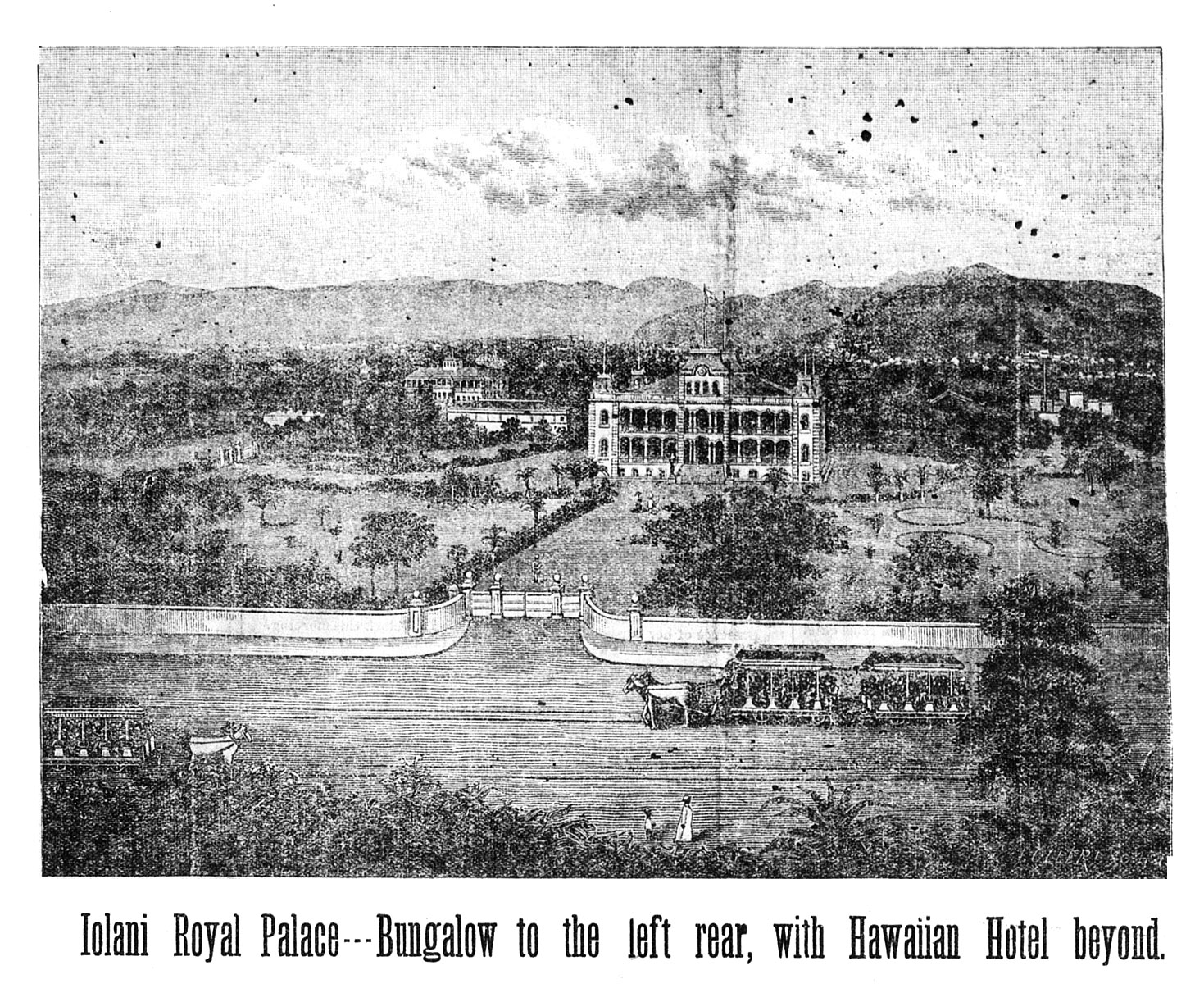
On the first page of this paper appears a view of Iolani Palace, the state residence of their Majesties King Kalakaua and Queen Kapiolani. To the left of the Palace is the Bungalow, in which the insurgents took refuge after being driven from the field pieces. This building is an ornate structure of wood, two stories, and used by the King as offices and private reception quarters. The Queen has also a suite of rooms in it. There was much costly furniture and articles of bric-a-brac in the building, the loss on which from the riflemen's fire is very great. Beyond the bungalow and Palace wall can be seen the upper portion and cupola of the Hawaiian Hotel. To the left of the hotel but not visible in the picture is the United States Legation, where the detachment of marines from the U. S. S. Adams was stationed for the protection of American residents. A company of the Honolulu Rifles was stationed in the Hotel grounds at the rear during the day. Right behind the Palace beyond a narrow street called Palace Walk are visible the square towers of the Household Guards’ barracks. Inside the wall on that side is the powder magazine invisible in the sketch. The Palace and its surrounding park are enclosed by a substantial stone wall some eight feet in height, indented with strong solid gates on all four sides, like that seen in front.
A few rods eastward on the opposite side of King street and fronting Punchbowl street is the famous old native stone church, in the tower of which were stationed sharpshooters and behind its high stone wall a strong detachment of the Honolulu Rifles. Nearly opposite the church on King street the two-story mansion of Mr. J. A. Hopper, commanding a view of the Palace yard, was occupied by sharpshooters. To the left of the bungalow may be seen the top of the Hawaiian Hotel Stables, from which some of the worst execution of sharpshooters was inflicted on that shelter of the rebels. A little below the Stables sharpshooters, under some cover of the dense foliage, posted in Postmaster General Wundenberg’s residence all day harassed the rebels.
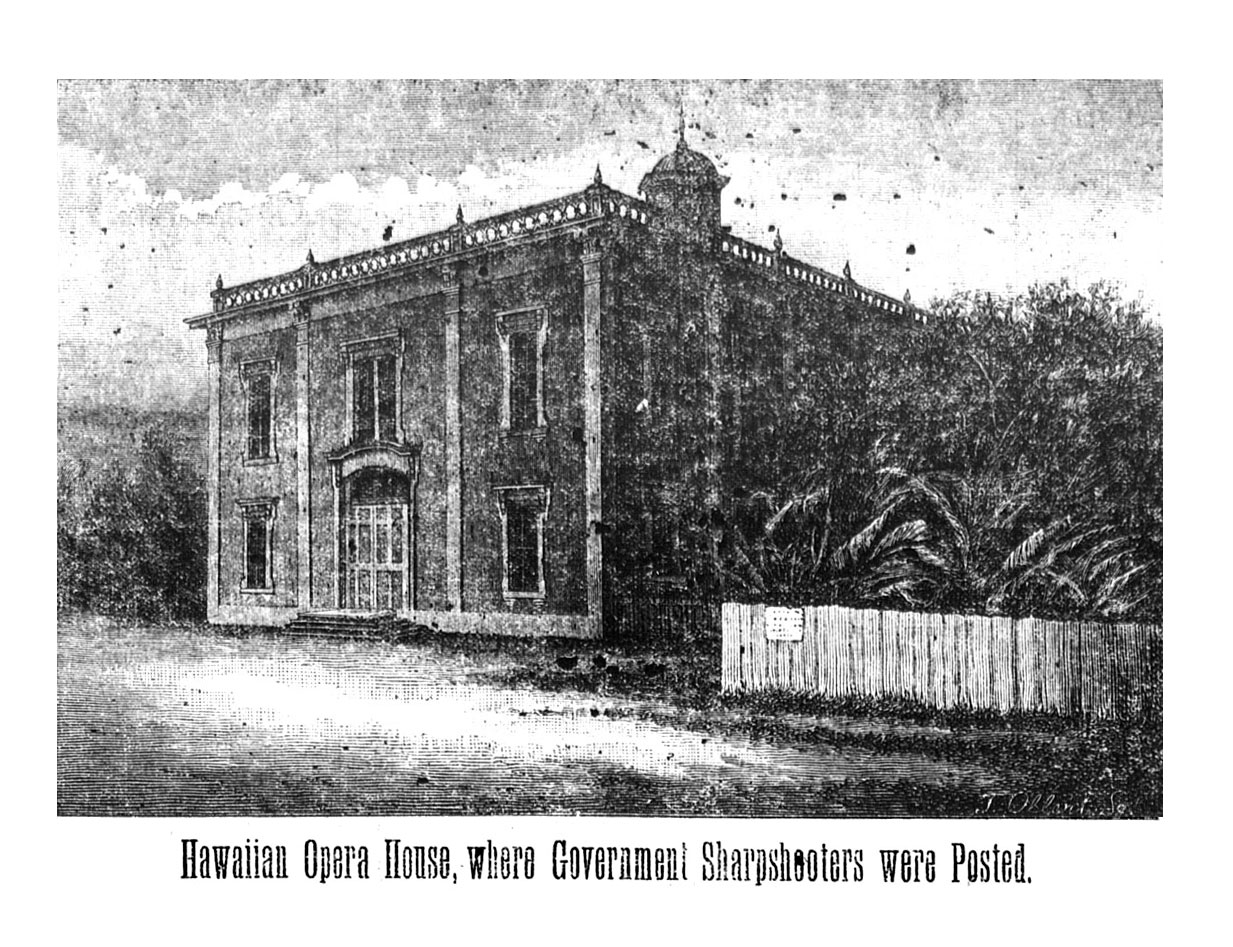
The Hawaiian Opera House is a handsome structure of brick situated nearly opposite the front entrance of the Palace on King street where the horse cars are seen in the Palace view, in the upper story, on the roof and in the cupola of the Opera House sharpshooters were posted, half a dozen of whom began the fight for the Government. To the east of the Opera House, across a narrow street, is the Government yard containing Aliiolani Hale, the capitol building of the Kingdom, also a new building ("Kapuaiwa”) containing the Government Survey and other public offices. In the tower of the main Government building sharpshooters were also posted after its capture from the rebels.
|
|